Supersonic Labs Releases Julia 1: A 144.3M-Parameter Open Decision Model That Runs on a CPU
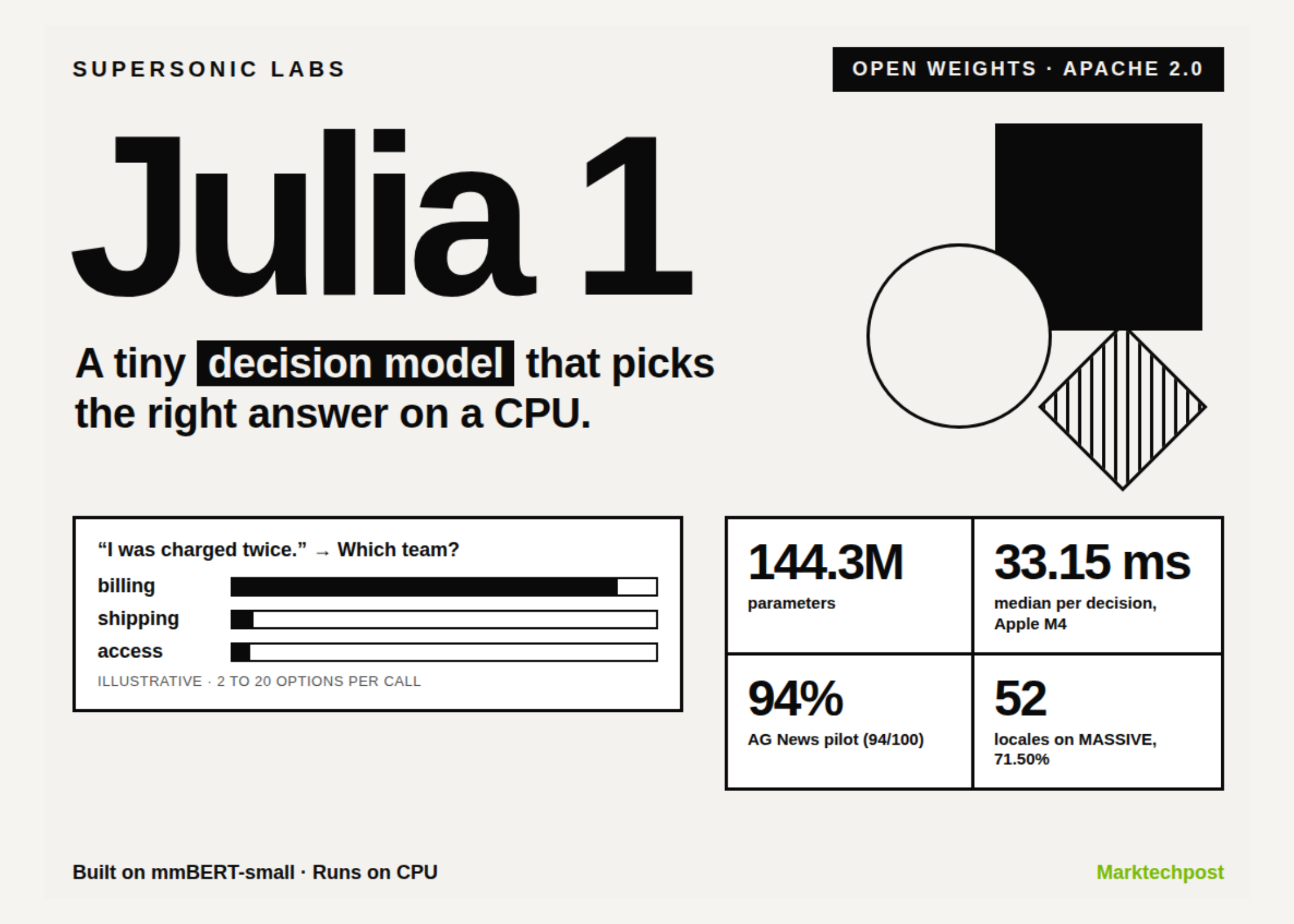
Supersonic Labs released Julia 1, a 144.3M-parameter open decision model built on mmBERT-small that runs on commodity CPUs. Licensed under Apache 2.0, it accepts context, a question, and 2–20 options, returning a single ranked choice with probabilities. It surpassed Jev reference benchmarks on 3 of 4 evaluation tracks, signaling viable ultra-light decision inference.
Key Takeaways
- Key Highlight:Supersonic Labs released Julia 1, a 144.3M-parameter open decision model built on mmBERT-small that runs on commodity CPUs. Licensed under Apache 2.0, it accepts context, a question, and 2–20 options, returning a single ranked choice with probabilities. It surpassed Jev reference benchmarks on 3 of 4 evaluation tracks, signaling viable ultra-light decision inference.
- Innovation & Tech:Highlights advancements in Supersonic, Labs, Releases, demonstrating rapid progress in model capabilities.
- Industry Impact:Reported via MarkTechPost, offering actionable signals for developers and technology leaders.
【Executive Summary & Core Event】
Supersonic Labs has formally released Julia 1, a 144.3-million-parameter decision model constructed on top of the mmBERT-small architecture. Unlike generative language models that produce free-form token sequences, Julia 1 is purpose-built for structured decision tasks: given a context passage, a natural-language question, and between two and twenty candidate options, the model returns a single selected answer accompanied by a calibrated probability distribution across the options. This formulation places Julia 1 in the category of discriminative decision models rather than instruction-tuned chat models, a distinction that materially affects deployment patterns, latency profiles, and evaluation methodology. The release is shipped under the Apache 2.0 license, permitting unrestricted commercial use, modification, and redistribution without copyleft obligations or per-query royalty constraints.
The headline engineering achievement is that Julia 1 achieves competitive decision accuracy while executing entirely on central processing units rather than requiring GPU acceleration. At 144.3 million parameters, the model is roughly two orders of magnitude smaller than frontier foundation models such as GPT-4-class systems or Llama 3 70B, yet it is targeted at a narrower and arguably more pervasive class of enterprise workloads: multiple-choice decision routing, classification, policy selection, and option ranking. Supersonic Labs reports that Julia 1 surpassed Jev reference values on three of four benchmark tracks, establishing an early signal that compact specialized decision models can outperform larger generalist systems on structured choice tasks while consuming a fraction of the compute and memory footprint.
【Technical Architecture & Key Innovations】
Julia 1 inherits its backbone from mmBERT-small, a compact BERT-variant encoder originally designed for multimodal and multilingual representation learning. The encoder architecture relies on bidirectional self-attention with reduced hidden dimensions and fewer transformer layers compared with standard BERT-base, which typically contains 110 million parameters across 12 layers and 768 hidden units. Julia 1’s 144.3 million parameter count suggests a slightly widened hidden dimension or additional classification heads layered atop the mmBERT-small trunk. The decision formulation concatenates or jointly encodes the context, question, and each candidate option, then applies a classification head that produces a softmax distribution over the option set. This architecture mirrors the scoring approach used in retrieval rerankers and multiple-choice commonsense benchmarks such as CommonsenseQA and ARC, but is generalized to handle variable option counts from two to twenty.
The critical architectural advantage is computational density. Because Julia 1 operates as an encoder-only model performing single-pass scoring rather than autoregressive token generation, inference latency is dominated by a fixed number of forward passes proportional to the number of options rather than the length of the generated output. On a modern CPU with AVX-512 vector extensions or Apple Silicon performance cores, a 144M-parameter encoder can complete inference in the low tens of milliseconds for short contexts, making it suitable for synchronous routing decisions in latency-sensitive pipelines. The model’s CPU-native execution eliminates the PCIe transfer overhead, VRAM capacity limits, and CUDA dependency that constrain GPU-deployed models. Supersonic Labs’ reported benchmark victories over Jev reference values on three of four tracks indicate that the model’s capacity is sufficient for the decision tasks it targets, though the fourth-track shortfall suggests boundary conditions where larger context windows or deeper reasoning may still require heavier models.
【Industry Context & Competitive Landscape】
Julia 1 enters a market segment that is paradoxically underserved despite the saturation of large language model releases. While OpenAI, Anthropic, Google, Meta, DeepSeek, and Qwen have competed aggressively on trillion-scale generative models and multimodal frontier capabilities, the niche of sub-billion-parameter decision models optimized for CPU deployment remains comparatively open. Meta’s Llama 3 8B and Qwen’s 1.8B and 4B variants approach this territory, but they remain autoregressive generative models that are over-specified for pure decision tasks and carry inference costs an order of magnitude higher than Julia 1’s encoder-only formulation. DeepSeek’s cost-disruption strategy has focused on reasoning models rather than lightweight discriminative scorers. Anthropic’s Claude and Google’s Gemini families offer no directly comparable CPU-native decision-only tier.
The competitive positioning most analogous to Julia 1 is not the frontier model race but the reranker and classifier ecosystem: Cohere Rerank, Jina Reranker, and BGE-reranker models occupy a similar functional niche, though they are typically optimized for document retrieval rather than general multiple-choice decision tasks. Julia 1’s Apache 2.0 licensing and CPU execution give it a structural advantage in regulated industries, air-gapped environments, and edge deployments where API dependencies on OpenAI or Anthropic are commercially or legally untenable. The Jev benchmark results, while not yet a comprehensive comparison against GPT-4o or Claude 3.5 on identical decision tasks, position Julia 1 as a credible candidate for organizations that prioritize inference cost, data sovereignty, and deployment simplicity over maximal reasoning depth. Its existence also validates a broader industry thesis that model specialization, not parameter scaling, will dominate the next phase of enterprise AI adoption.
【Developer & Enterprise Implications】
For developers and enterprise architects, Julia 1’s value proposition is operational simplicity. Deployment requires no GPU procurement, no CUDA driver configuration, no containerized inference server such as vLLM or TensorRT-LLM, and no API key management. The model can be loaded into a standard Python process using ONNX Runtime, PyTorch CPU bindings, or a quantized GGUF representation, with memory consumption well under one gigabyte even at full float32 precision. Int8 quantization would reduce this further to roughly 150 megabytes, enabling embedding within mobile applications, point-of-sale terminals, industrial controllers, and microservices with tight memory limits. Integration complexity is low: the input contract is a structured tuple of context, question, and options, and the output is a probability vector, making it trivial to wire into existing decision routing, content moderation, or recommendation pipelines.
The business impact centers on cost displacement. Organizations currently routing decision tasks to GPT-4o-mini or Claude Haiku at even fractional-cent pricing per query can eliminate that variable cost entirely by self-hosting Julia 1 on existing CPU infrastructure. At scale, this transforms decision inference from a metered expense into a sunk-cost amortization of existing hardware. The trade-off is capability ceiling: Julia 1 will not match frontier models on multi-step reasoning, open-ended generation, or tasks requiring broad world knowledge. Enterprises should deploy it for high-volume, well-scoped decision tasks such as intent classification, policy selection, moderation triage, and retrieval reranking, while reserving larger models for complex reasoning chains. The Apache 2.0 license also permits fine-tuning on domain-specific decision datasets, allowing organizations to specialize Julia 1 for vertical applications without licensing friction or vendor lock-in.
【Key Takeaways & Strategic Outlook】
Julia 1’s release underscores a strategic insight that the AI industry has been slow to internalize: the highest-volume enterprise AI workloads are not open-ended chatbot conversations but structured decision points embedded in existing software systems. A 144-million-parameter model that runs on a CPU, ships under a permissive license, and beats reference benchmarks on the majority of test tracks represents a viable substitute for API-dependent decision routing in a substantial fraction of enterprise use cases. The model’s existence challenges the assumption that competitive AI requires frontier-scale parameters or specialized accelerators, and it validates the thesis that task-specific encoder architectures remain commercially relevant even as generative models dominate public attention.
Looking forward, the trajectory Supersonic Labs has initiated with Julia 1 points toward a bifurcated AI stack: large generative models for complex reasoning and content creation, paired with compact decision models for high-frequency routing and classification. The next-generation evolution will likely include expanded context windows, multilingual decision benchmarks, multimodal option inputs, and fine-tuned domain variants for legal, medical, and financial decision tasks. If Julia 1’s successors can extend their benchmark dominance to broader evaluation suites while preserving CPU-native execution and Apache licensing, they could materially erode the unit economics of API-based decision services and accelerate enterprise migration toward self-hosted inference infrastructure. The era of the specialized small model has not ended; it is beginning its second wave.
This page provides an editorial summary based on publicly available information. It is not a republished article. Use the source link below for the original report.
Industry Insights & Analysis
As artificial intelligence rapidly evolves, breakthroughs surrounding Supersonic, Labs, Releases, Julia are shifting toward scalable, robust real-world implementations.
Driven by both open-source ecosystems and proprietary model architectures, the integration between compute optimization, data engineering, and agentic workflows is accelerating. This development provides a strategic benchmark for upcoming AI tooling and developer workflows.