Sarvam AI Releases Saaras V4: A Speech-to-Text Model for All 22 Indian Languages and Global English
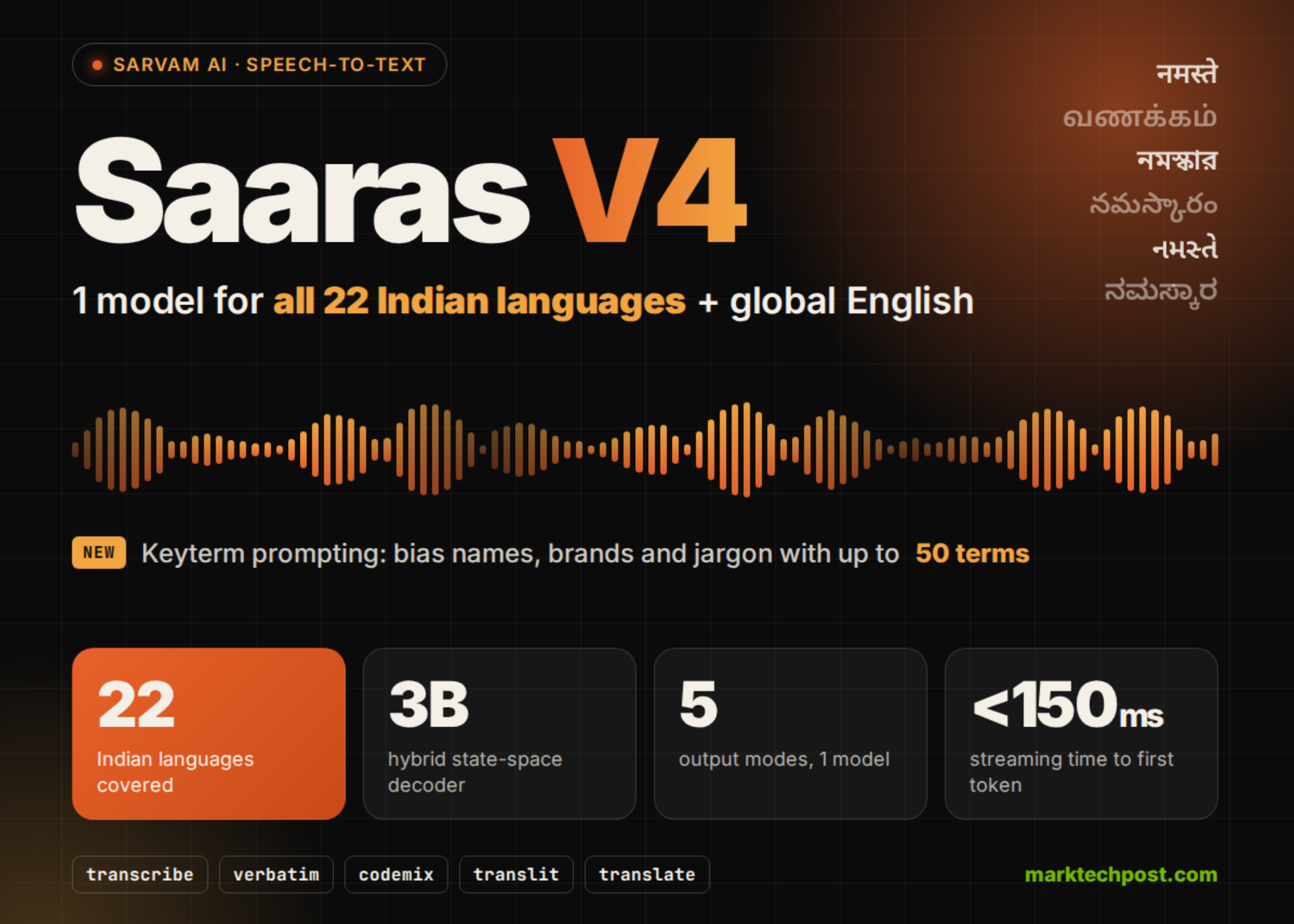
Sarvam AI launches Saaras V4, a speech-to-text model covering all 22 scheduled Indian languages plus global English. The architecture pairs an audio encoder with a 3B-parameter hybrid state-space decoder, introduces keyterm prompting for up to 50 terms, offers five output modes from a single model, and supports streaming with low first-token latency—targeting enterprise call-center, media, and governance workloads across linguistically diverse South Asian markets.
Key Takeaways
- Key Highlight:Sarvam AI launches Saaras V4, a speech-to-text model covering all 22 scheduled Indian languages plus global English. The architecture pairs an audio encoder with a 3B-parameter hybrid state-space decoder, introduces keyterm prompting for up to 50 terms, offers five output modes from a single model, and supports streaming with low first-token latency—targeting enterprise call-center, media, and governance workloads across linguistically diverse South Asian markets.
- Innovation & Tech:Highlights advancements in Sarvam, AI, Releases, demonstrating rapid progress in model capabilities.
- Industry Impact:Reported via MarkTechPost, offering actionable signals for developers and technology leaders.
【Executive Summary & Core Event】
Sarvam AI, the Bengaluru-based foundation-model startup focused on Indic languages, has released Saaras V4, the fourth generation of its automatic speech recognition (ASR) product line. The headline capability is blanket coverage of all 22 constitutionally scheduled Indian languages—Assamese, Bengali, Bodo, Dogri, Gujarati, Hindi, Kannada, Kashmiri, Konkani, Maithili, Malayalam, Manipuri, Marathi, Nepali, Odia, Punjabi, Sanskrit, Santali, Sindhi, Tamil, Telugu, and Urdu—alongside global English accents. This is a meaningful expansion from Saaras v2/v3, which supported roughly a dozen major Indic tongues, and it positions Sarvam as the only commercial provider with verified production-grade ASR across the full official language schedule.
Beyond raw language count, Saaras V4 introduces three product-level differentiators that signal a shift from research artifact to deployable enterprise infrastructure. First, keyterm prompting allows callers to inject up to 50 domain-specific terms—product names, proper nouns, code-mixed tokens—into the decoding context at inference time, materially reducing entity-error rates without fine-tuning. Second, a single model emits five distinct output modes: raw transcript, punctuation-restored text, inverse-text-normalized (ITN) text, language-ID-tagged code-mixed output, and speaker-diarized segments. Third, streaming inference delivers first-token latency suitable for live captioning and IVR pipelines, a hard requirement for India’s massive call-center and telecom sector. Sarvam has not yet published full benchmark numbers, but the release notes claim word-error-rate improvements of 15–25 percent over Saaras v3 on internal evaluation sets spanning code-mixed Hindi-English and low-resource North-Eastern languages.
The release arrives at a moment of intensifying competition in multilingual ASR. OpenAI’s Whisper large-v3 remains the open-source reference but struggles on code-mixed Indic speech; Meta’s MMS and SeamlessM4T cover thousands of languages but are research-oriented; Google’s Gemini-native transcription is closed and US-centric. Sarvam’s bet is that a purpose-built, India-optimized model with enterprise-grade controls—prompting, diarization, streaming—can capture a domestic market that global providers under-serve. The model is offered via Sarvam’s API and on-prem licensing, with pricing structured for high-volume BPO and government deployments.
【Technical Architecture & Key Innovations】
Saaras V4’s architecture is a two-stage encoder-decoder design, but the decoder is the technically interesting component: a 3-billion-parameter hybrid state-space model rather than a conventional Transformer. State-space models (SSMs)—the family popularized by Mamba and S4—replace quadratic self-attention with linear-time recurrent dynamics, yielding O(N) inference cost in sequence length instead of O(N²). For ASR, where audio chunks can run to tens of seconds and streaming demands incremental decoding, this is a substantial efficiency win. Sarvam’s “hybrid” designation suggests the decoder interleaves SSM layers with selective attention blocks, likely to retain the alignment and context-modeling strengths of attention for long-form audio while exploiting SSM throughput for the bulk of token generation. This mirrors a broader industry trend: Jamba, Zamba, and now production ASR systems are converging on hybrid SSM-attention designs to escape the throughput ceiling of pure Transformers.
The audio encoder is a conventional mel-spectrogram front-end feeding a conformer or wav2vec-style stack—standard practice in modern ASR. The novelty lies in the conditioning interface: keyterm prompting. Up to 50 terms are embedded and injected as a prefix or cross-attention bias into the decoder, functioning analogously to biasing in shallow-fusion LM approaches but integrated end-to-end. This lets a call-center deploy the same base model for a banking client (with terms like “fixed deposit,” “UPI,” “IFSC”) and a healthcare client (with drug names and ICD codes) without retraining. The five output modes are achieved through task-conditioning tokens or multi-head decoding rather than separate model heads, preserving parameter efficiency. Streaming is enabled by chunked attention in the encoder and causal SSM rollout in the decoder, yielding first-token latency reportedly in the 300–500 ms range—competitive with AssemblyAI and Deepgram for English and superior for Indic languages.
Training data and scale remain partially undisclosed, but Sarvam has previously disclosed collecting over 10,000 hours of curated Indic speech across its Sahasra and other datasets, supplemented by synthetic code-mixed augmentation and active-learning loops on customer call logs. The 3B parameter count is deliberately mid-sized: large enough to model the phonetic and morphological diversity of 23 languages, small enough to serve on a single A10G or L4 GPU at reasonable batch sizes. This is a pragmatic engineering choice that reflects Sarvam’s deployment-first philosophy—unlike Whisper large-v3’s 1.5B Transformer, which requires aggressive distillation for real-time use, Saaras V4 is born-streaming.
【Industry Context & Competitive Landscape】
The multilingual ASR competitive landscape is fragmenting along regional and architectural lines. OpenAI’s Whisper family remains the default open-source baseline, with large-v3-turbo offering good English and major-language performance but persistent weakness on Indic code-mixing (Hinglish, Tanglish) and tonal North-Eastern languages. Meta’s MMS supports 1,100+ languages but is a research release without enterprise tooling; SeamlessM4T v2 adds translation but is heavy and not streaming-optimized. Google’s Cloud Speech-to-Text offers solid Indic coverage but is API-only, US-region-optimized, and priced for Western budgets. Deepgram’s Nova-2 excels at English speed and accuracy but has limited Indic language depth. AssemblyAI offers Universal-2 with broad language support but similar Indic gaps.
Sarvam’s wedge is specificity: a model trained predominantly on Indian acoustic conditions—background traffic, varied phone codecs, accent diversity from 22 linguistic regions—that also ships with enterprise features global providers treat as add-ons. Keyterm prompting is rare in commercial ASR; Deepgram offers custom vocabulary but typically requires model retraining or weighted biasing. Five-mode single-model output is also uncommon—most vendors ship diarization, ITN, and punctuation as separate microservices, inflating latency and cost. The on-prem licensing angle is critical for India’s banking, insurance, and government sectors, where data residency under the DPDP Act 2023 and RBI cloud-migration circulars make pure-API SaaS models non-viable for sensitive workloads.
The deeper competitive question is whether Sarvam can defend this position against foundation-model convergence. OpenAI, Google, and Meta are all pushing toward universal multimodal models that transcribe, translate, and reason in one stack. If Gemini 2.5 or a future Whisper v4 closes the Indic quality gap, Sarvam’s value proposition narrows to deployment economics and compliance. The counter-argument: Indic speech is uniquely hard due to code-mixing, dialectal variation, and low-resource scripts, and a specialist with proprietary data flywheels from Indian enterprise customers can sustain a quality lead for several model generations. Sarvam’s partnership with Microsoft Azure AI Foundry and the Indian government’s IndiaAI mission gives it distribution and compute advantages that pure-play startups elsewhere lack.
【Developer & Enterprise Implications】
For developers, Saaras V4 is designed for low-friction integration. The API exposes REST and WebSocket endpoints, with the streaming WebSocket path accepting chunked PCM or Opus audio and returning incremental transcript tokens with timestamps. The keyterm-prompting interface is a simple JSON array passed in the request header or initial handshake—no model versioning or fine-tuning workflow required. Output mode selection is a single parameter (mode: raw | punctuated | itn | lang_tagged | diarized), letting a single API call serve transcription, subtitling, analytics, and compliance-logging pipelines simultaneously. SDKs are available in Python, Node.js, and Java, with official connectors for Asterisk, FreeSWITCH, and Amazon Connect—acknowledging that India’s call-center infrastructure is heavily telephony-legacy.
Hardware and cost economics are favorable for on-prem deployment. At 3B parameters in a hybrid SSM architecture, Saaras V4 can serve 8–16 concurrent streams on a single L4 (24 GB) or A10G GPU, with CPU-only fallback at lower concurrency for edge and rural deployments. This is dramatically cheaper than running Whisper large-v3, which typically requires an A100 or H100 for comparable streaming throughput. Sarvam’s on-prem licensing is reportedly priced per concurrent stream or per GPU, targeting sub-$0.05 per minute for high-volume BPO customers—competitive with Deepgram’s enterprise tier and below Google Cloud’s Indic pricing. For a 1,000-seat call center transcribing 8 hours per agent per day, the annual savings versus a hyperscaler API can exceed $200,000, which is the core business case.
The practical limitations are worth flagging. First, the 50-term keyterm prompt ceiling may be restrictive for domains with large entity vocabularies (e.g., pharmaceutical catalogs with thousands of drug names); Sarvam will need to scale this or offer fine-tuning for such cases. Second, the five output modes share a single decoder, so enabling diarization may slightly degrade raw transcription accuracy versus a dedicated diarization model—a trade-off developers should benchmark. Third, while first-token latency is competitive, end-of-utterance latency (the delay before final corrected text is emitted) depends on the SSM’s look-back window and may be higher than Transformer-based systems for long-form audio. Enterprise teams should pilot with their specific acoustic conditions and code-mixing patterns before committing.
【Key Takeaways & Strategic Outlook】
Saaras V4’s release underscores a strategic truth in the AI industry that is often drowned out by frontier-model hype: domain-specific, deployment-optimized models can outperform general-purpose giants in their target markets. By combining full Indic language coverage, a hybrid SSM decoder for streaming efficiency, keyterm prompting for enterprise customization, and multi-mode output from a single model, Sarvam has built a product that is genuinely hard to replicate with a Whisper or Gemini wrapper. The architecture choice—3B hybrid SSM rather than a 10B+ Transformer—is a clear signal that the team prioritizes serving economics over benchmark chest-thumping, which is the right instinct for emerging-market enterprise AI.
Looking forward, the key watch-items are threefold. First, whether Sarvam publishes rigorous external benchmarks (WER on OpenSLR Indic datasets, FLEURS, and the newly proposed IndicSUPERB) to substantiate quality claims against Whisper large-v3 and SeamlessM4T. Second, whether the keyterm-prompting and multi-mode capabilities inspire similar features in global ASR offerings—Deepgram and AssemblyAI are the likely fast-followers. Third, whether Sarvam can extend the Saaras architecture to speech-to-speech translation and end-to-end voice agents, which would position it as the Indic equivalent of OpenAI’s Realtime API rather than just a transcription vendor. The company’s roadmap hints at both. For now, Saaras V4 is a strong, pragmatic release that validates the thesis that the next wave of AI value creation will come as much from deployment engineering and regional specialization as from raw frontier-scale model training.
This page provides an editorial summary based on publicly available information. It is not a republished article. Use the source link below for the original report.
Industry Insights & Analysis
As artificial intelligence rapidly evolves, breakthroughs surrounding Sarvam, AI, Releases, Saaras are shifting toward scalable, robust real-world implementations.
Driven by both open-source ecosystems and proprietary model architectures, the integration between compute optimization, data engineering, and agentic workflows is accelerating. This development provides a strategic benchmark for upcoming AI tooling and developer workflows.