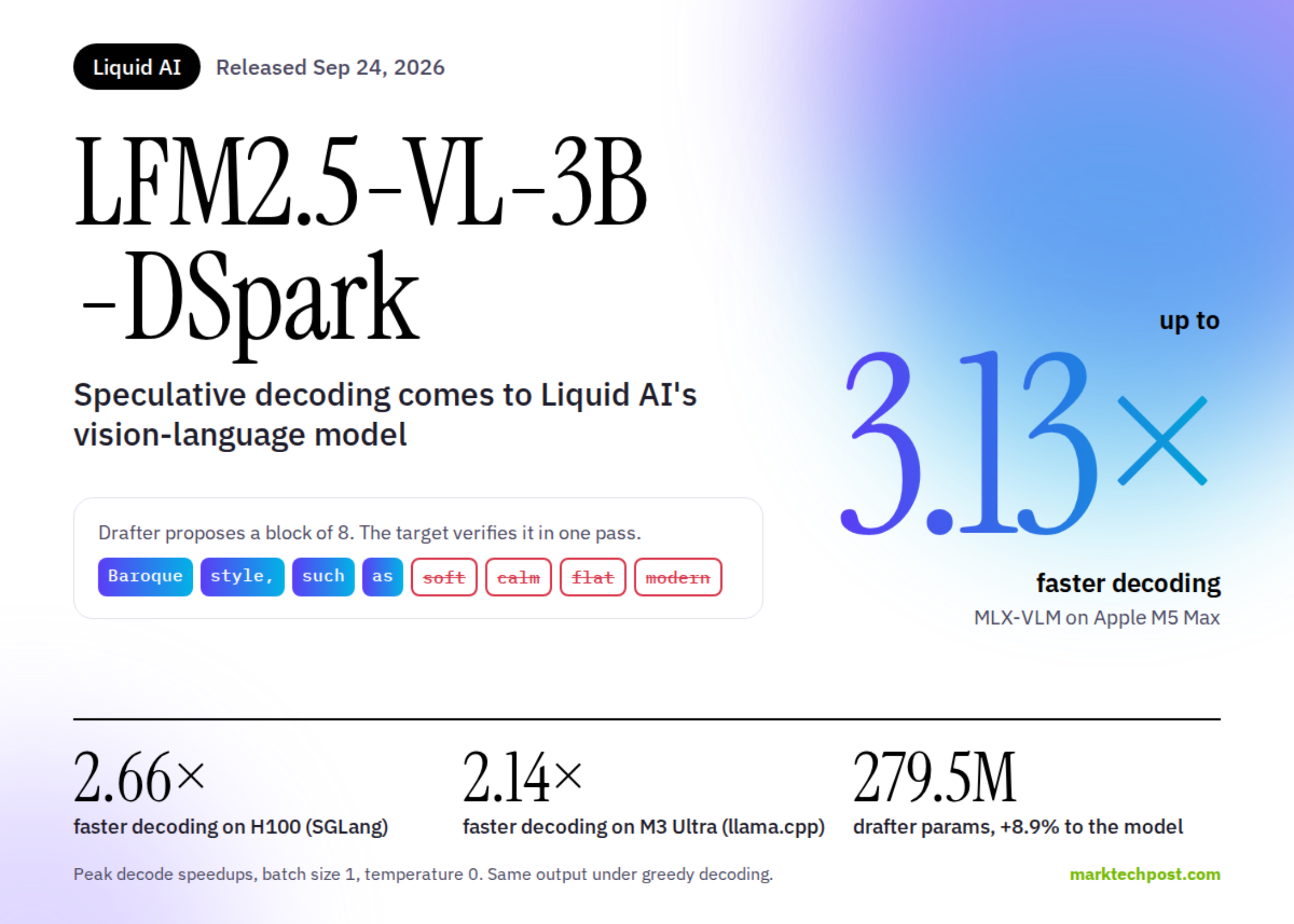
Liquid AI Releases LFM2.5-VL-3B-DSpark: Speculative Decoding for Vision-Language Models With Up to 3.13x Faster Decoding
Liquid AI has unveiled LFM2.5-VL-3B-DSpark, a 279.5M-parameter speculative draft model that accelerates its LFM2.5-VL-3B vision-language model by up to 3.13x on Apple M5 Max and 2.66x on NVIDIA H100, while preserving greedy-decoding output. This marks a significant step in bringing speculative decoding to edge and cloud VLM inference.
Key Takeaways
- Key Highlight:Liquid AI has unveiled LFM2.5-VL-3B-DSpark, a 279.5M-parameter speculative draft model that accelerates its LFM2.5-VL-3B vision-language model by up to 3.13x on Apple M5 Max and 2.66x on NVIDIA H100, while preserving greedy-decoding output. This marks a significant step in bringing speculative decoding to edge and cloud VLM inference.
- Innovation & Tech:Highlights advancements in Apple, NVIDIA, Liquid, demonstrating rapid progress in model capabilities.
- Industry Impact:Reported via MarkTechPost, offering actionable signals for developers and technology leaders.
【Executive Summary & Core Event】
Liquid AI has released LFM2.5-VL-3B-DSpark, a 279.5-million-parameter draft model engineered specifically to enable speculative decoding for its parent vision-language model, LFM2.5-VL-3B. The release represents a targeted optimization layer rather than a new foundation model: the draft model is trained to predict token sequences that the larger 3B-parameter VLM would generate, allowing the system to propose multiple candidate tokens in parallel and verify them in a single forward pass. On Apple's M5 Max silicon, the system achieves up to 3.13x faster decoding, while on NVIDIA's H100 GPU it delivers 2.66x speedup—all while producing bit-identical output to the original model under greedy decoding conditions. This lossless guarantee is critical for enterprise deployments where output reproducibility is non-negotiable.
The naming convention 'DSpark' signals the draft model's role as a lightweight, high-velocity predictor that 'sparks' the larger model's generation pipeline. Liquid AI, founded by researchers from the MIT-IBM Watson AI Lab and CSAIL, has been building its portfolio around non-transformer architectures—specifically Liquid Neural Networks and structured state-space models—that offer favorable inference characteristics. The LFM2.5-VL-3B itself is a multimodal model combining vision encoding with language generation, and the addition of a dedicated speculative draft model extends Liquid's strategy of optimizing the full inference stack rather than relying solely on architectural efficiency in the base model. The release includes integration support for major inference frameworks, lowering the barrier to adoption for developers already deploying Liquid's model family.
【Technical Architecture & Key Innovations】
Speculative decoding, the core technique enabled by LFM2.5-VL-3B-DSpark, operates by decoupling token proposal from token verification. The 279.5M-parameter draft model autoregressively generates a sequence of candidate tokens—typically 4 to 8 tokens per speculation step—which are then validated in a single parallel forward pass through the larger 3B-parameter target VLM. Tokens that match the target model's distribution are accepted, while the first mismatch triggers a rollback and re-decoding from that position. Because the verification pass processes all candidate tokens simultaneously, it exploits the parallelism inherent in transformer and hybrid architectures, converting what would be N sequential autoregressive steps into one parallel computation plus a small number of draft-model forward passes. The acceptance rate of the draft model directly determines the effective speedup, making the draft model's distributional alignment with the target model the critical design parameter.
The DSpark draft model is architecturally distinct from the target VLM, optimized for low-latency sequential generation rather than multimodal reasoning. At 279.5M parameters—roughly 9.3% of the target model's size—it is small enough that its forward passes are nearly negligible in compute cost, yet large enough to maintain high acceptance rates. Liquid AI's choice of a structured state-space or hybrid backbone for the draft model likely contributes to its efficiency on Apple Silicon, where the memory hierarchy and unified memory architecture favor models with lower parameter counts and recurrent-style computation patterns. The 3.13x speedup on M5 Max versus 2.66x on H100 is notable: it suggests that the draft model's overhead is proportionally smaller relative to the target model's per-token cost on Apple's architecture, where the larger model's autoregressive passes face higher latency penalties. The lossless guarantee under greedy decoding is achieved because speculative decoding with greedy selection is mathematically equivalent to standard greedy decoding—accepted tokens are exactly those the target model would have produced, and rejected tokens are never emitted.
【Industry Context & Competitive Landscape】
Liquid AI's release positions it in a competitive niche that is rapidly gaining strategic importance: inference optimization for multimodal models. The major AI labs have pursued speculative decoding internally—Google's Gemini models use Medusa-style multi-head prediction, OpenAI has experimented with draft-model approaches for GPT-4 inference, and Meta has released speculative decoding support in its Llama ecosystem. However, Liquid AI differentiates by offering a purpose-built, downloadable draft model with explicit hardware-specific benchmarks, targeting both cloud (H100) and edge (Apple Silicon) deployment scenarios. This dual-target strategy is uncommon; most speculative decoding research focuses on datacenter GPUs, while Liquid's Apple Silicon results tap into the growing developer population building AI applications on macOS and iOS platforms.
In the broader VLM landscape, LFM2.5-VL-3B competes with models like Qwen2-VL-2B, Phi-3.5-Vision, and MobileVLM. The speculative decoding capability gives Liquid a practical edge in latency-sensitive applications such as real-time visual question answering, document analysis, and on-device assistant scenarios. DeepSeek's recent work on speculative decoding for language models and Anthropic's inference optimizations for Claude suggest the industry is converging on speculative techniques as a standard acceleration layer. Liquid's contribution of making this work specifically for vision-language models—where the draft model must account for visual grounding in the target model's distribution—is technically nontrivial and addresses a gap that larger labs have not fully productized for external developers.
【Developer & Enterprise Implications】
For developers, integrating LFM2.5-VL-3B-DSpark requires loading two models—the 3B target and the 279.5M draft—into memory, adding approximately 10% to the target model's memory footprint. The practical impact is substantial: a 3x decoding speedup on Apple Silicon means that applications running on consumer-grade MacBooks can achieve near-server-class latency for multimodal inference, dramatically expanding the addressable deployment surface for VLM-powered applications. For cloud deployments on H100, the 2.66x speedup translates directly to reduced GPU-seconds per request, lowering inference costs proportionally for high-volume API endpoints. The lossless guarantee eliminates the need for quality regression testing, which is typically a significant engineering overhead when adopting inference optimizations like quantization or distillation.
The deployment complexity is moderate: developers need an inference framework that supports the speculative decoding protocol (token proposal, batched verification, and conditional acceptance). Liquid AI provides integration paths for popular serving frameworks, and the draft model's small size means it can be co-located with the target model on the same device without requiring additional hardware. For enterprise teams, the business case is straightforward—either reduce infrastructure costs by 2.5-3x for the same throughput, or increase throughput by the same factor on existing hardware. The Apple Silicon optimization is particularly relevant for privacy-preserving on-device applications in healthcare, legal document processing, and defense, where data cannot be sent to cloud endpoints but multimodal AI capabilities are still required.
【Key Takeaways & Strategic Outlook】
LFM2.5-VL-3B-DSpark represents a maturation signal for speculative decoding: what was once a research curiosity is now being productized as downloadable, hardware-specific acceleration components with concrete benchmark numbers. Liquid AI's strategy of optimizing the inference stack—base model architecture, draft model, and hardware targeting—rather than competing solely on raw model scale reflects a pragmatic understanding of where deployment bottlenecks actually exist. The lossless guarantee is the key enabler for enterprise adoption, as it removes the quality-cost tradeoff that has historically slowed optimization adoption.
Looking forward, the release foreshadows a trend toward 'inference acceleration layers' as first-class artifacts in the AI model ecosystem. We can expect to see draft models become standard companions for foundation model releases, with acceptance rates and hardware-specific speedups becoming routine benchmark metrics alongside perplexity and task accuracy. Liquid AI's focus on Apple Silicon also signals a strategic bet on edge computing as a growth market for AI inference, potentially positioning the company as a leader in the on-device AI deployment wave that is accelerating as consumer hardware gains AI-capable NPUs and unified memory architectures.
This page provides an editorial summary based on publicly available information. It is not a republished article. Use the source link below for the original report.
Industry Insights & Analysis
As artificial intelligence rapidly evolves, breakthroughs surrounding Apple, NVIDIA, Liquid, AI are shifting toward scalable, robust real-world implementations.
Driven by both open-source ecosystems and proprietary model architectures, the integration between compute optimization, data engineering, and agentic workflows is accelerating. This development provides a strategic benchmark for upcoming AI tooling and developer workflows.