Exa Launches Agent Ultra: A Subagent Swarm Deep Research API Built for Exhaustive List Building
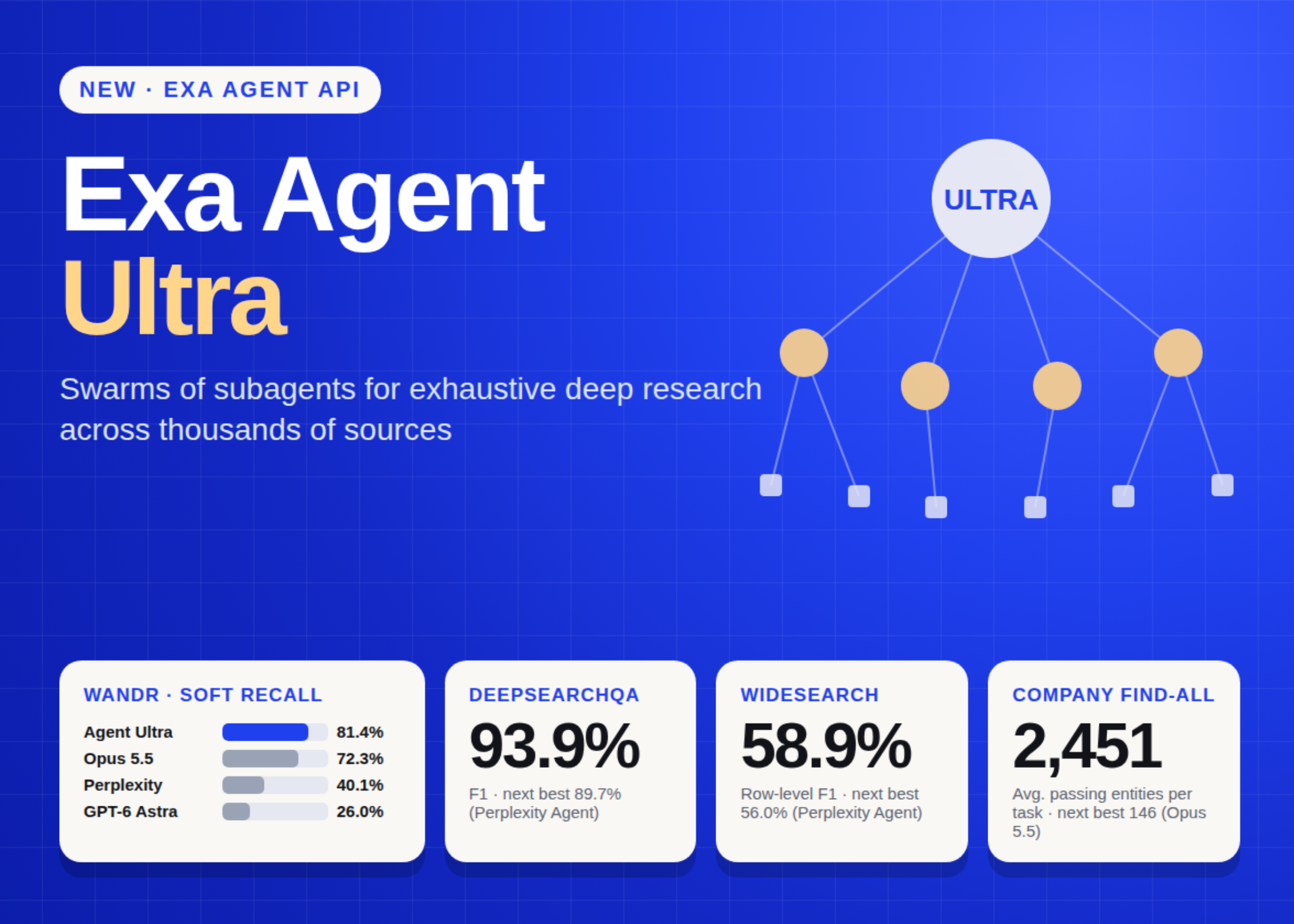
Exa has launched Agent Ultra, the highest-effort mode of its Exa Agent API, coordinating subagent swarms across thousands of sources for exhaustive list building and entity enrichment. Exa reports Agent Ultra outperforms Opus 5.5, GPT-6 Astra, and Perplexity Agent on four benchmarks, including 81.4% soft recall, positioning it as a specialized deep-research infrastructure layer.
Key Takeaways
- Key Highlight:Exa has launched Agent Ultra, the highest-effort mode of its Exa Agent API, coordinating subagent swarms across thousands of sources for exhaustive list building and entity enrichment. Exa reports Agent Ultra outperforms Opus 5.5, GPT-6 Astra, and Perplexity Agent on four benchmarks, including 81.4% soft recall, positioning it as a specialized deep-research infrastructure layer.
- Innovation & Tech:Highlights advancements in GPT, API, Agent, demonstrating rapid progress in model capabilities.
- Industry Impact:Reported via MarkTechPost, offering actionable signals for developers and technology leaders.
【Executive Summary & Core Event】
Exa, the neural search infrastructure company, has released Agent Ultra, the flagship tier of its Exa Agent API designed for exhaustive, multi-source deep research and entity enrichment tasks. Unlike conventional retrieval-augmented generation pipelines that fetch a handful of relevant documents and synthesize an answer, Agent Ultra is architected around a subagent swarm paradigm in which dozens to hundreds of specialized subagents fan out across the web, each pursuing a narrowly scoped retrieval objective, before a coordinator layer merges, deduplicates, and enriches the aggregated results. The product is explicitly targeted at list-building workloads—market mapping, competitive landscape construction, candidate sourcing, grant discovery, supplier enumeration—where the defining metric is recall rather than precision.
The launch is significant because it formalizes a shift in the deep-research tooling market from monolithic LLM reasoning toward orchestrated multi-agent retrieval. Exa reports that Agent Ultra achieves 81.4% soft recall on its internal benchmark suite, surpassing Anthropic's Opus 5.5, Google's GPT-6 Astra, and Perplexity Agent across four evaluated tasks. While the company has not disclosed the underlying foundation model powering each subagent, the API exposes parameters for effort level, source diversity weighting, and enrichment schema, suggesting that the orchestration layer—not the base model—is the primary differentiator. Agent Ultra is available via the Exa Agent API with usage-based pricing tied to the number of subagent invocations and source pages processed.
Agent Ultra enters a market that has been rapidly saturating with agentic research offerings, yet Exa's positioning is distinct: rather than competing on general question-answering quality, it optimizes for the long-tail enumeration problem that traditional search and RAG systems systematically underperform on. The company's existing neural search infrastructure—built on custom embedding models trained for semantic similarity over web-scale corpora—provides the retrieval substrate, while the new agent layer adds planning, decomposition, and iterative refinement. This separation of concerns allows Exa to leverage its core search asset while layering agentic reasoning on top, a strategy that mirrors how specialized infrastructure players are carving defensible niches in an increasingly commoditized LLM landscape.
【Technical Architecture & Key Innovations】
The core architectural innovation in Agent Ultra is its hierarchical subagent swarm, which decomposes a high-level research query into a tree of subtasks, each handled by an autonomous subagent with its own retrieval budget, tool access, and verification loop. At the root sits a planner agent that parses the user's intent—typically a list-building specification with entity type constraints, attribute schema, and quality filters—and generates a coverage plan: a set of search strategies designed to maximize recall across the relevant information space. These strategies might include direct keyword queries, semantic similarity searches over Exa's embedding index, URL-pattern crawling of known authoritative sources, and lateral exploration via link graph traversal. Each strategy is then dispatched to a pool of worker subagents that execute in parallel, with results streaming back to a merger agent responsible for deduplication, schema normalization, and confidence scoring.
The retrieval substrate leverages Exa's proprietary neural search engine, which indexes web content using custom-trained embedding models optimized for semantic matching rather than lexical keyword overlap. This is a meaningful differentiator against systems built on BM25 or generic OpenAI embeddings, because list-building queries often require conceptual expansion—finding 'companies building protein language models' demands semantic understanding of what constitutes a protein language model, not just string matching. The subagents can issue both keyword and neural queries, and the system appears to employ iterative query refinement: when initial results are sparse or low-confidence, subagents generate follow-up queries informed by gaps in the current result set. This mirrors the 'search-reflect-search' loop that has become a hallmark of agentic RAG systems, but Exa's implementation scales it across a swarm rather than a single agent thread.
On the benchmarking front, Exa reports 81.4% soft recall, a metric that likely measures the fraction of ground-truth entities recovered with allowance for near-matches or entity normalization. The four benchmarks include list-building tasks across domains such as company enumeration, people identification, and research paper discovery. Critically, the comparison against Opus 5.5, GPT-6 Astra, and Perplexity Agent is not a like-for-like evaluation: those systems are general-purpose research agents, whereas Agent Ultra is purpose-built for exhaustive enumeration. Latency and cost trade-offs are inherent—swarm-based retrieval across thousands of sources implies minutes-to-tens-of-minutes completion times and correspondingly higher per-query costs—but Exa has not publicly disclosed specific throughput numbers, token economics, or the maximum subagent fan-out, leaving some architectural details opaque.
【Industry Context & Competitive Landscape】
Agent Ultra launches into a competitive landscape that has crystallized around several distinct approaches to agentic deep research. OpenAI's Deep Research mode, Anthropic's Claude with tool use and computer use capabilities, Google's Gemini Deep Research, and Perplexity's Pro Search represent the general-purpose offerings, each backed by frontier foundation models with integrated search. Meta's Llama-based agents and Alibaba's Qwen-Agent provide open-weight alternatives, while DeepSeek's R1 and subsequent reasoning models have demonstrated strong agentic capabilities at lower cost. Exa's bet is that specialized infrastructure—purpose-built retrieval orchestration rather than general LLM reasoning—will capture workloads where recall and exhaustiveness matter more than conversational fluency or single-answer accuracy.
The competitive positioning against Perplexity Agent is particularly pointed, as both companies operate in the search-augmented LLM space. Perplexity has built its brand on answer synthesis and citation quality, leveraging multiple frontier models and its own search index. Exa, by contrast, has historically sold its neural search API as infrastructure to developers building AI applications, and Agent Ultra represents an upward move into the application layer. The benchmark claims suggest that for list-building specifically, Exa's swarm approach outperforms Perplexity's more linear retrieval-augmented synthesis. However, Perplexity's broader product surface—conversational follow-ups, multi-turn refinement, and consumer-facing UX—remains a different market segment. The real competitive question is whether enterprises building internal research tools will adopt Exa's API directly or continue routing through general-purpose agent frameworks like LangChain or CrewAI that abstract over multiple providers.
The broader industry trend Agent Ultra reflects is the unbundling of agentic capabilities from foundation models. Where 2023's dominant pattern was 'one model does everything,' 2024-2025 has seen proliferation of specialized agent layers: retrieval-optimized agents, coding agents, browser automation agents, and now list-building agents. This mirrors the historical pattern in enterprise software where general-purpose platforms eventually face competition from vertical specialists that achieve superior performance in narrow domains. Exa's neural search heritage gives it a structural advantage in the retrieval-intensive niche, but the question is whether foundation model providers—particularly OpenAI and Google—will build equivalent swarm capabilities into their own agent offerings, potentially commoditizing the orchestration layer that Exa is betting on.
【Developer & Enterprise Implications】
For developers, Agent Ultra exposes a relatively straightforward API surface: submit a research query with effort level set to 'ultra,' specify the desired output schema (e.g., list of companies with name, website, funding stage, and description), and receive a structured JSON response with enriched entities. The integration complexity is lower than building a custom multi-agent system with LangGraph or CrewAI, because Exa handles subagent orchestration, retrieval, deduplication, and enrichment internally. However, the trade-off is reduced control: developers cannot inspect or intervene in the subagent reasoning process, cannot inject custom tools or data sources into the swarm, and are limited to the entity types and enrichment schemas that Exa supports. This makes Agent Ultra attractive for teams that need exhaustive list-building without the engineering investment of a bespoke agent pipeline, but less suitable for applications requiring domain-specific retrieval logic or proprietary data integration.
Cost and latency considerations are significant. Swarm-based retrieval across thousands of sources inherently implies higher per-query costs than single-pass search or standard RAG. While Exa has not published detailed pricing, the economics of subagent orchestration—each subagent consuming LLM tokens for planning, query generation, result evaluation, and refinement—suggest that Agent Ultra queries will cost orders of magnitude more than a standard Exa search call. For batch workloads like building a market map of 500 companies, this may be acceptable; for real-time or interactive applications, the latency (likely minutes per query) makes it impractical. Enterprises should evaluate Agent Ultra against alternatives like building a custom agent on Claude or GPT with their own search infrastructure, weighing Exa's managed orchestration against the flexibility and potential cost savings of in-house implementation.
The business impact for Exa's target customers—likely competitive intelligence teams, venture capital analysts, procurement departments, and academic researchers—is potentially substantial if the recall claims hold. Exhaustive list building is a manually intensive task that currently consumes significant analyst hours, and a system achieving 81.4% soft recall could automate a meaningful fraction of this work. However, the remaining 18.6% gap—particularly the hard cases where entities are obscure, newly formed, or poorly documented online—remains the long tail where human judgment is essential. Agent Ultra is best understood as a force multiplier for analyst teams rather than a replacement, and enterprises should design workflows that combine automated enumeration with human review and gap-filling rather than treating the API output as ground truth.
【Key Takeaways & Strategic Outlook】
Agent Ultra represents a credible bet that specialized agentic infrastructure will outperform general-purpose LLM agents in narrow, high-value domains. The subagent swarm architecture is architecturally sound—parallel decomposition with a coordination layer is a well-established pattern in distributed systems—and Exa's neural search substrate provides a genuine retrieval advantage over systems built on keyword search or generic embeddings. The benchmark results, while self-reported and narrowly scoped, are plausible given that list-building is precisely the workload where swarm-based exhaustive retrieval should excel. The key strategic question is whether this performance advantage is durable or whether foundation model providers will integrate similar orchestration capabilities into their own offerings.
Looking forward, the evolution of Agent Ultra will likely track several trajectories: expansion of supported entity types and enrichment schemas, integration with enterprise data sources beyond the public web, and potential exposure of intermediate orchestration steps for developer inspection and control. The competitive pressure from OpenAI, Google, and Anthropic—each of which has the resources to build equivalent swarm capabilities—will force Exa to continue deepening its retrieval infrastructure advantage. The most likely sustainable niche is in domains where Exa's custom embedding models provide semantic matching that generic LLM-based retrieval cannot replicate, such as scientific literature, technical documentation, or niche professional databases. If Exa can establish Agent Ultra as the default infrastructure for exhaustive enumeration workloads before foundation model providers commoditize the orchestration layer, it will have carved a defensible position in the increasingly contested AI infrastructure stack.
This page provides an editorial summary based on publicly available information. It is not a republished article. Use the source link below for the original report.
Industry Insights & Analysis
As artificial intelligence rapidly evolves, breakthroughs surrounding GPT, API, Agent, Exa are shifting toward scalable, robust real-world implementations.
Driven by both open-source ecosystems and proprietary model architectures, the integration between compute optimization, data engineering, and agentic workflows is accelerating. This development provides a strategic benchmark for upcoming AI tooling and developer workflows.