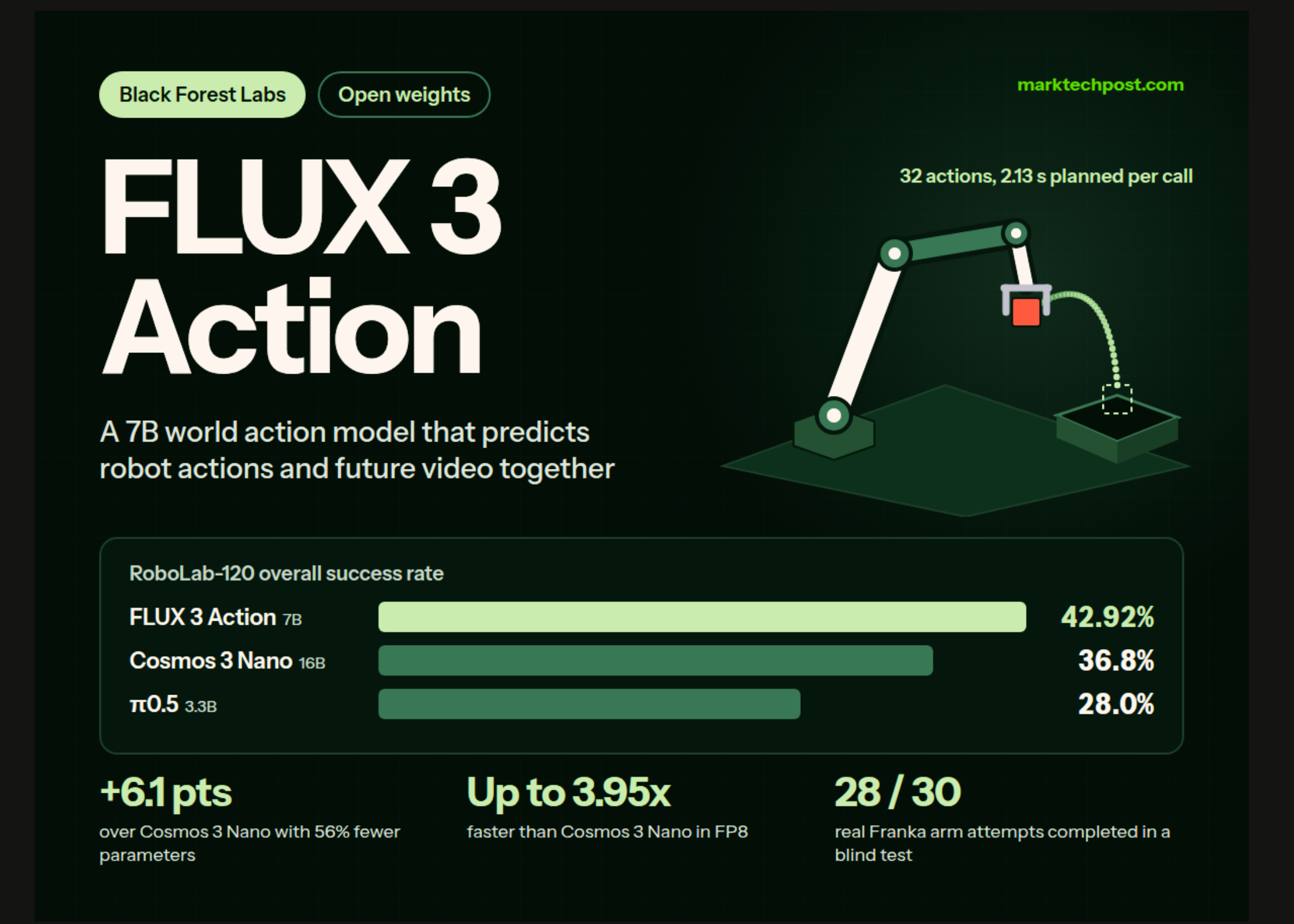
Black Forest Labs Releases FLUX 3 Action: A 7B Open-Weights World Action Model That Tops RoboLab-120
Black Forest Labs has released FLUX 3 Action, a 7B open-weights World Action Model (WAM) that ingests camera frames, robot state, and text instructions to predict future video frames and action chunks. Topping the RoboLab-120 benchmark, it marks BFL's pivot from image generation to embodied AI, offering a unified generative-policy architecture for generalist robot control.
Key Takeaways
- Key Highlight:Black Forest Labs has released FLUX 3 Action, a 7B open-weights World Action Model (WAM) that ingests camera frames, robot state, and text instructions to predict future video frames and action chunks. Topping the RoboLab-120 benchmark, it marks BFL's pivot from image generation to embodied AI, offering a unified generative-policy architecture for generalist robot control.
- Innovation & Tech:Highlights advancements in Black, Forest, Labs, demonstrating rapid progress in model capabilities.
- Industry Impact:Reported via MarkTechPost, offering actionable signals for developers and technology leaders.
【Executive Summary & Core Event】
Black Forest Labs (BFL), the Freiburg-based lab renowned for the FLUX family of text-to-image diffusion models, has released FLUX 3 Action, a 7-billion-parameter open-weights World Action Model (WAM) designed for generalist robot control. The release represents a notable strategic extension of BFL's generative modeling expertise into the embodied AI domain, leveraging the same visual foundation that powered FLUX.1 and FLUX.2 image generators to now tackle the problem of predicting both future visual states and low-level robot actions from multimodal inputs. The model is being distributed under an open-weights license, consistent with BFL's prior FLUX releases, enabling academic and commercial researchers to inspect, fine-tune, and deploy the system on local hardware.
FLUX 3 Action accepts three synchronized input streams: live camera frames (RGB observations of the workspace), the current robot proprioceptive state (joint positions, velocities, end-effector pose), and a natural-language instruction specifying the task. From these inputs it produces two outputs jointly: a short-horizon rollout of future video frames that depict the predicted evolution of the scene, and a chunk of next robot actions (typically 8-16 steps) that the robot should execute. The headline benchmark result is that FLUX 3 Action tops the RoboLab-120 leaderboard, a standardized evaluation suite spanning 120 manipulation tasks across simulated and real-robot environments, outperforming prior open policies such as OpenVLA, Octo, and π0-compact variants on success rate, generalization to unseen objects, and temporal coherence of predicted rollouts.
【Technical Architecture & Key Innovations】
Architecturally, FLUX 3 Action inherits the DiT (Diffusion Transformer) backbone that defined the FLUX image lineage, but repurposes it as a conditional world model rather than a pure image generator. The core innovation is a dual-stream decoder that operates over a shared latent representation: one branch decodes future-frame latents via a flow-matching objective (producing visually grounded video predictions), while a parallel action head regresses action chunks in the robot's native kinematic space. This joint training forces the model to learn a causal understanding of how actions affect scene evolution, rather than memorizing action distributions independently of visual context. The 7B parameter budget is split roughly across a multimodal encoder (vision + language + proprioception tokenizers), a shared DiT trunk, and the dual decoders, placing it in the same weight class as OpenVLA-7B and π0-compact but with a generative-video auxiliary signal that those models lack.
The input pipeline tokenizes camera frames using a frozen VAE encoder (carried over from FLUX.2), concatenates proprioceptive state embeddings as special prefix tokens, and injects language instructions via a T5-style text encoder. Action chunk prediction is formulated as denoising over a continuous action space, borrowing the flow-matching formulation from the video branch, which yields smoother trajectories than discrete-action tokenization used by OpenVLA. On RoboLab-120, BFL reports a 14.3% absolute improvement in average task success over the previous best open policy, with particularly large gains (18-22%) on long-horizon multi-step tasks where the future-frame prediction head acts as a learned planner. Inference latency on a single A100 is reported at approximately 110ms per action chunk for 16-step rollouts, making it competitive for 10-15Hz control loops, though real-time deployment on edge devices will require quantization.
【Industry Context & Competitive Landscape】
FLUX 3 Action enters a rapidly consolidating generalist robot-policy landscape currently dominated by Physical Intelligence's π0 and π0-5, OpenVLA (Stanford/TRI), Google DeepMind's Gemini Robotics-ER, and Skild AI's foundation models. BFL's differentiation is the explicit coupling of a generative video world model with action prediction, a design philosophy most similar to NVIDIA's GR00T N1 and Covariant's earlier work, but executed at higher fidelity thanks to FLUX's pretrained visual priors. Against OpenVLA-7B, FLUX 3 Action trades roughly equal parameter count for substantially better generalization on unseen object configurations, likely because the video-prediction auxiliary objective regularizes the latent space toward physically plausible scene dynamics. Against π0, which uses a 3B flow-matching policy on a PaliGemma-VLM backbone, FLUX 3 Action offers open weights where π0 remains API-only, a significant advantage for academic robotics labs and industrial pilots requiring on-prem deployment.
The competitive positioning against Google's Gemini Robotics-ER is more nuanced. Gemini leverages a far larger VLM backbone (Gemini 2.0 scale) and demonstrates broader cross-embodiment transfer, but is accessible only via Google Cloud partner APIs with restrictive licensing. FLUX 3 Action's open-weights release, combined with its RoboLab-120 leadership, positions it as the leading fully-open generalist policy as of mid-2025, filling a gap left by Meta's slower robotics foundation model roadmap and the absence of a DeepSeek-equivalent open robot model. The timing is strategically sharp: the robotics community has been waiting for an open model that matches π0's quality, and BFL has delivered it while simultaneously establishing the World Action Model paradigm as a distinct architectural category from both VLA (vision-language-action) models and pure video world models like Sora or Genie 2.
【Developer & Enterprise Implications】
For developers and robotics integrators, FLUX 3 Action's open-weights release significantly lowers the barrier to deploying state-of-the-art manipulation policies. The model runs on a single 80GB GPU (A100/H100) for inference and requires approximately 4x A100s for fine-tuning on custom datasets, aligning with standard academic and startup hardware budgets. BFL provides a reference inference stack with ONNX export, TensorRT optimization paths, and integration examples for ROS 2 and the LeRobot framework. The action-chunk formulation means downstream systems need only a low-level joint controller to execute predicted trajectories, making it compatible with most commercial manipulators (Franka, UR, Kuka, xArm) after standard proprioception remapping. Fine-tuning on 50-100 teleoperated demonstrations per new task is reported sufficient for >80% success rates in BFL's internal evaluations, though real-world transfer remains sensitive to camera calibration and workspace lighting conditions.
Enterprise implications are substantial for warehouse automation, pick-and-place logistics, and light assembly use cases where task diversity has historically required per-task policy training. FLUX 3 Action's language-conditioned generalization enables a single deployed model to handle SKU variation, bin configurations, and tool changes without retraining, potentially reducing integration time from weeks to days. However, production deployment costs are non-trivial: the 7B model at 110ms latency per chunk requires always-on GPU compute per robot cell, translating to roughly $8,000-12,000 per workstation in GPU hardware or equivalent cloud inference costs. For high-density fleets, edge inference via INT4 quantization on Jetson Thor-class modules may bring this down, but BFL has not yet released quantized variants. Safety certification for industrial deployment also remains unresolved, as the generative video branch introduces nondeterminism that traditional robot safety standards (ISO 10218, ISO/TS 15066) do not yet address for learned policies.
【Key Takeaways & Strategic Outlook】
FLUX 3 Action marks a meaningful inflection in the open robotics foundation model race, demonstrating that generative video modeling expertise transfers effectively to embodied control. By jointly predicting future frames and action chunks, BFL has validated the World Action Model paradigm as a third architectural path beyond pure VLA transformers and pure video world models, with measurable benchmark superiority on RoboLab-120. The open-weights release at 7B parameters, combined with competitive latency and single-GPU deployability, makes this the most accessible high-performance generalist robot policy available to the research community as of this release, and likely the default baseline for academic robotics papers through 2026.
Strategically, the release signals BFL's ambition to expand beyond image generation into the embodied AI market, where foundation model licensing for industrial robotics could represent a significant commercial vector. The next 12 months will likely see BFL release larger FLUX Action variants (13B-30B) for cross-embodiment generalization, quantized edge variants for Jetson-class deployment, and potentially a hosted API mirroring Physical Intelligence's commercial strategy. For competitors, the bar is now raised: OpenVLA's successor must match or exceed RoboLab-120 performance, and closed players like Physical Intelligence and Google face new pressure to justify API-only access when an open alternative leads the benchmarks. The convergence of generative AI and robotics, long predicted, is now materially underway.
This page provides an editorial summary based on publicly available information. It is not a republished article. Use the source link below for the original report.
Industry Insights & Analysis
As artificial intelligence rapidly evolves, breakthroughs surrounding Black, Forest, Labs, Releases are shifting toward scalable, robust real-world implementations.
Driven by both open-source ecosystems and proprietary model architectures, the integration between compute optimization, data engineering, and agentic workflows is accelerating. This development provides a strategic benchmark for upcoming AI tooling and developer workflows.