Fastino Releases GLiNER2.5-Decide: A 340M Open-Weight Decision Model That Runs on CPU
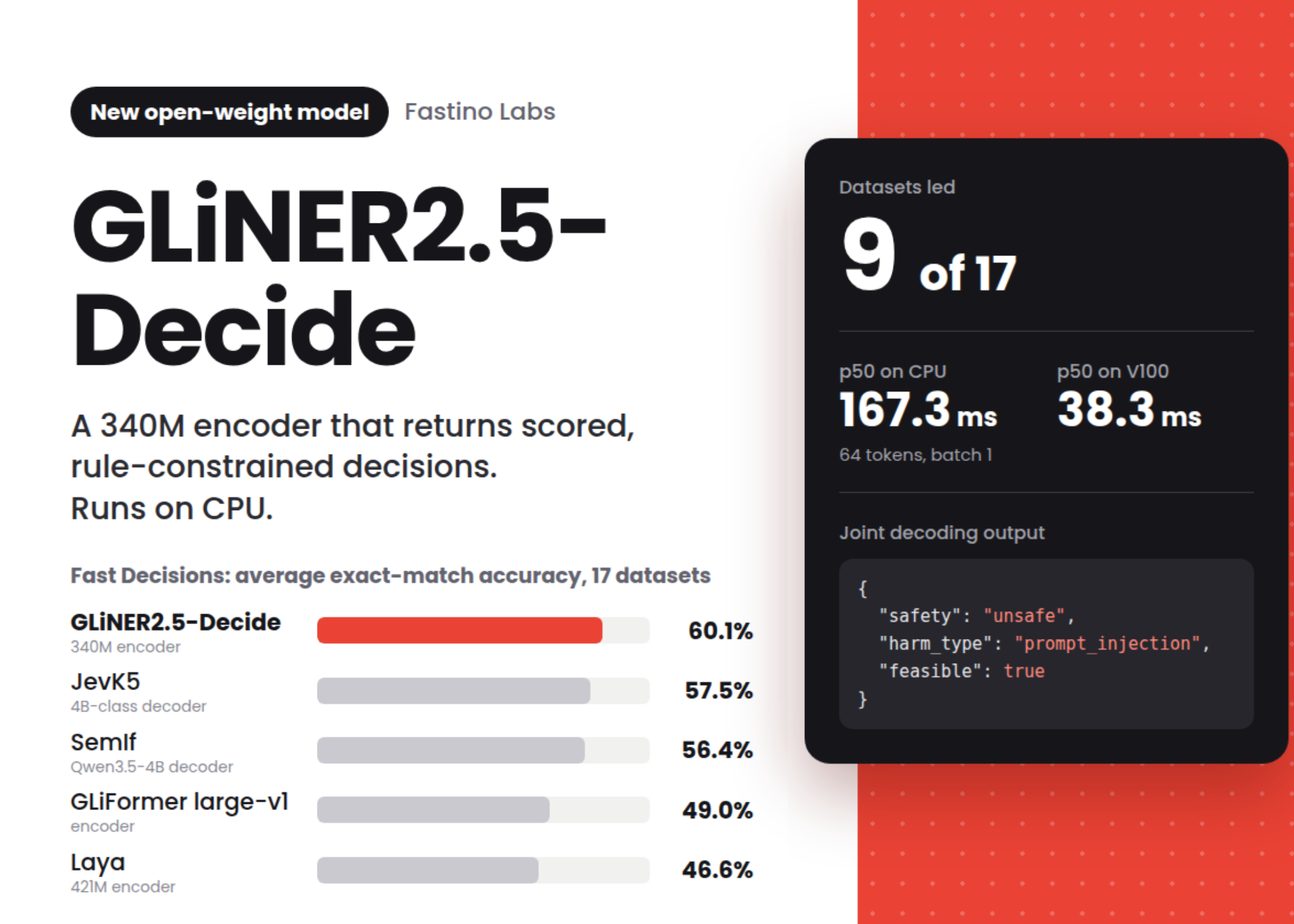
Fastino Labs has released GLiNER2.5-Decide, a 340M-parameter open-weight decision model that runs on CPU. It accepts text and a schema of typed questions, returning structured answers with probability distributions, confidence scores, and constraint-feasibility metadata. The model targets enterprise decision-making and structured extraction at the edge, challenging GPU-bound LLM workflows.
Key Takeaways
- Key Highlight:Fastino Labs has released GLiNER2.5-Decide, a 340M-parameter open-weight decision model that runs on CPU. It accepts text and a schema of typed questions, returning structured answers with probability distributions, confidence scores, and constraint-feasibility metadata. The model targets enterprise decision-making and structured extraction at the edge, challenging GPU-bound LLM workflows.
- Innovation & Tech:Highlights advancements in Fastino, Releases, GLiNER2.5-Decide, demonstrating rapid progress in model capabilities.
- Industry Impact:Reported via MarkTechPost, offering actionable signals for developers and technology leaders.
【Executive Summary & Core Event】
Fastino Labs has unveiled GLiNER2.5-Decide, a 340M-parameter open-weight decision model that represents a significant evolution in the GLiNER (Generalist and Lightweight model for Named Entity Recognition) family. Unlike conventional generative LLMs that produce free-form text, GLiNER2.5-Decide is architected as a structured decision engine: it accepts a text passage and a schema of typed questions, then returns structured answers where each response includes a probability distribution over possible answers, a calibrated confidence score, and constraint-feasibility metadata indicating whether the answer satisfies user-defined constraints. This design positions the model as a purpose-built tool for information extraction, classification, and decision support rather than open-ended dialogue.
The release is notable for its deployment profile. Fastino emphasizes that GLiNER2.5-Decide runs on CPU, eliminating the GPU dependency that dominates contemporary LLM inference. At 340M parameters, the model is orders of magnitude smaller than frontier models from OpenAI, Anthropic, or Google, yet it targets a specific and commercially valuable niche: deterministic, schema-constrained decision-making over text. The open-weight release follows a permissive licensing strategy aimed at enterprise adoption, allowing organizations to run the model locally without API costs or data egress concerns. This aligns with a growing industry trend toward specialized small models that outperform generalist LLMs on narrowly defined tasks while dramatically reducing operational overhead.
GLiNER2.5-Decide builds on the prior GLiNER lineage, which established a reputation for efficient zero-shot and few-shot named entity recognition using a bi-encoder architecture with span-level classification. The Decide variant extends this foundation into a broader decision-model paradigm, supporting typed question schemas that can encode complex extraction logic. By returning probability distributions rather than single tokens, the model enables downstream systems to implement threshold-based routing, human-in-the-loop review, and uncertainty-aware pipelines—capabilities that are difficult to achieve reliably with standard generative models.
【Technical Architecture & Key Innovations】
GLiNER2.5-Decide retains the core architectural philosophy of the GLiNER family: a relatively compact transformer encoder that processes both the input text and the question schema within a shared representation space. The model employs a bi-encoder or cross-encoder design where text spans and question prompts are encoded jointly, enabling span-level scoring against typed queries. This is fundamentally different from autoregressive LLMs, which generate tokens sequentially. Instead, GLiNER2.5-Decide performs parallel evaluation of candidate spans against the schema, producing probability distributions over answer candidates in a single forward pass. This architectural choice is what enables CPU-native inference: the model avoids the memory-bandwidth bottleneck of autoregressive decoding, which typically requires high-bandwidth GPU memory (HBM) for acceptable latency.
The model's output structure is its most distinctive technical feature. Each answer is accompanied by three metadata components: a probability distribution over the answer space, a scalar confidence score, and constraint-feasibility metadata. The probability distribution enables uncertainty quantification—a critical requirement for enterprise decision systems where false positives carry operational cost. The confidence score is presumably calibrated against the model's empirical accuracy, allowing downstream consumers to set acceptance thresholds. Constraint-feasibility metadata indicates whether the proposed answer satisfies structural or semantic constraints defined in the schema (e.g., date format, entity type, numeric range). This metadata layer transforms the model from a pure classifier into a decision-support component that can be composed within larger pipeline architectures.
At 340M parameters, the model is positioned in the efficiency tier of the AI model landscape. For context, this is roughly 0.2% the size of a 70B-parameter model like Llama 3 70B. The parameter efficiency is achieved through task-specific design: rather than storing broad world knowledge and generative capabilities, the model concentrates its capacity on span detection, question understanding, and structured output generation. The CPU inference claim is plausible given the encoder-only architecture and modest parameter count. Encoder models are inherently more CPU-friendly than decoder models because they avoid the sequential token generation loop and can leverage optimized inference libraries like ONNX Runtime or Intel OpenVINO. Fastino likely targets sub-second latency for typical document-length inputs on standard server-class CPUs.
【Industry Context & Competitive Landscape】
GLiNER2.5-Decide enters a competitive landscape that includes both specialized extraction models and general-purpose LLMs pressed into extraction roles. On the specialized side, it competes with spaCy's industrial NLP pipelines, Hugging Face's token classification models, and Microsoft's Table Transformer for structured extraction. On the generalist side, organizations increasingly use GPT-4o, Claude 3.5 Sonnet, and Gemini 1.5 Flash for extraction tasks via function calling and structured output modes. Fastino's differentiation is clear: GLiNER2.5-Decide offers the structured output guarantees of function-calling LLMs but at a fraction of the cost and with local deployment, while providing richer uncertainty metadata than either generalist LLMs or traditional NER systems.
The competitive positioning against open-weight models is equally relevant. Meta's Llama 3.1 8B and Alibaba's Qwen2.5 7B can perform extraction via structured output, but they require GPU infrastructure for acceptable latency and carry significantly higher operational costs. DeepSeek-V3 and Mistral's models offer strong extraction capabilities but are similarly GPU-bound. GLiNER2.5-Decide's CPU-native profile makes it attractive for edge deployment, on-premise enterprise environments with strict data residency requirements, and high-volume batch processing where per-document API costs would be prohibitive. The 340M parameter count also means the model can be fine-tuned rapidly on modest hardware, enabling domain-specific customization that is impractical with multi-billion-parameter models.
The broader industry trend favors model specialization and composability. As organizations mature in their AI adoption, many are recognizing that routing every task through a frontier LLM is economically unsustainable and operationally fragile. Fastino's approach aligns with the emerging pattern of using small specialized models for high-volume structured tasks while reserving frontier LLMs for complex reasoning and generation. This is the same thesis driving approaches like GLiNER's predecessor work, Microsoft's Phi models for specific tasks, and the broader move toward mixture-of-experts at the system level rather than the model level. GLiNER2.5-Decide's schema-driven interface and probability-aware outputs make it particularly well-suited as a component in agentic pipelines where reliability and cost predictability matter more than conversational fluency.
【Developer & Enterprise Implications】
For developers, GLiNER2.5-Decide offers a straightforward integration path. The schema-based input interface means developers define typed questions declaratively rather than engineering prompts—a significant advantage over LLM-based extraction where prompt sensitivity can cause output drift. The structured output format, including probability distributions and confidence scores, integrates naturally with existing data pipelines, rule engines, and decision management systems. Organizations can implement threshold-based acceptance logic: answers above a confidence threshold are auto-processed, while lower-confidence results are routed for human review. This is a mature pattern in industrial NLP and information extraction, and GLiNER2.5-Decide's native support for it reduces the integration complexity that typically surrounds LLM-based extraction systems.
The CPU deployment profile has significant cost implications. Eliminating GPU requirements removes the largest cost component in AI inference infrastructure. For a processing 100,000 documents daily, the difference between CPU-based local inference and GPU-based API calls to frontier models can represent orders of magnitude in cost savings. A standard server with a modern CPU (e.g., Intel Xeon or AMD EPYC) can host the model with minimal incremental infrastructure. The open-weight license enables on-premise deployment, addressing data residency and compliance requirements that make cloud API usage problematic in regulated industries like healthcare, finance, and government. Fine-tuning on domain-specific data is feasible on a single consumer GPU or even high-end CPU clusters, lowering the barrier to domain adaptation.
However, the model's practical scope is bounded by its design philosophy. GLiNER2.5-Decide is not a general-purpose language model. It cannot perform complex multi-step reasoning, generate fluent prose, or handle open-ended questions. Organizations requiring those capabilities will still need a complementary LLM. The model's value proposition is strongest in high-volume, well-defined extraction and decision tasks: document classification, entity extraction, field validation, compliance checking, and structured data population from unstructured text. Developers should also evaluate the model's coverage across languages and domains, as 340M-parameter models may exhibit narrower language coverage than larger multilingual models. Benchmarking against existing extraction pipelines on domain-specific data will be essential before production deployment.
【Key Takeaways & Strategic Outlook】
GLiNER2.5-Decide represents a compelling case for task-specific model design in an industry increasingly dominated by frontier-scale generalist models. By focusing on structured decision-making with rich uncertainty metadata, Fastino has created a tool that addresses real enterprise pain points: cost, reliability, and deployability. The CPU-native inference profile is not merely a technical curiosity—it is a strategic positioning that opens deployment scenarios inaccessible to GPU-bound models. As AI infrastructure costs come under scrutiny, models like GLiNER2.5-Decide that deliver high-value capabilities on commodity hardware will gain traction, particularly among organizations that have been priced out of GPU-intensive AI workflows.
Looking forward, the decision-model paradigm that GLiNER2.5-Decide embodies points toward a more compositional AI architecture where specialized small models handle well-defined tasks within larger systems. The inclusion of probability distributions and constraint-feasibility metadata reflects a maturation of enterprise AI expectations: organizations want not just answers but calibrated confidence and structural guarantees. Fastino's roadmap will likely expand the model's schema expressiveness, language coverage, and domain-specific variants. The competitive pressure from both open-weight LLMs and commercial extraction services will drive continued innovation in this space. For technology leaders evaluating AI deployment strategies, GLiNER2.5-Decide warrants serious evaluation as a cost-effective, reliable component for structured text processing pipelines, particularly where local deployment and uncertainty quantification are operational requirements rather than nice-to-have features.
This page provides an editorial summary based on publicly available information. It is not a republished article. Use the source link below for the original report.
Industry Insights & Analysis
As artificial intelligence rapidly evolves, breakthroughs surrounding Fastino, Releases, GLiNER2.5-Decide, Open-Weight are shifting toward scalable, robust real-world implementations.
Driven by both open-source ecosystems and proprietary model architectures, the integration between compute optimization, data engineering, and agentic workflows is accelerating. This development provides a strategic benchmark for upcoming AI tooling and developer workflows.