Perplexity Trains Its Computer Agent on Real Mistakes With Hint-Guided Self-Distillation
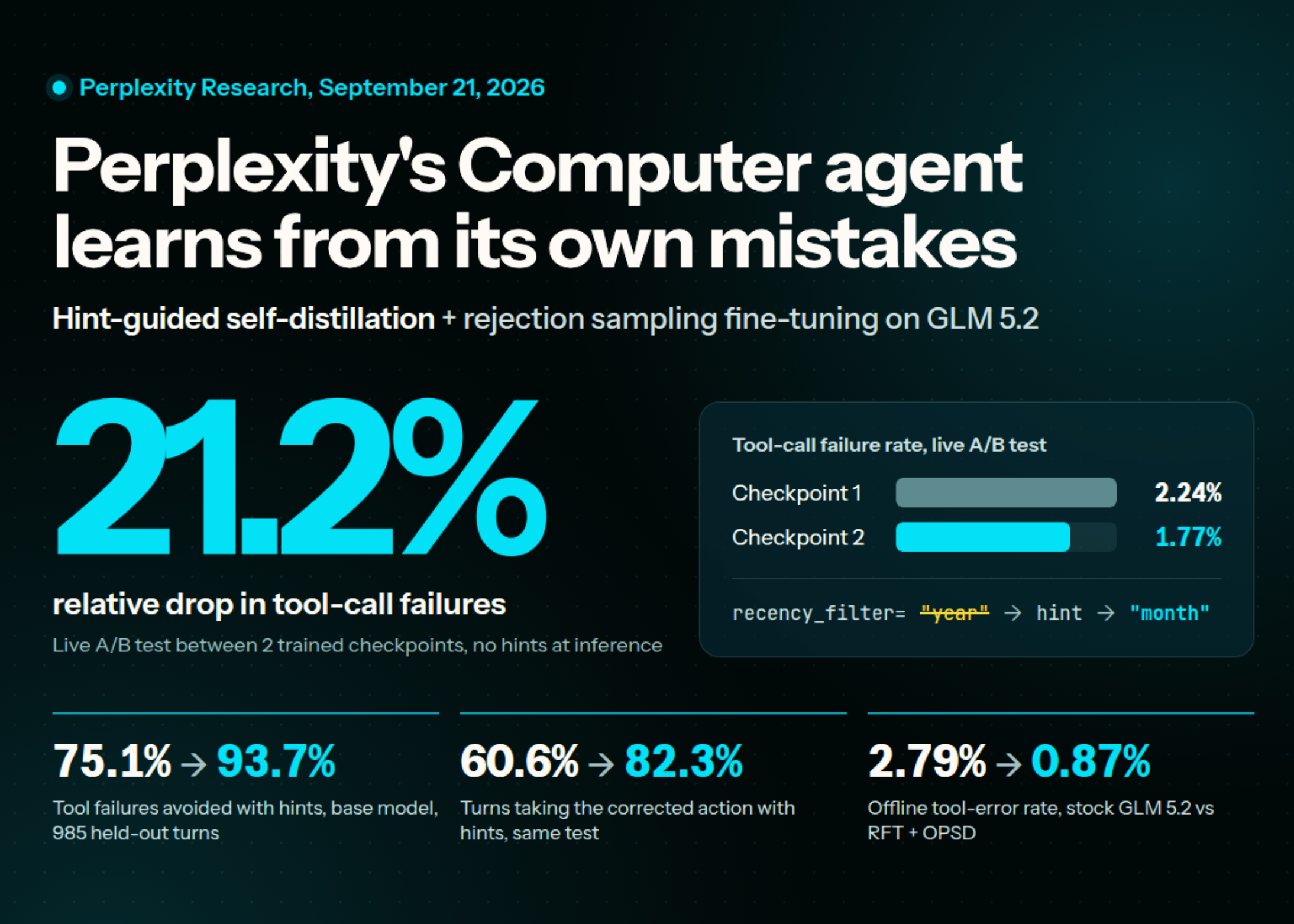
Perplexity Research unveiled a post-training pipeline for its Computer agent that learns from real user sessions, including failures, via rejection sampling fine-tuning paired with hint-guided self-distillation. A live A/B test showed tool-call failures dropped significantly, marking a meaningful advance in agent reliability and self-correction from production telemetry.
Key Takeaways
- Key Highlight:Perplexity Research unveiled a post-training pipeline for its Computer agent that learns from real user sessions, including failures, via rejection sampling fine-tuning paired with hint-guided self-distillation. A live A/B test showed tool-call failures dropped significantly, marking a meaningful advance in agent reliability and self-correction from production telemetry.
- Innovation & Tech:Highlights advancements in Agent, Perplexity, Trains, demonstrating rapid progress in model capabilities.
- Industry Impact:Reported via MarkTechPost, offering actionable signals for developers and technology leaders.
【Executive Summary & Core Event】
Perplexity Research has published a new post-training study detailing how it trains the model embedded inside Perplexity Computer, its browser-based agent product, directly on real user interaction logs. The approach is notable because it deliberately includes failed sessions rather than discarding them, treating tool-call mistakes as first-class training signal. The pipeline combines two complementary techniques: rejection sampling fine-tuning (RSFT), which filters and retains only high-quality trajectories from sampled rollouts, and hint-guided self-distillation, where the model is nudged toward corrective behavior using structured hints derived from post-hoc analysis of what went wrong. Together these form a closed-loop improvement cycle that turns production friction into supervised learning material.
The motivation is straightforward but industrially significant: agentic systems that invoke external tools, navigate DOMs, and chain multi-step actions degrade sharply when any single tool call fails or hallucinates parameters. Rather than relying solely on curated synthetic trajectories or human-annotated demonstrations, Perplexity mines its own live traffic. The reported A/B test demonstrated a measurable reduction in tool-call failures in production, validating that learning from mistakes, not just successes, yields robust gains. This positions the work alongside a growing body of research on self-improving agents, iterative DPO, and trajectory-level preference optimization, but distinguishes itself through the scale and authenticity of real-session data and the hint mechanism that bridges failure to correction without full human relabeling.
【Technical Architecture & Key Innovations】
The core architecture rests on two interlocking post-training stages. In the first stage, rejection sampling fine-tuning, the policy model generates multiple candidate trajectories for a given user task context drawn from real logs. These rollouts are scored by a reward signal that evaluates task completion, tool-call validity, and adherence to expected agent behavior. Only the top-performing trajectories, including those that recovered from initial errors, are retained for supervised fine-tuning. This filtering step ensures the model learns from demonstrated success while still being exposed to the distribution of real-world complications, ambiguous instructions, partial page loads, and malformed API responses that synthetic data rarely captures faithfully.
The second stage, hint-guided self-distillation, addresses the problem of how to extract learnable signal from failed trajectories without expensive human correction. When a session fails, the system performs post-hoc analysis to identify the failure point, such as a wrong selector, an incorrect parameter, or a premature action. A structured hint is then generated, encoding what the correct next step should have been, and the model is prompted to regenerate the trajectory segment conditioned on that hint. The corrected output is treated as a pseudo-ground-truth target and distilled back into the policy through standard next-token loss. This effectively converts the teacher model, the same base model guided by hints, into a self-correcting supervisor, amortizing the cost of improvement across the entire fleet of user sessions without requiring per-example annotation. The result is a scalable self-improvement loop where production failures become training curriculum.
【Industry Context & Competitive Landscape】
Perplexity's method lands in a competitive landscape where agent reliability is the central battleground. OpenAI's Operator and GPT-4o agent frameworks, Anthropic's Claude Computer Use, and Google's Project Mariner all face the same core problem: tool-call and navigation failures compound across multi-step trajectories, eroding user trust. Most frontier labs have leaned on curated demonstration datasets or constitutional-style RLHF to address this. Perplexity differentiates by operationalizing failure mining at production scale, effectively turning its deployed user base into a continuous data engine. This is philosophically closer to DeepSeek's R1-style self-play and iterative refinement than to OpenAI's heavily supervised approaches.
Compared to Meta's Llama-based agent research and Alibaba's Qwen-Agent stack, which emphasize open tool-calling benchmarks and structured planning, Perplexity's contribution is less about architecture and more about post-training data strategy. The hint-guided distillation mechanism resembles trajectory-level DPO and process-reward methods explored by Anthropic and academic groups, but its integration with live A/B testing and real session telemetry gives it an empirical grounding that benchmark-only evaluations lack. The reported failure reduction, if reproducible across task domains, could pressure competitors to disclose similar production-loop training pipelines rather than relying on static evaluation suites that increasingly fail to predict real-world agent performance.
【Developer & Enterprise Implications】
For developers building agent systems, Perplexity's pipeline offers a transferable blueprint. The core insight, that failed trajectories contain high-value learning signal when properly processed, can be implemented with existing tooling: rollout sampling via vLLM or SGLang, reward scoring via rule-based validators or LLM judges, and distillation through standard SFT pipelines on corrected segments. The hint-generation step is the most engineering-intensive component, requiring a diagnostic layer that can pinpoint failure causes in complex agent traces. Organizations with substantial production traffic can replicate this loop; those without it will need synthetic failure injection to approximate the same data distribution.
The business implications are significant. Agent failure rates directly drive churn, support costs, and willingness to pay. A measurable reduction in tool-call failures translates to higher task completion rates, which for Perplexity Computer means more reliable browser automation and search-augmented workflows. The self-distillation approach also reduces dependence on human annotation teams, lowering the marginal cost of continuous improvement. However, the method introduces risks: learning from real user data raises privacy and consent considerations, and hint quality becomes a new bottleneck. Poorly constructed hints could propagate systematic corrections that look good on average but degrade edge-case performance. Enterprises adopting similar pipelines should invest in robust hint-validation and regression testing before deploying distilled models to production traffic.
【Key Takeaways & Strategic Outlook】
Perplexity's study reinforces a strategic shift in how frontier agent systems are trained: the most valuable data is no longer curated demonstrations but the messy, failure-rich telemetry generated by real users. By pairing rejection sampling with hint-guided self-distillation, Perplexity has built a scalable loop that converts production mistakes into model improvements without proportional human oversight. This approach is likely to become standard practice among deployed agent providers, as it offers a compounding advantage: the more users a product has, the faster its underlying model improves.
Looking forward, the next evolutionary step will be closing the loop fully, moving from offline post-hoc hint generation to online correction where agents self-diagnose and self-correct within a single session. This would require more sophisticated process-reward models and real-time failure detection. Competitors will need to match Perplexity's data pipeline sophistication or risk falling behind on the metric that matters most to users: does the agent actually complete the task. The era of benchmark-optimized agents is giving way to production-optimized agents, and Perplexity's method is an early, credible articulation of how that transition works in practice.
This page provides an editorial summary based on publicly available information. It is not a republished article. Use the source link below for the original report.
Industry Insights & Analysis
As artificial intelligence rapidly evolves, breakthroughs surrounding Agent, Perplexity, Trains, Its are shifting toward scalable, robust real-world implementations.
Driven by both open-source ecosystems and proprietary model architectures, the integration between compute optimization, data engineering, and agentic workflows is accelerating. This development provides a strategic benchmark for upcoming AI tooling and developer workflows.