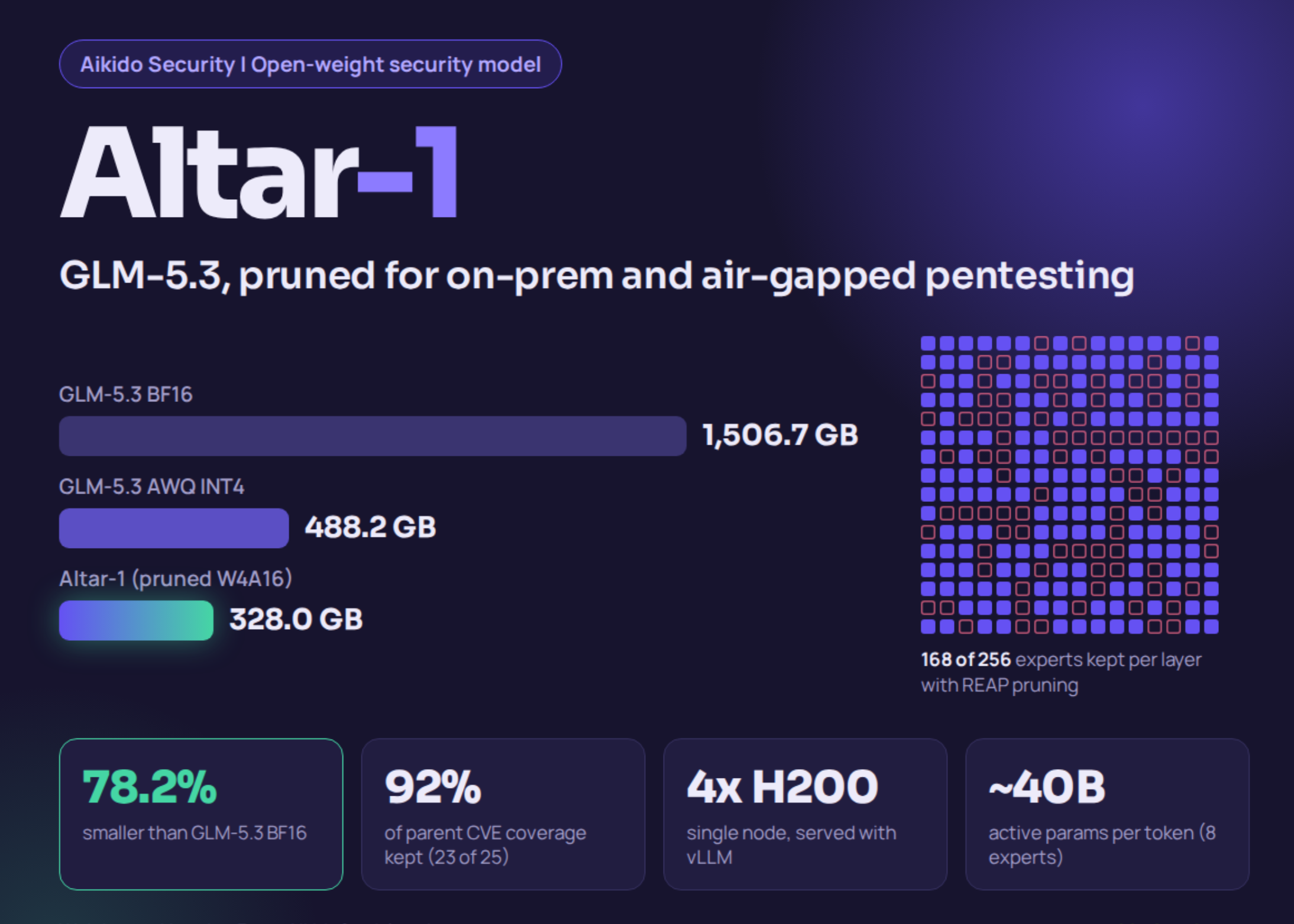
Aikido Security Releases Altar-1: An Open-Weight Security Model Pruned From GLM-5.3 to 328 GB
Aikido Security has released Altar-1, an open-weight security-focused LLM pruned from Z.AI's GLM-5.3 to 328 GB. Designed for on-premises and air-gapped deployment, it powers the Aikido Machine autonomous pentesting appliance. The release signals a shift toward specialized, self-hosted AI for security-sensitive enterprise environments.
Key Takeaways
- Key Highlight:Aikido Security has released Altar-1, an open-weight security-focused LLM pruned from Z.AI's GLM-5.3 to 328 GB. Designed for on-premises and air-gapped deployment, it powers the Aikido Machine autonomous pentesting appliance. The release signals a shift toward specialized, self-hosted AI for security-sensitive enterprise environments.
- Innovation & Tech:Highlights advancements in Aikido, Security, Releases, demonstrating rapid progress in model capabilities.
- Industry Impact:Reported via MarkTechPost, offering actionable signals for developers and technology leaders.
【Executive Summary & Core Event】
Aikido Security, a cybersecurity platform provider, has announced the release of Altar-1, its first open-weight large language model specifically engineered for security operations. Altar-1 is a pruned and specialized derivative of Z.AI's GLM-5.3 foundation model, compressed to a 328 GB footprint while retaining the reasoning and code-analysis capabilities necessary for autonomous penetration testing, vulnerability assessment, and threat modeling. The model is purpose-built to run inside customer-controlled infrastructure, a critical requirement for organizations that cannot transmit source code, network topology data, or vulnerability disclosures to cloud-hosted AI providers. Altar-1 serves as the cognitive engine behind Aikido Machine, the company's autonomous pentesting appliance designed for on-premises and air-gapped deployments.
The strategic significance of this release lies in its intersection of three converging trends: the proliferation of open-weight foundation models, the growing demand for AI-driven security automation, and the regulatory and operational constraints that prevent many enterprises from using cloud-based LLMs for security-critical workloads. By pruning a general-purpose foundation model rather than training from scratch, Aikido has achieved a security-specialized model at a fraction of the training cost while inheriting the broad reasoning capabilities of GLM-5.3. The 328 GB size indicates a substantial model—likely in the 100+ billion parameter range depending on quantization—positioning Altar-1 as a heavyweight model capable of complex multi-step reasoning required for genuine security analysis rather than lightweight inference tasks.
Aikido Security's decision to release Altar-1 as open-weight also reflects a broader industry movement toward transparency in security AI. Closed security models create trust asymmetries: defenders cannot audit how a model arrives at vulnerability classifications or whether it introduces false negatives. An open-weight model allows security teams to inspect, fine-tune, and red-team the model itself, creating a verifiable chain of reasoning from model weights to security recommendations. This is particularly important for air-gapped environments—military networks, critical infrastructure, financial trading systems—where the model must operate without any external API dependencies.
【Technical Architecture & Key Innovations】
Altar-1 is derived from Z.AI's GLM-5.3, a transformer-based foundation model from the GLM (General Language Model) family developed by Zhipu AI and related entities. The GLM architecture employs autoregressive blank-filling pretraining objectives, differing from the standard causal language modeling approach used in GPT-family models, which can provide advantages in bidirectional understanding during fine-tuning. GLM-5.3 likely incorporates architectural innovations common to recent frontier models, including grouped-query attention, rotary positional embeddings (RoPE), SwiGLU activation functions, and potentially mixture-of-experts (MoE) routing for conditional computation. The pruning process that produced Altar-1 would have involved structured pruning of attention heads, intermediate layers, and possibly expert modules, followed by knowledge distillation to recover performance lost during compression.
The 328 GB model size is a critical technical specification. Assuming FP16 or BF16 precision, this suggests a parameter count in the range of 160-200 billion parameters. If the model employs INT8 or mixed-precision quantization, the underlying parameter count could be significantly higher. For context, GLM-4 was reported at approximately 130 billion parameters, so GLM-5.3 likely represents a substantial scale-up. The pruning to 328 GB implies that Aikido's team identified and removed parameters contributing least to security-relevant reasoning tasks—code comprehension, vulnerability pattern recognition, exploit chain analysis—while preserving the model's general reasoning substrate. This task-specific pruning is more sophisticated than general compression, as it requires security-domain evaluation metrics throughout the pruning pipeline to ensure retention of capabilities like static analysis reasoning, CVE correlation, and attack surface mapping.
The security specialization likely involves additional fine-tuning stages beyond pruning: supervised fine-tuning on security corpora including CVE databases, exploit databases, security research papers, and pentest reports; followed by reinforcement learning from human feedback (RLHF) or preference optimization using security expert annotations. The model's integration into Aikido Machine as an autonomous pentesting appliance suggests it has been instrumented for agentic workflows—tool calling, multi-turn planning, code execution sandboxing, and structured output generation for vulnerability reports. This agentic capability layer is architecturally distinct from the base model and likely involves a surrounding framework for tool orchestration, context management across long security audit sessions, and safety guardrails to prevent the model from generating actionable exploit code in inappropriate contexts.
【Industry Context & Competitive Landscape】
Altar-1 enters a competitive landscape where AI-driven security tools are proliferating rapidly but predominantly through cloud-hosted APIs. OpenAI's GPT-4o and Anthropic's Claude 3.5 Sonnet are widely used in security tools from vendors like Snyk, GitHub, and CrowdStrike, but these rely on cloud inference, creating data sovereignty concerns. Google's Gemini models power security features in Google Cloud's Mandiant and Chronicle platforms, again within Google's infrastructure. Meta's Llama 3.1 and DeepSeek's open-weight models have been adapted for security use cases by third parties, but none have been purpose-built for autonomous pentesting with air-gap capability. Altar-1's differentiation is clear: it is the first major open-weight model specifically pruned and fine-tuned for security operations with an appliance deployment model.
The competitive positioning against DeepSeek is particularly relevant, as both share Chinese AI ecosystem origins and open-weight distribution philosophies. DeepSeek-V3 and DeepSeek-R1 have demonstrated that open-weight models can approach frontier closed-model performance at significantly lower cost. Altar-1's derivation from GLM-5.3 rather than DeepSeek suggests Aikido evaluated multiple foundation models and selected GLM for superior code reasoning or security-domain transfer characteristics. Against Meta's Llama 3.1 405B, Altar-1 offers security specialization that general-purpose Llama lacks, though Llama's broader community ecosystem provides advantages in tooling and fine-tuning infrastructure. Qwen2.5 from Alibaba represents another open-weight competitor with strong code capabilities, but similarly lacks security-specific optimization.
The autonomous pentesting market itself is emerging, with competitors including Pentest People, Cobalt, and Pentera offering automated security validation platforms. However, these tools typically use rule-based engines or cloud API calls to LLMs rather than running a dedicated local model. Aikido Machine's approach of embedding Altar-1 directly in an appliance creates a fundamentally different deployment paradigm: no data leaves the customer's network, no API rate limits constrain scanning depth, and the model can be customized with organization-specific threat intelligence without sharing that data externally. This positions Aikido uniquely against both traditional pentest service providers and cloud-dependent AI security platforms.
【Developer & Enterprise Implications】
For enterprise deployment, Altar-1's 328 GB size imposes significant but manageable hardware requirements. At FP16 precision, the model requires approximately 700 GB of GPU VRAM for inference—translating to roughly 8-10 NVIDIA H100 80GB GPUs or equivalent. For air-gapped environments, this hardware must be procured, provisioned, and maintained entirely within the customer's infrastructure. However, with INT4 or INT8 quantization, the memory footprint could be reduced to 170-340 GB, potentially fitting on 4-6 H100s or even high-memory configurations of A100 GPUs. Aikido likely provides optimized inference configurations within the Aikido Machine appliance, abstracting these hardware complexities from end users. The appliance model is critical here: customers purchase a pre-configured system rather than assembling GPU clusters themselves.
Integration complexity is moderated by the appliance deployment model. Rather than requiring customers to implement model serving infrastructure, Aikido Machine likely ships with pre-configured inference servers (potentially using vLLM, TensorRT-LLM, or custom serving stack), agentic orchestration frameworks, and security tool integrations. For developers, the open-weight release enables custom fine-tuning on organization-specific vulnerability taxonomies, internal codebase patterns, and proprietary threat models. This is a significant advantage over API-based models where fine-tuning is either unavailable or requires shipping sensitive data to vendor clouds. The business impact for security teams is substantial: autonomous pentesting can compress assessment cycles from weeks to hours, enable continuous security validation rather than point-in-time audits, and provide consistent baseline coverage across large application portfolios.
Deployment costs include both the appliance hardware (likely $200K-500K for GPU-equipped servers) and ongoing operational costs for power, cooling, and model updates. However, these costs must be evaluated against the alternative of human pentest services (typically $50K-200K per engagement) and the risk of data exposure through cloud-based AI tools. For regulated industries—defense, financial services, healthcare—the ability to perform AI-assisted security analysis without data egress may justify the infrastructure investment independently of performance considerations. Aikido will need to provide robust update mechanisms for air-gapped environments, likely through signed offline model bundles and vulnerability database snapshots delivered via secure media or dedicated network links.
【Key Takeaways & Strategic Outlook】
Altar-1 represents a meaningful convergence of open-weight AI and specialized security tooling, demonstrating that foundation models can be effectively pruned and specialized for vertical-domain deployment without losing core reasoning capabilities. The 328 GB model size indicates that Aikido prioritized capability retention over deployment efficiency, targeting enterprises with sufficient infrastructure to support heavyweight local models. This is a deliberate trade-off: smaller models could run on more modest hardware but would sacrifice the multi-step reasoning depth necessary for genuine autonomous pentesting. The open-weight release also creates a feedback loop where security researchers can audit, improve, and extend the model, potentially accelerating its capability development beyond what a single vendor could achieve internally.
Looking forward, Altar-1 signals a likely proliferation of domain-specialized open-weight models derived from frontier foundation models. The pruning-plus-fine-tuning approach is dramatically more efficient than training from scratch, enabling specialized vendors to create vertical AI products without billion-dollar training budgets. For the security industry specifically, autonomous pentesting appliances with embedded LLMs could transform security assessment from a periodic service engagement into a continuous capability. The next generation of such models will likely incorporate multimodal capabilities—analyzing network diagrams, system architecture visualizations, and UI-based attack surfaces alongside code and text. As open-weight models approach and occasionally match frontier closed-model performance, the data sovereignty advantage of appliances like Aikido Machine will increasingly outweigh the convenience advantages of cloud APIs for security-sensitive workloads. Organizations should monitor this space closely, as the ability to run frontier-class security AI on-premises may reshape vendor selection criteria across the cybersecurity market.
This page provides an editorial summary based on publicly available information. It is not a republished article. Use the source link below for the original report.
Industry Insights & Analysis
As artificial intelligence rapidly evolves, breakthroughs surrounding Aikido, Security, Releases, Altar-1 are shifting toward scalable, robust real-world implementations.
Driven by both open-source ecosystems and proprietary model architectures, the integration between compute optimization, data engineering, and agentic workflows is accelerating. This development provides a strategic benchmark for upcoming AI tooling and developer workflows.