BottleCap AI Releases ThinkingCap-Qwen3.8-27B: 37.2% Fewer Thinking Tokens at a 0.86pp Accuracy Cost
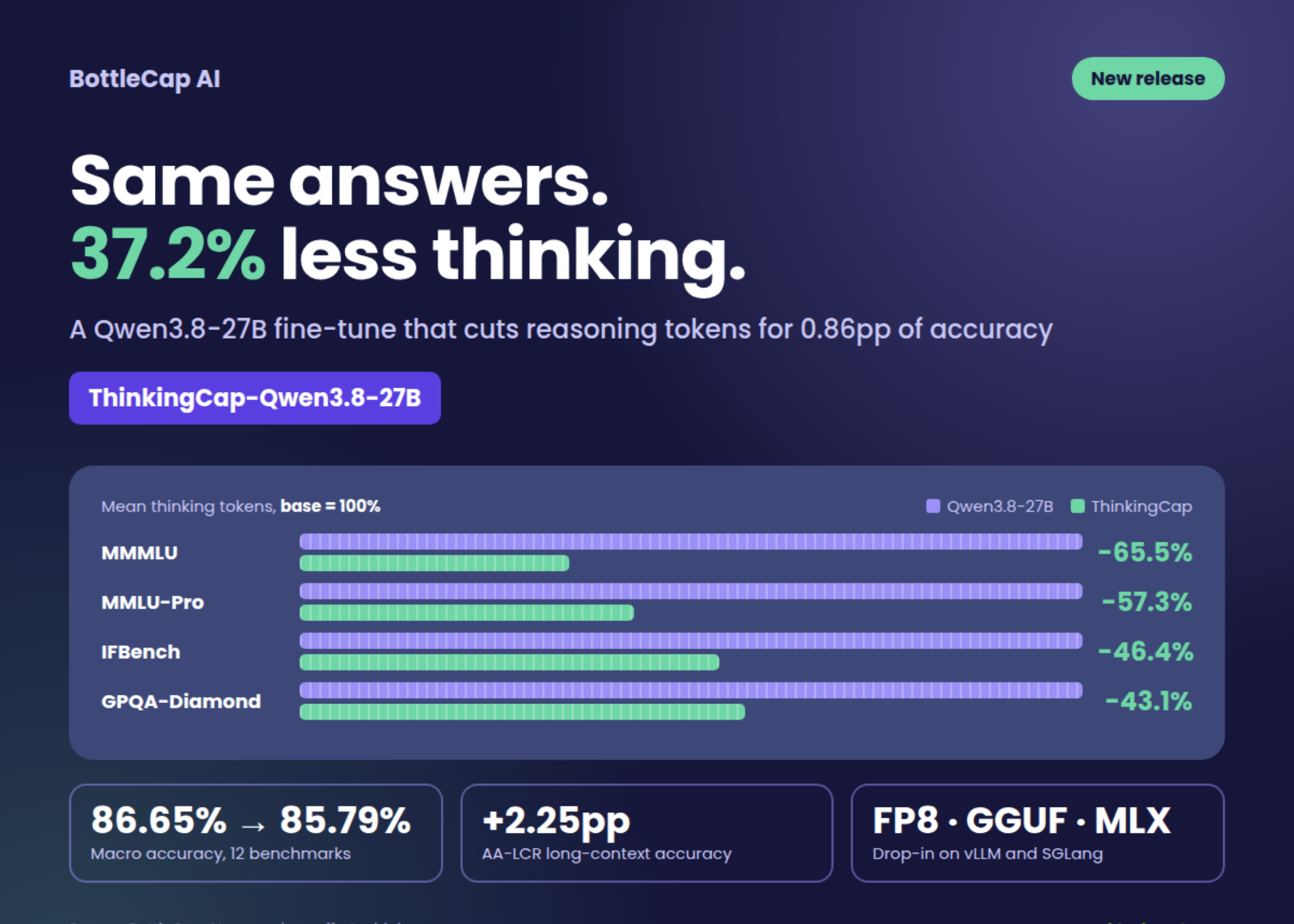
BottleCap AI releases ThinkingCap-Qwen3.8-27B, a fine-tuned variant of Qwen3.8-27B that reduces thinking token consumption by 37.2% across 12 benchmarks while incurring only a 0.86 percentage point macro accuracy decline. The model improves long-context AA-LCR by 2.25pp and ships as a drop-in replacement for vLLM and SGLang deployments.
Key Takeaways
- Key Highlight:BottleCap AI releases ThinkingCap-Qwen3.8-27B, a fine-tuned variant of Qwen3.8-27B that reduces thinking token consumption by 37.2% across 12 benchmarks while incurring only a 0.86 percentage point macro accuracy decline. The model improves long-context AA-LCR by 2.25pp and ships as a drop-in replacement for vLLM and SGLang deployments.
- Innovation & Tech:Highlights advancements in Qwen, BottleCap, AI, demonstrating rapid progress in model capabilities.
- Industry Impact:Reported via MarkTechPost, offering actionable signals for developers and technology leaders.
【Executive Summary & Core Event】
BottleCap AI has released ThinkingCap-Qwen3.8-27B, a post-trained derivative of Alibaba's Qwen3.8-27B foundation model engineered specifically to compress the reasoning trace length that chain-of-thought models generate during inference. The release targets a well-documented inefficiency in modern reasoning models: while extended thinking tokens improve accuracy on complex tasks, they also inflate latency, compute cost, and token billing in production environments. ThinkingCap-Qwen3.8-27B addresses this by reducing thinking token generation by 37.2% across a 12-benchmark evaluation suite, with macro accuracy declining modestly from 86.65% to 85.79%—a 0.86 percentage point delta that the company frames as an acceptable trade-off for inference cost reduction.
The model is positioned as a drop-in replacement compatible with vLLM and SGLang, two of the most widely deployed open-source inference engines, meaning organizations already running Qwen3.8-27B can swap weights without modifying their serving infrastructure. Notably, the fine-tune also improves long-context performance on the AA-LCR benchmark by 2.25 percentage points, suggesting the training regimen did not uniformly degrade capabilities and may have selectively enhanced certain reasoning regimes. The release reflects a growing industry trend of optimizing reasoning models not for peak benchmark scores but for the accuracy-cost Pareto frontier, where marginal accuracy sacrifices yield substantial operational savings at scale.
【Technical Architecture & Key Innovations】
ThinkingCap-Qwen3.8-27B inherits the Qwen3.8-27B base architecture, which employs a decoder-only transformer with grouped-query attention, SwiGLU activations, and RoPE positional encoding. The 27-billion parameter scale places it in a competitive mid-tier bracket—larger than typical 7B-14B models but significantly smaller than 70B+ systems—making it feasible for single-GPU or dual-GPU deployment on contemporary hardware like NVIDIA H100 or A100 80GB configurations. The architectural innovation in ThinkingCap lies not in structural modifications but in the post-training methodology that reshapes the model's reasoning token distribution, likely through a combination of supervised fine-tuning on compressed reasoning traces and reinforcement learning from token-budgeted reward signals.
The 37.2% reduction in thinking tokens is achieved without architectural pruning or quantization, preserving the full representational capacity of the 27B parameter set. This suggests the fine-tuning process teaches the model to internalize intermediate reasoning steps more efficiently—either by collapsing redundant logical steps, eliminating verification loops, or shortening explanatory asides that reasoning models often generate. The accuracy retention rate of 98.99% (85.79/86.65) indicates the model maintains near-equivalent reasoning quality while producing substantially shorter chains. The 2.25pp improvement on AA-LCR (a long-context reasoning benchmark) is particularly architecturally significant, as it demonstrates that token compression did not degrade—and in fact enhanced—the model's ability to maintain coherent reasoning across extended context windows, possibly because shorter thinking traces reduce attention dilution over generated content.
【Industry Context & Competitive Landscape】
ThinkingCap-Qwen3.8-27B enters a competitive landscape where reasoning efficiency has become a primary differentiator. OpenAI's o1 and o3 models, Anthropic's Claude 3.5 Sonnet with extended thinking, and DeepSeek's R1 have all demonstrated that reasoning token volume directly correlates with both capability and cost. DeepSeek R1 in particular popularized the open-weight reasoning model paradigm, but its thinking traces are notoriously verbose. BottleCap's approach of fine-tuning an existing strong base model (Qwen3.8-27B) for token efficiency represents a pragmatic middle path between training reasoning models from scratch and accepting the cost overhead of existing reasoning-optimized systems.
Against Meta's Llama 3.1 family and Google's Gemini 2.0 Flash Thinking, ThinkingCap-Qwen3.8-27B occupies a distinct niche: it is not a frontier-scale model but offers a production-ready efficiency optimization that frontier labs have largely addressed through proprietary serving optimizations rather than weight-level interventions. The vLLM and SGLang compatibility is strategically important, as it lowers adoption friction for the open-source AI ecosystem that has coalesced around these serving frameworks. Qwen models have gained significant traction in 2024-2025, particularly in Asian markets and among cost-sensitive deployments, and BottleCap's fine-tune effectively creates a specialized variant that extends Qwen's value proposition into the reasoning-efficiency segment where DeepSeek R1 distillations and smaller reasoning models currently compete.
【Developer & Enterprise Implications】
For developers and enterprises, ThinkingCap-Qwen3.8-27B offers immediate, quantifiable cost benefits. A 37.2% reduction in thinking tokens translates directly to reduced GPU-hours per query, lower token-based API costs, and faster time-to-first-token and time-to-last-token metrics. In high-volume production environments—customer support automation, code generation pipelines, agentic workflows—where reasoning models may generate thousands of thinking tokens per request, this reduction can lower inference costs by roughly a third while maintaining accuracy within one percentage point of the baseline. The drop-in compatibility with vLLM and SGLang means deployment requires only a weight swap, with no changes to tokenization, prompt templates, or API contracts.
The 0.86pp accuracy cost requires careful evaluation against use-case sensitivity. For applications where 85.79% macro accuracy is sufficient—many production reasoning tasks, including code review, document summarization, and multi-step tool use—the trade-off is clearly favorable. However, for high-stakes domains like mathematical proof verification, legal reasoning, or medical decision support, the accuracy delta may be unacceptable. The 2.25pp AA-LCR improvement suggests the model may be particularly valuable for long-context applications such as document analysis, codebase reasoning, or multi-turn agentic conversations, where both token efficiency and context coherence are critical. Enterprises should benchmark against their specific workloads rather than relying on the aggregate macro accuracy figure, as the 12-benchmark suite may not reflect domain-specific performance distributions.
【Key Takeaways & Strategic Outlook】
ThinkingCap-Qwen3.8-27B represents a meaningful contribution to the emerging discipline of reasoning model efficiency optimization. The release validates the thesis that reasoning token volume is not monotonically correlated with accuracy—substantial compression is achievable with minimal capability loss through targeted post-training. This has implications for the broader reasoning model ecosystem: as the industry moves toward agentic systems where models may chain dozens of reasoning steps, the cost of verbose thinking traces compounds multiplicatively, making efficiency optimizations like BottleCap's increasingly valuable. The model also demonstrates that the open-source community can productively specialize strong base models for specific operational characteristics without frontier-scale compute budgets.
Looking forward, this release signals a shift in how the AI community will evaluate reasoning models. Peak benchmark accuracy will remain important, but the accuracy-per-token and accuracy-per-dollar metrics will become primary selection criteria for production deployments. BottleCap's approach—fine-tuning for token efficiency while preserving capability—could become a standard post-training stage for reasoning models, analogous to how quantization and speculative decoding became standard serving optimizations. The long-context improvement also suggests that reasoning compression and context handling may be synergistic rather than antagonistic, opening research directions into whether shorter thinking traces fundamentally improve attention economics in transformer-based reasoning systems.
This page provides an editorial summary based on publicly available information. It is not a republished article. Use the source link below for the original report.
Industry Insights & Analysis
As artificial intelligence rapidly evolves, breakthroughs surrounding Qwen, BottleCap, AI, Releases are shifting toward scalable, robust real-world implementations.
Driven by both open-source ecosystems and proprietary model architectures, the integration between compute optimization, data engineering, and agentic workflows is accelerating. This development provides a strategic benchmark for upcoming AI tooling and developer workflows.