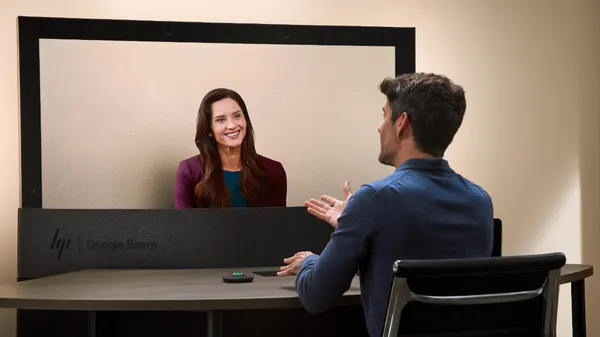
Google Beam expands with new regions, partners, and customers
Google Beam, the AI-powered 3D video communication platform formerly known as Project Starline, is expanding to five new countries with a partnership with Industrious for extended network deployment. The system leverages real-time neural rendering, depth estimation, and view synthesis to deliver glasses-free 3D telepresence.
Key Takeaways
- Key Highlight:Google Beam, the AI-powered 3D video communication platform formerly known as Project Starline, is expanding to five new countries with a partnership with Industrious for extended network deployment. The system leverages real-time neural rendering, depth estimation, and view synthesis to deliver glasses-free 3D telepresence.
- Innovation & Tech:Highlights advancements in Google, Beam, AI-powered, demonstrating rapid progress in model capabilities.
- Industry Impact:Reported via Google AI, offering actionable signals for developers and technology leaders.
【Executive Summary & Core Event】
Google Beam represents one of the most ambitious applications of real-time AI in communication infrastructure, evolving from Project Starline into a commercial-grade 3D telepresence platform. The announcement of expansion into five new countries marks a significant milestone in Google's strategy to transform remote collaboration beyond traditional video conferencing. The partnership with Industrious, a major workspace solutions provider, signals Google's intent to integrate Beam into professional environments where high-fidelity communication creates measurable business value. This expansion follows years of refinement in the underlying neural rendering pipeline that enables glasses-free 3D visualization.
The core technology stack combines multiple AI disciplines working in concert: computer vision for real-time depth estimation, neural rendering for view synthesis, machine learning for compression optimization, and sophisticated spatial audio processing. Google has progressively miniaturized the hardware from room-sized installations to more deployable form factors, making regional expansion feasible. The system captures a person from multiple angles using an array of cameras and sensors, then uses AI models to reconstruct and display a life-size, three-dimensional representation on a light field display. This creates the perceptual illusion that the remote participant is physically present in the same room, complete with realistic eye contact and spatial depth cues that traditional video conferencing fundamentally cannot replicate.
The expansion to five new countries represents both a technical and commercial validation of the platform's maturity. Google has not yet disclosed the specific countries, but the geographic spread suggests the system can handle diverse network conditions, regulatory environments, and infrastructure capabilities. The Industrious partnership is particularly strategic, as it provides immediate access to premium workspace locations where Beam units can be deployed without requiring customers to invest in dedicated facilities. This network-based deployment model lowers the barrier to adoption and creates a sustainable business model for scaling the technology beyond Google's own campuses and select enterprise partners.
【Technical Architecture & Key Innovations】
The technical architecture of Google Beam represents a convergence of several cutting-edge AI technologies operating within strict real-time constraints. At its foundation, the system employs a multi-camera array that captures the subject from multiple simultaneous viewpoints. These feeds are processed through a neural rendering pipeline that performs real-time depth estimation and view synthesis. The AI models, likely based on advancements in neural radiance fields (NeRFs) and their real-time variants, reconstruct a continuous 3D representation of the subject. This representation is then rendered for the viewer's specific perspective on a specialized light field display, creating the glasses-free 3D effect. The entire pipeline must operate with end-to-end latency below human perceptual thresholds, typically under 150 milliseconds, to maintain the illusion of presence and avoid motion sickness.
Google's engineering teams have made significant breakthroughs in compressing the neural rendering pipeline for real-time operation. Traditional NeRF implementations require minutes to hours for training and seconds per frame for rendering. Beam achieves real-time performance through a combination of pre-trained models adapted to individual subjects, hardware acceleration via custom tensor processing units, and optimized network architectures that trade some visual fidelity for dramatic speed improvements. The system also incorporates sophisticated computer vision algorithms for real-time background segmentation, lighting adaptation, and artifact correction. These models must handle edge cases such as rapid movement, occlusions, and multiple participants without introducing visible glitches that would break the immersion.
The networking and streaming architecture represents another significant technical achievement. The system must transmit high-fidelity 3D data over standard internet connections, requiring AI-powered compression algorithms that go far beyond traditional video codecs. Google likely employs learned compression models that can exploit the 3D structure of the data, achieving bandwidth efficiency that would be impossible with conventional approaches. The expansion to new countries suggests these compression algorithms can adapt to varying network conditions, maintaining acceptable quality even on connections with higher latency or lower bandwidth. The spatial audio component adds another layer of complexity, requiring real-time HRTF (Head-Related Transfer Function) processing to ensure sound appears to emanate from the correct spatial location relative to the 3D visual representation.
【Industry Context & Competitive Landscape】
Google Beam enters a competitive landscape that includes traditional video conferencing giants like Zoom, Microsoft Teams, and Cisco Webex, as well as emerging spatial computing platforms like Apple Vision Pro and Meta Quest. However, Beam occupies a unique position in this ecosystem. Unlike VR-based solutions that require headsets, Beam's glasses-free approach removes a significant friction point for adoption in professional settings. The system competes more directly with high-end telepresence systems from companies like Cisco (TelePresence) and Poly, but with fundamentally superior technology that creates genuine 3D presence rather than the life-size 2D displays of legacy systems. The Industrious partnership gives Google a distribution channel that competitors cannot easily replicate.
The competitive dynamics also involve the broader spatial computing and metaverse ecosystem. Meta has invested heavily in VR-based social presence through Horizon Workrooms, while Apple has positioned Vision Pro as a mixed-reality productivity device. Google's approach with Beam sidesteps the headset adoption problem entirely, targeting the meeting room rather than the individual user. This strategy could prove more effective for enterprise adoption, where IT departments are hesitant to deploy headsets at scale. However, the cost per unit remains a significant barrier compared to software-based solutions. Microsoft's Mesh platform and Nvidia's CloudXR represent alternative approaches to spatial communication that could eventually compete with Beam if they achieve similar quality without specialized hardware.
The expansion also positions Google against emerging AI video generation technologies from companies like Runway, Synthesia, and even OpenAI's Sora. While these companies focus on generating synthetic video content, Beam represents real-time capture and rendering of actual human presence. The technologies could eventually converge, with AI generation techniques enhancing Beam's rendering quality or enabling features like virtual background replacement in 3D space. Google's vertical integration of AI research, custom hardware (TPUs), display technology, and now physical deployment infrastructure through Industrious creates a moat that would be difficult for any single competitor to replicate. The regional expansion suggests Google is confident in the system's reliability and is ready to test commercial viability at scale.
【Developer & Enterprise Implications】
For enterprises considering Google Beam adoption, the partnership with Industrious represents a significant reduction in deployment complexity. Rather than investing in dedicated facilities, specialized power infrastructure, and IT support, organizations can access Beam through Industrious locations on a per-use or subscription basis. This model dramatically lowers the total cost of ownership and eliminates the risk of investing in technology that may evolve rapidly. However, organizations must still consider network requirements, as the system likely demands dedicated bandwidth with low latency and high reliability. IT teams will need to evaluate whether their existing network infrastructure can support Beam sessions, particularly for international connections that may traverse multiple service provider networks.
The developer and integration implications are more nuanced. Google has not yet announced a public API or SDK for Beam, suggesting the platform remains primarily a managed experience rather than a developer-accessible technology. However, the underlying AI technologies—real-time neural rendering, depth estimation, and 3D compression—have implications across the broader developer ecosystem. Google could eventually expose these capabilities through cloud APIs, enabling developers to build applications that leverage 3D capture and rendering without requiring Beam hardware. Enterprise developers should monitor for such announcements, as the ability to integrate Beam-quality 3D communication into custom applications could transform industries from telemedicine to remote design review.
The business impact for early adopters centers on the quality of remote collaboration, particularly for high-stakes interactions where traditional video conferencing creates friction. Industries such as financial services, legal, healthcare, and creative collaboration could see measurable productivity improvements from the enhanced presence and non-verbal communication that Beam enables. The Industrious partnership specifically targets the flexible workspace market, suggesting Google sees professional services firms as the primary early adopter segment. Organizations should evaluate the cost-benefit of Beam sessions against travel costs for key meetings, particularly for C-suite communication, client presentations, and complex collaborative work where the quality of interaction directly impacts outcomes.
【Key Takeaways & Strategic Outlook】
The expansion of Google Beam to five new countries represents a critical inflection point for 3D telepresence technology. After years of research and development under Project Starline, Google is signaling that the underlying AI technologies have reached sufficient maturity for broader commercial deployment. The partnership with Industrious demonstrates a thoughtful go-to-market strategy that addresses the deployment and accessibility challenges that have historically limited adoption of advanced telepresence systems. This expansion will provide valuable data on real-world performance across diverse network conditions, user populations, and use cases that will inform the next generation of the technology.
Looking forward, the trajectory of Google Beam suggests several likely developments. The hardware will continue to miniaturize, potentially reaching a form factor suitable for individual office deployment within two to three years. The AI models powering the neural rendering pipeline will benefit from Google's continued advances in foundation models and custom silicon, enabling higher fidelity and lower latency. We may also see Google expose Beam's underlying technologies through cloud APIs, creating a developer ecosystem around real-time 3D communication. The competitive response from Meta, Apple, and Microsoft will likely intensify, potentially leading to standardization efforts for spatial communication protocols. For now, Google has established a clear lead in glasses-free 3D telepresence, and this expansion consolidates that position while testing the commercial viability of the technology at scale.
This page provides an editorial summary based on publicly available information. It is not a republished article. Use the source link below for the original report.
Industry Insights & Analysis
As artificial intelligence rapidly evolves, breakthroughs surrounding Google, Beam, AI-powered, Project are shifting toward scalable, robust real-world implementations.
Driven by both open-source ecosystems and proprietary model architectures, the integration between compute optimization, data engineering, and agentic workflows is accelerating. This development provides a strategic benchmark for upcoming AI tooling and developer workflows.