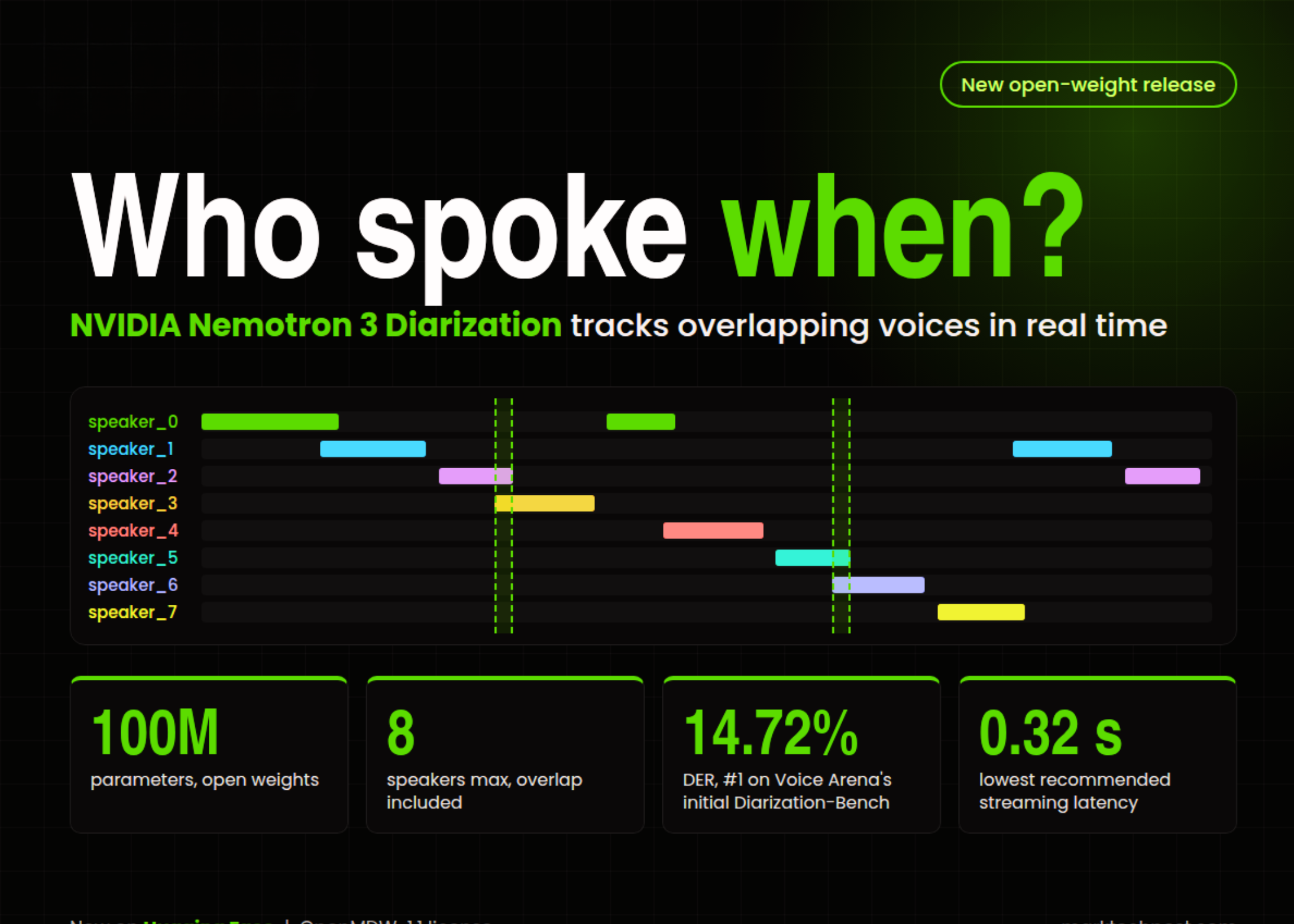
NVIDIA Releases Nemotron 3 Diarization: A 100M-Parameter Open-Weight Model That Tracks 8 Speakers in Real Time
NVIDIA has released Nemotron 3 Diarization, a 100M-parameter open-weight speaker diarization model on Hugging Face that tracks up to 8 speakers in real time, including overlapping speech. A single checkpoint handles both offline and streaming inference, marking a shift from pipeline-based diarization toward unified neural approaches and intensifying competition in speech AI infrastructure.
Key Takeaways
- Key Highlight:NVIDIA has released Nemotron 3 Diarization, a 100M-parameter open-weight speaker diarization model on Hugging Face that tracks up to 8 speakers in real time, including overlapping speech. A single checkpoint handles both offline and streaming inference, marking a shift from pipeline-based diarization toward unified neural approaches and intensifying competition in speech AI infrastructure.
- Innovation & Tech:Highlights advancements in NVIDIA, Releases, Nemotron, demonstrating rapid progress in model capabilities.
- Industry Impact:Reported via MarkTechPost, offering actionable signals for developers and technology leaders.
【Executive Summary & Core Event】
NVIDIA has unveiled Nemotron 3 Diarization, an open-weight speaker diarization model now available on Hugging Face under the Nemotron branding. The model, containing approximately 100 million parameters, is designed to answer a deceptively simple question that has vexed speech processing for decades: who spoke when. Unlike traditional diarization systems that chain together separate voice activity detection, speaker embedding, and clustering modules, Nemotron 3 Diarization appears to consolidate these stages into a unified neural architecture capable of tracking up to eight simultaneous speakers, including scenarios where voices overlap—a notoriously difficult problem in meeting transcription, call center analytics, and broadcast captioning.
The release is notable for several reasons. First, the single-checkpoint design supports both offline batch processing and real-time streaming inference, eliminating the common engineering burden of maintaining separate models for production latency-sensitive versus accuracy-optimized workloads. Second, NVIDIA has chosen open weights on Hugging Face, signaling an intent to seed adoption among developers and researchers rather than gate the model behind an API. Third, the 100M-parameter footprint is remarkably compact compared to contemporary large language models, reflecting the specialized nature of diarization as a sequence-labeling task rather than generative language modeling. This positions Nemotron 3 Diarization as infrastructure-layer technology—something to be embedded inside larger speech pipelines rather than consumed as a standalone product.
【Technical Architecture & Key Innovations】
Speaker diarization has historically been approached through multi-stage pipelines: voice activity detection (VAD) segments speech from silence, an embedding model extracts x-vectors or ECAPA-TDNN embeddings from each segment, and a clustering algorithm such as agglomerative hierarchical clustering or spectral grouping assigns segments to speakers. This pipeline approach, exemplified by NVIDIA's own NeMo framework and open-source projects like pyannote.audio, achieves strong results but suffers from error propagation—mistakes in VAD corrupt embeddings, and clustering struggles with overlapping speech and short turns. Nemotron 3 Diarization represents a paradigm shift toward end-to-end neural diarization, where a single differentiable model ingests raw or filtered audio features and directly outputs speaker-attributed time stamps.
The 100M-parameter scale suggests an architecture likely built on conformer or transformer-encoder backbones operating on mel-spectrogram or filterbank features, possibly with multi-head attention mechanisms trained to discriminate speaker identities through permutation-invariant training (PIT) or end-to-end neural diarization (EEND) objectives. The ability to handle overlapping speech is a strong indicator that the model employs multi-label classification or multi-output heads rather than hard speaker assignment, since overlap requires simultaneous prediction of multiple active speakers per frame. Real-time streaming support implies causal or low-latency attention patterns, possibly with chunked attention or a streaming conformer variant that processes audio in sliding windows while maintaining speaker state across segments. The single-checkpoint duality between offline and streaming modes likely leverages configurable attention masking or a unified training objective that subsumes both contexts.
【Industry Context & Competitive Landscape】
The speaker diarization market sits at the intersection of speech recognition, conversation intelligence, and media processing, with established players including AssemblyAI, Deepgram, Rev.ai, Google Cloud Speech-to-Text, and AWS Transcribe offering diarization as a managed service. Open-source alternatives such as pyannote.audio, SpeechBrain, and Kaldi-derived pipelines have dominated research and self-hosted deployments. NVIDIA's entry with Nemotron 3 Diarization does not directly compete with API providers but rather with the open-source ecosystem and the tooling layer, particularly pyannote.audio, which has become the de facto open-weight diarization standard. By offering a compact, streaming-capable, overlap-aware model under a permissive license, NVIDIA is positioning itself as the hardware-accelerated alternative for enterprises that want to run diarization on-premises without sacrificing real-time performance.
Compared to frontier AI competition, this release is orthogonal to the arms race between OpenAI, Anthropic, Google Gemini, DeepSeek, Meta Llama, and Qwen in large language model capabilities. However, it strengthens NVIDIA's broader strategy of owning the full AI stack—from CUDA and TensorRT inference engines through NeMo training frameworks to domain-specific models like Parakeet ASR, Riva speech services, and now Nemotron 3 Diarization. Where OpenAI and Google offer diarization bundled into Whisper or Gemini transcription APIs, NVIDIA enables competitors to those services by providing the building blocks for independent speech pipelines. This is consistent with NVIDIA's role as an arms merchant in the AI ecosystem rather than a direct application provider.
【Developer & Enterprise Implications】
For developers and enterprises, Nemotron 3 Diarization offers several practical advantages. The open-weight release on Hugging Face means the model can be downloaded, fine-tuned, and deployed without API dependencies or per-minute transcription costs—a significant factor for high-volume call center analytics or media archival processing. The compact 100M-parameter footprint enables deployment on modest GPU hardware, likely a single consumer-grade or entry-level data center GPU, rather than requiring multi-GPU inference infrastructure. Integration with NVIDIA's NeMo framework and Riva runtime should provide optimized TensorRT-LLM or Triton inference server pipelines, though the model's compatibility with standard Hugging Face transformers tooling also supports framework-agnostic adoption.
The real-time streaming capability is the most operationally significant feature. Call centers, live captioning services, and meeting platforms require diarization with sub-second latency, and most open-source diarization systems are batch-only, forcing developers to implement custom streaming approximations or accept high latency. A single checkpoint that handles both modes reduces model management complexity and ensures behavioral consistency between offline training data labeling and live production inference. The eight-speaker limit covers the vast majority of meeting and call scenarios, though broadcast scenarios with larger speaker counts may still require fallback approaches. Enterprises should evaluate the model against domain-specific audio conditions—telephony bandwidth, noisy environments, accented speech—since diarization accuracy is highly sensitive to training data distribution.
【Key Takeaways & Strategic Outlook】
Nemotron 3 Diarization reflects a broader industry trend toward consolidating multi-stage speech processing pipelines into unified neural models, following the same trajectory that transformed automatic speech recognition from hybrid acoustic-language model pipelines into end-to-end transformer systems. The emphasis on overlapping speech and streaming inference indicates that NVIDIA is targeting the hardest remaining problems in diarization, not merely optimizing for clean benchmark conditions. The open-weight strategy is a deliberate move to capture developer mindshare in the speech AI ecosystem, positioning NVIDIA hardware and software as the default platform for enterprises building custom speech infrastructure rather than consuming managed APIs.
Looking forward, expect convergence between diarization models and large language model-based speech systems. As models like GPT-4o and Gemini 2.0 integrate native audio understanding, the boundary between ASR, diarization, and conversational AI will blur. NVIDIA's bet is that specialized, efficient models like Nemotron 3 Diarization will retain advantages in latency, cost, and deployability for production speech pipelines even as multimodal frontier models encroach on these tasks. The next generation will likely see diarization integrated with speaker recognition, emotion detection, and language identification in unified speech foundation models, and NVIDIA's NeMo ecosystem is well-positioned to be a primary training and deployment substrate for that evolution.
This page provides an editorial summary based on publicly available information. It is not a republished article. Use the source link below for the original report.
Industry Insights & Analysis
As artificial intelligence rapidly evolves, breakthroughs surrounding NVIDIA, Releases, Nemotron, Diarization are shifting toward scalable, robust real-world implementations.
Driven by both open-source ecosystems and proprietary model architectures, the integration between compute optimization, data engineering, and agentic workflows is accelerating. This development provides a strategic benchmark for upcoming AI tooling and developer workflows.