Google Releases Gemini 3.8 Flash TTS and Flash-Lite TTS With Prompt-Based Voice Design
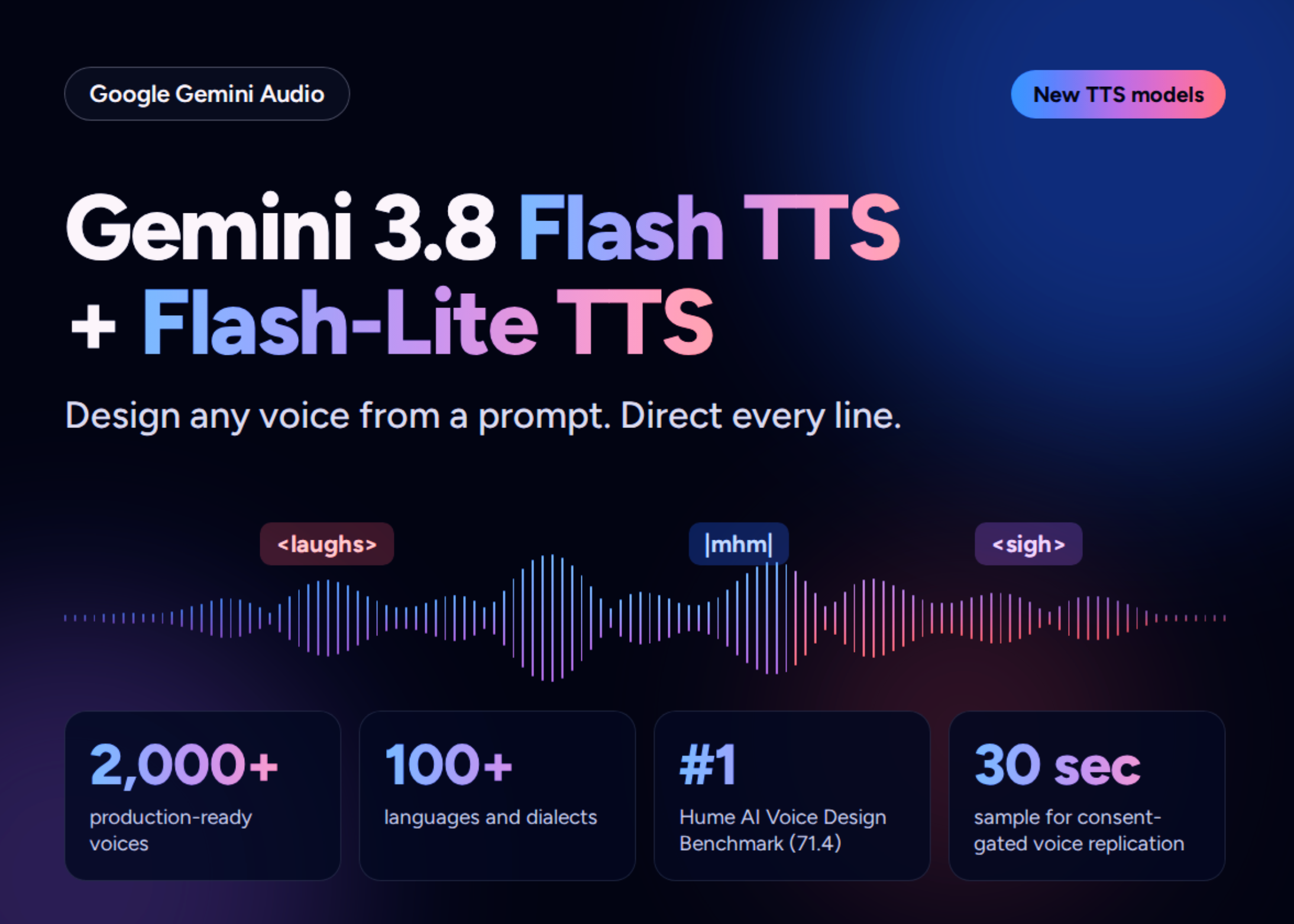
Google has launched Gemini 3.8 Flash TTS and Flash-Lite TTS, two new text-to-speech models accessible via the Gemini API and Google AI Studio. Flash TTS enables prompt-based voice design across 100+ languages and claims the top spot on Hume AI's Voice Design Benchmark, signaling Google's aggressive push into generative speech synthesis.
Key Takeaways
- Key Highlight:Google has launched Gemini 3.8 Flash TTS and Flash-Lite TTS, two new text-to-speech models accessible via the Gemini API and Google AI Studio. Flash TTS enables prompt-based voice design across 100+ languages and claims the top spot on Hume AI's Voice Design Benchmark, signaling Google's aggressive push into generative speech synthesis.
- Innovation & Tech:Highlights advancements in Google, Gemini, API, demonstrating rapid progress in model capabilities.
- Industry Impact:Reported via MarkTechPost, offering actionable signals for developers and technology leaders.
【Executive Summary & Core Event】
Google has officially released Gemini 3.8 Flash TTS and Flash-Lite TTS, two new text-to-speech models that extend the Gemini multimodal family into the speech synthesis domain. The models are now generally available through the Gemini API and Google AI Studio, targeting developers building voice-enabled applications, conversational agents, and accessibility tools. Flash TTS, the higher-capacity variant, introduces prompt-based voice design—a paradigm shift from traditional speaker-locked TTS systems—allowing developers to describe voice characteristics in natural language and generate novel, synthetic voices that match the description. Flash-Lite TTS serves as a lower-latency, cost-optimized variant for high-throughput production workloads.
The release positions Google directly against specialized speech AI providers such as ElevenLabs, Hume AI, and Microsoft Azure Neural TTS, while also complementing Google's existing Cloud TTS offerings. Flash TTS supports over 100 languages, a significant breadth advantage that aligns with Google's global infrastructure footprint. The model's #1 ranking on Hume AI's Voice Design Benchmark—a third-party evaluation framework that scores systems on voice naturalness, expressiveness, and prompt adherence—provides an early signal of competitive quality. However, the benchmark is relatively new and the field is evolving rapidly, so the ranking should be interpreted as a snapshot rather than a definitive verdict. The naming convention ('3.8') suggests these models are built on an intermediate Gemini architecture iteration, likely sharing components with the Gemini 2.5 Flash family but optimized for the audio output modality.
【Technical Architecture & Key Innovations】
Gemini 3.8 Flash TTS represents a departure from conventional concatenative and parametric TTS pipelines, which rely on fixed speaker embeddings and phoneme-to-spectrogram mappings. Instead, the model appears to leverage an end-to-end neural architecture—likely a transformer-based sequence-to-sequence framework—that conditions voice generation on both input text and a natural language voice description prompt. This prompt-conditioning mechanism is conceptually similar to how diffusion models in image generation condition on text, but applied to the audio waveform or mel-spectrogram domain. The architecture likely employs a multi-stream decoder that jointly models linguistic content, prosody (pitch, duration, energy), and timbral characteristics, enabling fine-grained control over the synthesized voice without requiring separate speaker encoder modules.
The Flash-Lite variant likely employs architectural optimizations such as reduced decoder depth, quantized weights, or distillation from the full Flash TTS model to achieve lower inference latency and reduced computational cost. Given Google's stated emphasis on the 'Flash' branding across the Gemini family, these models probably utilize grouped-query attention (GQA) and possibly mixture-of-experts (MoE) routing to maintain quality while reducing active parameter count during inference. The 100+ language support suggests a multilingual training corpus with cross-lingual transfer learning, where shared phonetic representations enable the model to synthesize languages with limited training data. The Voice Design Benchmark performance implies robust zero-shot generalization to novel voice descriptions—a capability that requires the model to have learned a disentangled latent space where voice identity, emotion, and linguistic content can be independently controlled and recombinated.
【Industry Context & Competitive Landscape】
The TTS market has become one of the most fiercely contested segments in generative AI, with ElevenLabs establishing an early lead through its voice cloning and prompt-based voice generation capabilities. Google's entry with Gemini 3.8 Flash TTS directly challenges ElevenLabs' core value proposition—natural language voice design—while leveraging Google's distribution advantages through the Gemini API ecosystem. Microsoft Azure Neural TTS and Amazon Polly remain dominant in enterprise deployments due to their deep integration with cloud platforms, but they have lagged in the prompt-based voice generation paradigm. OpenAI's TTS offering, while capable, remains limited in voice diversity and language coverage. Anthropic has not entered the speech generation space.
Google's competitive strategy here is clear: bundle high-quality TTS into the Gemini API to create a one-stop multimodal platform, reducing the incentive for developers to integrate third-party speech providers. The #1 ranking on Hume AI's Voice Design Benchmark is strategically significant because Hume AI is itself a competitor in the emotional speech space—Google outperforming on a competitor's benchmark carries narrative weight. However, ElevenLabs retains advantages in voice cloning fidelity, a mature developer tooling ecosystem, and a large library of community-contributed voices. Google's 100+ language coverage is a meaningful differentiator against ElevenLabs, which supports approximately 30 languages with varying quality levels. The open-source landscape, including Meta's Voicebox research and Coqui TTS, remains fragmented and lacks production-grade prompt-based voice design capabilities comparable to the proprietary leaders.
【Developer & Enterprise Implications】
For developers, Gemini 3.8 Flash TTS integration is straightforward within the existing Gemini API and Google AI Studio workflow, requiring only an API call with text input and a voice description prompt. This eliminates the need to pre-select speaker IDs or fine-tune models on custom voice data—a significant reduction in integration complexity compared to traditional TTS pipelines. However, production deployment considerations remain: latency-sensitive applications (real-time conversational agents, live narration) will need to evaluate Flash-Lite TTS's actual inference times, which Google has not yet published in detailed benchmarks. Cost is another critical factor—Google's pricing for TTS API calls will determine whether Flash TTS is viable for high-volume workloads such as call center automation or audiobook generation, where per-character costs can accumulate rapidly.
Enterprise adoption will likely hinge on voice consistency and reproducibility—whether the same prompt reliably generates the same voice across sessions, which is essential for brand voice standardization. Google's compliance posture regarding voice generation ethics, including safeguards against deepfake voice misuse, will be scrutinized by enterprise security teams. The models' performance on low-resource languages, prosodic expressiveness for emotional content, and ability to handle domain-specific terminology (medical, legal, technical) will require independent validation. Developers migrating from ElevenLabs or Azure TTS will need to assess whether the quality differential justifies switching costs, including re-engineering audio pipelines and retraining downstream models that consume TTS output. The availability through Google AI Studio lowers the barrier for prototyping, but enterprise-grade SLAs, data residency guarantees, and usage quotas will determine production readiness.
【Key Takeaways & Strategic Outlook】
Google's release of Gemini 3.8 Flash TTS and Flash-Lite TTS marks a significant escalation in the TTS wars, bringing prompt-based voice design to a platform with unmatched distribution reach. The #1 Voice Design Benchmark ranking and 100+ language support position Google as a serious challenger to ElevenLabs' category leadership. The two-tier Flash/Flash-Lite strategy mirrors Google's approach across the Gemini model family—offering quality-optimized and latency-optimized variants to address different deployment scenarios. This release also signals that Google views speech as an integral modality within the Gemini ecosystem rather than a standalone product, reinforcing the platform's multimodal positioning against OpenAI and Anthropic.
Looking forward, the key questions are whether Google can sustain its benchmark lead as competitors iterate, whether the models' real-world quality matches benchmark performance, and whether Google's pricing and enterprise features will attract large-scale production workloads. The prompt-based voice design paradigm is still maturing—expect rapid improvements in emotional expressiveness, voice cloning integration, and real-time streaming capabilities across all providers. For enterprises evaluating TTS strategies, the emergence of a Google-backed option reduces vendor lock-in risk and creates pricing pressure that benefits the entire market. Developers should prototype with both Flash TTS and Flash-Lite TTS to assess quality-latency tradeoffs for their specific use cases, while monitoring Google's roadmap for voice cloning, streaming, and fine-tuning capabilities that would further close the gap with specialized providers.
This page provides an editorial summary based on publicly available information. It is not a republished article. Use the source link below for the original report.
Industry Insights & Analysis
As artificial intelligence rapidly evolves, breakthroughs surrounding Google, Gemini, API, Releases are shifting toward scalable, robust real-world implementations.
Driven by both open-source ecosystems and proprietary model architectures, the integration between compute optimization, data engineering, and agentic workflows is accelerating. This development provides a strategic benchmark for upcoming AI tooling and developer workflows.