A Coding Guide to TypeSafe AI Jev: Typed Decisions, Calibrated Confidence, and Speculative Fan-Out with a System One Model
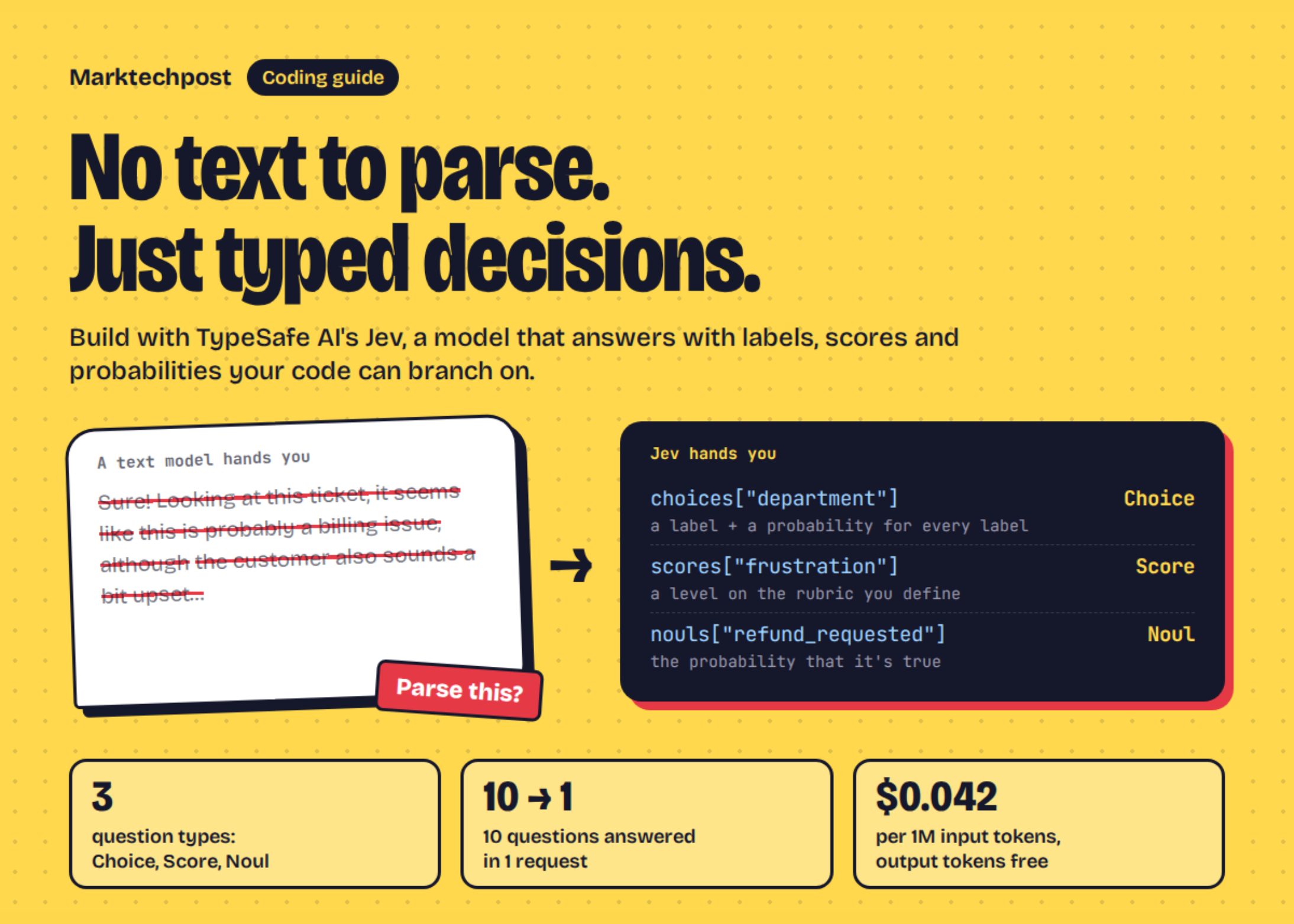
TypeSafe AI's Jev introduces a System One model engineered for non-text, structured judgments rather than conversational text generation. With a Python SDK exposing primitive question types—Choice, Score, and Noul—Jev enables typed decisions, calibrated confidence scoring, and speculative fan-out execution, offering developers a deterministic interface for AI-driven decision pipelines.
Key Takeaways
- Key Highlight:TypeSafe AI's Jev introduces a System One model engineered for non-text, structured judgments rather than conversational text generation. With a Python SDK exposing primitive question types—Choice, Score, and Noul—Jev enables typed decisions, calibrated confidence scoring, and speculative fan-out execution, offering developers a deterministic interface for AI-driven decision pipelines.
- Innovation & Tech:Highlights advancements in Coding, Guide, TypeSafe, demonstrating rapid progress in model capabilities.
- Industry Impact:Reported via MarkTechPost, offering actionable signals for developers and technology leaders.
【Executive Summary & Core Event】
TypeSafe AI's Jev represents a paradigm shift in how machine learning models are conceptualized and deployed in production environments. Unlike mainstream large language models (LLMs) such as OpenAI's GPT-4o, Anthropic's Claude 3.5 Sonnet, or Google's Gemini 1.5 Pro—which are fundamentally autoregressive text generators fine-tuned for instruction following—Jev is purpose-built as a 'System One' model. The nomenclature borrows from Daniel Kahneman's cognitive framework, where System One refers to fast, intuitive, automatic decision-making. In this context, Jev is designed to produce structured, non-text judgments: discrete choices, calibrated scores, and null-indicating outputs (Noul) rather than free-form prose. This architectural intent positions Jev not as a competitor to conversational AI, but as a complementary decision engine for pipelines requiring typed, auditable, and confidence-calibrated outputs.
The core offering centers on a Python SDK that exposes three primitive question types: Choice (selecting from discrete options), Score (producing calibrated numeric evaluations), and Noul (a null-output primitive indicating insufficient signal or abstention). These primitives are composable into complex decision workflows. A standout feature is 'speculative fan-out,' a pattern where the model evaluates multiple decision branches in parallel, with confidence gating determining which branches' results are committed. This mirrors speculative execution in modern CPU architectures, where multiple execution paths are pursued optimistically and reconciled based on validation conditions. The tutorial coverage includes SDK installation, primitive instantiation, confidence threshold configuration, and integration patterns for production decision systems. TypeSafe AI appears to be targeting the gap between raw LLM inference and deterministic business logic, where traditional models produce unstructured text that requires brittle parsing to extract actionable decisions.
【Technical Architecture & Key Innovations】
Jev's architecture deviates fundamentally from transformer-based autoregressive language models. While specific model parameters (parameter count, training corpus, attention mechanism details) are not fully disclosed in the available material, the System One designation implies a model optimized for rapid, bounded judgment tasks rather than token-by-token sequence generation. The three primitive question types—Choice, Score, and Noul—suggest an output space that is fundamentally categorical or ordinal rather than lexical. Choice primitives likely map to a classification head over discrete option sets, Score primitives to a regression or ordinal ranking head producing calibrated probability estimates, and Noul to an explicit abstention mechanism—a critical feature for high-stakes decision pipelines where forced choices produce catastrophic errors. This abstention capability distinguishes Jev from conventional LLMs, which are notoriously reluctant to express uncertainty and often hallucinate confident-sounding answers when evidence is insufficient.
The speculative fan-out mechanism is architecturally significant. In implementation, this likely involves the model evaluating multiple decision paths simultaneously—perhaps through batched inference over candidate branches—and applying confidence thresholds to select which results propagate. This is analogous to speculative decoding in LLM inference (where a smaller draft model proposes tokens validated by a larger verifier), but applied at the decision level rather than the token level. Confidence calibration is the linchpin: for speculative fan-out to function correctly, the model's confidence scores must be well-calibrated—meaning a 0.8 confidence claim corresponds to approximately 80% empirical accuracy. Poor calibration would cause either excessive false commits (under-confidence) or wasted computation (over-confidence). TypeSafe AI's emphasis on 'calibrated confidence' suggests post-training calibration techniques such as temperature scaling, Platt scaling, or isotonic regression applied to raw model logits. The throughput implications are substantial: parallel branch evaluation with confidence-gated commitment enables latency hiding and efficient resource utilization, particularly when integrated with asynchronous execution patterns in the Python SDK.
【Industry Context & Competitive Landscape】
Jev enters a market currently dominated by general-purpose LLMs repurposed for structured output tasks. OpenAI's function calling and structured output APIs, Anthropic's tool use capabilities, and Google's Gemini function calling all represent attempts to bolt structured output onto fundamentally text-generative architectures. Meta's Llama 3.1 and Alibaba's Qwen 2.5, as open-weight models, have been similarly adapted through fine-tuning and constrained decoding. DeepSeek's recent releases have demonstrated strong reasoning capabilities. However, all these approaches share a fundamental tension: they generate text first, then extract structure from that text. This creates failure modes including JSON schema violations, inconsistent option selection, and uncalibrated confidence estimates. Jev's native structured output space eliminates this extraction layer entirely.
The competitive positioning is nuanced. Jev is unlikely to replace GPT-4o or Claude for tasks requiring rich text generation, summarization, or multi-turn dialogue. Instead, it competes in the decision-engine space occupied by traditional ML classifiers, gradient-boosted decision trees, and specialized fine-tuned models. The differentiation lies in flexibility: traditional classifiers require task-specific training data, while Jev's primitive question types suggest a more general-purpose decision interface. The closest analog may be OpenAI's Evals framework or classification fine-tuning, but Jev's emphasis on confidence calibration and speculative execution patterns suggests a more sophisticated production orientation. The market gap TypeSafe AI targets is significant: enterprises deploying AI for automated decision-making (content moderation, fraud detection, routing, triage) currently cobble together LLM APIs, output parsers, retry logic, and confidence estimation heuristics. Jev promises to collapse this stack into a single typed interface. However, adoption barriers include the lack of ecosystem maturity compared to OpenAI's developer tooling, uncertainty about model performance on domain-specific tasks, and the organizational inertia of existing LLM-based pipelines.
【Developer & Enterprise Implications】
From a developer integration perspective, Jev's Python SDK represents a significant simplification over current structured-output workflows. Typical LLM-based decision pipelines require: prompt engineering with output format instructions, JSON schema validation, retry logic for malformed outputs, confidence estimation via logprob analysis or sampling-based methods, and fallback handling. Jev collapses this into typed primitive calls—Choice(options=[...]), Score(...), Noul()—with confidence values returned natively. The speculative fan-out pattern, if exposed through an intuitive API, could enable complex decision trees to be evaluated with automatic parallelism and confidence-based pruning. This would be particularly valuable in latency-sensitive applications like real-time content moderation, dynamic pricing, or autonomous routing where sequential evaluation of decision branches introduces unacceptable delays.
However, practical deployment considerations remain substantial. Hardware requirements and inference costs are not detailed in the available material, but the System One designation suggests a model size optimized for rapid inference rather than maximum capability—potentially enabling on-premise deployment or edge inference. Enterprise integration will depend on SDK maturity, language support beyond Python, observability tooling, and integration with existing data pipelines. The confidence calibration claim requires empirical validation across diverse domains; calibration that holds on benchmark distributions may degrade on production data with distribution shift. Business impact could be significant for organizations currently spending engineering resources on output parsing, retry logic, and confidence estimation infrastructure. If Jev delivers on its promises, the total cost of ownership for AI decision pipelines could decrease substantially through reduced infrastructure complexity and improved reliability. However, organizations will need to evaluate Jev against the alternative of fine-tuning smaller open-weight models (Llama 3.1 8B, Qwen 2.5 7B) on domain-specific decision tasks, which may offer comparable performance with greater control over model behavior and data residency.
【Key Takeaways & Strategic Outlook】
TypeSafe AI's Jev represents a philosophically distinct approach to AI deployment: rather than attempting to make text-generative models produce structured outputs through constraint and parsing, it builds structure into the model's native output space. This mirrors a broader industry trend toward specialization—recognition that general-purpose LLMs, despite their versatility, introduce unnecessary complexity and failure modes for bounded decision tasks. The System One framing is apt: just as human cognition delegates routine judgments to fast, automatic processes, AI infrastructure may evolve to delegate structured decisions to specialized, calibrated models while reserving expensive generative reasoning for tasks that genuinely require it. The speculative fan-out pattern, borrowed from CPU architecture, demonstrates how computational patterns from traditional systems engineering can inform AI inference design.
The strategic outlook depends on several factors. First, empirical validation of calibration quality across diverse domains will determine whether Jev earns trust in high-stakes applications. Second, ecosystem development—observability, evaluation, fine-tuning, and deployment tooling—will determine whether Jev achieves production adoption beyond prototyping. Third, the competitive response from incumbent LLM providers matters: if OpenAI or Anthropic introduces native calibrated confidence scoring and abstention capabilities in their APIs, Jev's differentiation narrows. Nevertheless, the architectural commitment to structured outputs from the ground up—rather than as a post-hoc layer—provides a fundamental advantage that bolt-on solutions may struggle to match. For organizations evaluating AI decision infrastructure, Jev warrants serious consideration as a specialized component within a broader AI stack, particularly for applications where output reliability, confidence calibration, and decision auditability outweigh the need for rich text generation. The next generation of AI infrastructure will likely be heterogeneous—combining System One decision engines, System Two reasoning models, and classical ML—and Jev positions TypeSafe AI as an early mover in this specialized layer.
This page provides an editorial summary based on publicly available information. It is not a republished article. Use the source link below for the original report.
Industry Insights & Analysis
As artificial intelligence rapidly evolves, breakthroughs surrounding Coding, Guide, TypeSafe, AI are shifting toward scalable, robust real-world implementations.
Driven by both open-source ecosystems and proprietary model architectures, the integration between compute optimization, data engineering, and agentic workflows is accelerating. This development provides a strategic benchmark for upcoming AI tooling and developer workflows.