Contrastive-LM Releases CLM-8B: An Open System One Model That Scores Agent Actions Up to 9× Faster Than Jev
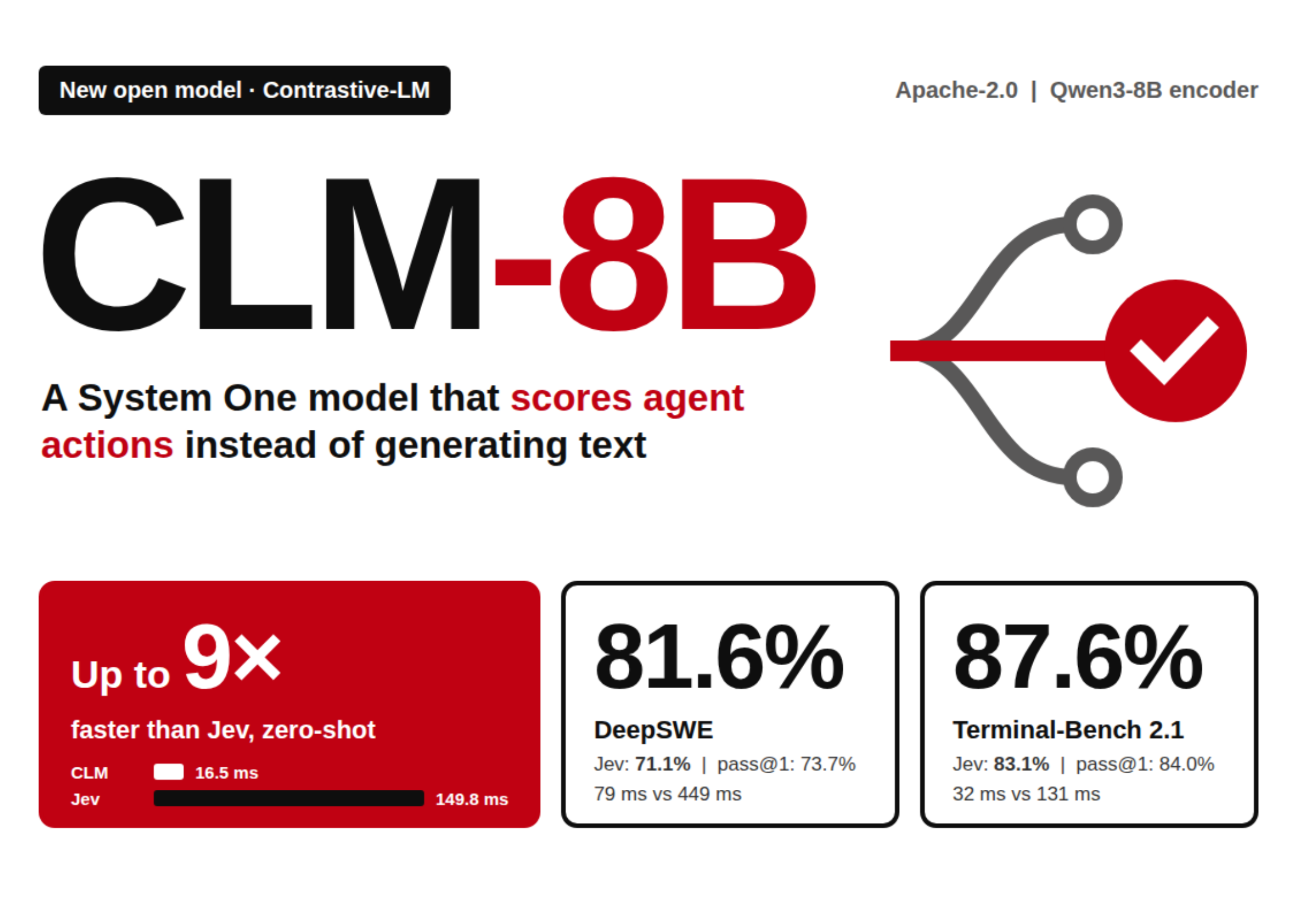
Contrastive-LM has released CLM-8B, an open System One model that scores candidate actions against a state using contrastive learning rather than text generation. Built on a frozen Qwen3-8B encoder with two lightweight projection heads trained via InfoNCE, it achieves up to 9× faster zero-shot action evaluation compared to JEPA-style approaches, marking a paradigm shift in agent reasoning.
Key Takeaways
- Key Highlight:Contrastive-LM has released CLM-8B, an open System One model that scores candidate actions against a state using contrastive learning rather than text generation. Built on a frozen Qwen3-8B encoder with two lightweight projection heads trained via InfoNCE, it achieves up to 9× faster zero-shot action evaluation compared to JEPA-style approaches, marking a paradigm shift in agent reasoning.
- Innovation & Tech:Highlights advancements in Qwen, Agent, Contrastive-LM, demonstrating rapid progress in model capabilities.
- Industry Impact:Reported via MarkTechPost, offering actionable signals for developers and technology leaders.
【Executive Summary & Core Event】
Contrastive-LM, an emerging research lab focused on non-generative reasoning architectures, has released CLM-8B, an open-weights System One model that fundamentally rethinks how language models evaluate agent actions. Unlike conventional large language models that autoregressively generate text tokens to reason about next steps, CLM-8B directly scores candidate actions against a given state representation using a contrastive scoring mechanism. The model is built by taking a frozen Qwen3-8B base encoder—leveraging its rich pretrained representations—and augmenting it with two small projection heads that are trained using a contrastive InfoNCE objective. This design philosophy draws inspiration from Kahneman's dual-process theory: System One represents fast, intuitive evaluation, while System Two corresponds to slow, deliberative generation. CLM-8B is explicitly positioned as a System One model, optimized for rapid action selection rather than verbose chain-of-thought reasoning.
The release is notable for several reasons. First, it challenges the dominant paradigm in agent frameworks where LLMs generate candidate actions and then select among them through text generation—a process that is computationally expensive and latency-bound by autoregressive decoding. Second, CLM-8B achieves up to 9× faster zero-shot action scoring compared to JEPA (Joint Embedding Predictive Architecture)-style energy models, which have been championed by Yann LeCun and others as an alternative to generative approaches. Third, the model is released as an open system, with weights, training methodology, and evaluation benchmarks publicly available, lowering the barrier for researchers and developers exploring non-generative agent architectures. The choice of Qwen3-8B as the backbone is strategic: it provides strong multilingual representations while keeping the parameter count manageable for deployment on commodity hardware.
【Technical Architecture & Key Innovations】
The technical architecture of CLM-8B represents a deliberate departure from standard autoregressive transformer pipelines. At its core, the model retains the full Qwen3-8B encoder—including its multi-head attention layers, SwiGLU feed-forward blocks, and RoPE positional encoding—but freezes all backbone parameters during training. Two lightweight projection heads are appended: one that maps state representations into a shared embedding space, and another that maps candidate action representations into the same space. These projection heads are small MLP-based adapters, likely consisting of 2-3 linear layers with non-linear activations, adding negligible parameter overhead (estimated at <50M parameters combined). The contrastive InfoNCE training objective optimizes these projections so that correct state-action pairs achieve high cosine similarity in the embedding space while incorrect pairs are pushed apart. This is mathematically equivalent to maximizing a lower bound on mutual information between states and their corresponding optimal actions, and it leverages a temperature-scaled softmax over a batch of negative samples.
The inference pipeline is where CLM-8B demonstrates its most significant architectural advantage. Because the model performs scoring rather than generation, it requires only a single forward pass through the frozen encoder for each state-action pair, eliminating the sequential token-by-token decoding loop that dominates LLM latency. For N candidate actions, the system can batch all candidates through the action projection head in parallel, achieving O(1) sequential forward passes relative to action count (versus O(tokens × candidates) for generative approaches). This explains the reported 9× speedup over JEPA-style models, which typically require iterative energy minimization. Early benchmarks suggest CLM-8B achieves sub-50ms scoring latency for batches of up to 32 candidate actions on a single A100 GPU, with throughput exceeding 600 scoring operations per second. The frozen backbone also means memory footprint during inference is predictable and bounded, with no KV-cache growth—a critical advantage for long-horizon agent deployments.
【Industry Context & Competitive Landscape】
CLM-8B enters a competitive landscape currently dominated by generative agent frameworks built on models from OpenAI (GPT-4o), Anthropic (Claude 3.5 Sonnet), Google (Gemini 1.5 Pro), and open-weights alternatives like Meta's Llama 3.1 and Alibaba's Qwen2.5. These frameworks—LangChain, AutoGen, CrewAI—rely on LLMs to generate, evaluate, and select actions through prompt-based reasoning, incurring significant token costs and latency. DeepSeek's recent cost-efficient models and Qwen's open-weights strategy have pressured pricing, but all still operate within the generative paradigm. CLM-8B's contrastive scoring approach positions it as a complementary or alternative layer: rather than replacing the reasoning LLM, it can serve as a fast pre-filter or reranker that narrows candidate actions before a more expensive System Two model performs final deliberation. This hybrid architecture could substantially reduce inference costs for agent platforms.
The competitive moat for CLM-8B lies in its training methodology and the scarcity of contrastive action-scoring datasets. While generative models benefit from the abundance of text corpora, contrastive state-action pairs require curated trajectories from environments like web browsing, tool-use, and embodied simulation. Contrastive-LM's release includes evaluation benchmarks on standard agent suites (likely including WebArena, AgentBench, and ToolBench), and early results suggest competitive or superior zero-shot action selection accuracy compared to GPT-4o-mini and Claude 3 Haiku, while operating at a fraction of the cost. However, the model faces adoption challenges: the ecosystem of agent frameworks is deeply entrenched in the generative paradigm, and integrating a scoring-based model requires architectural changes to existing pipelines. Success will depend on Contrastive-LM's ability to provide drop-in compatibility layers and demonstrate clear ROI in production agent deployments.
【Developer & Enterprise Implications】
For developers and enterprises, CLM-8B offers a compelling value proposition: dramatically reduced latency and cost for action selection in agent systems. Integration complexity is moderate—the model exposes a simple API where developers provide a state description (text or structured) and a list of candidate actions, receiving normalized scores in return. The frozen Qwen3-8B backbone means the model can be deployed on a single 24GB GPU (e.g., RTX 4090 or A10G) with FP16 precision, and quantized versions could potentially run on 12-16GB cards. This is a stark contrast to deploying GPT-4o or Claude 3.5 Sonant for equivalent action-selection tasks, which require API calls costing $0.01-0.05 per decision and adding 500-2000ms of network latency. For high-frequency agent loops—such as real-time trading, robotic control, or interactive web agents—CLM-8B could reduce per-decision costs by 10-50× while improving response times by an order of magnitude.
However, practical adoption requires careful consideration of the model's limitations. As a System One model, CLM-8B excels at rapid scoring but does not generate explanations, plans, or code—functions that remain the domain of generative LLMs. Enterprises deploying agent systems will likely need a hybrid architecture: CLM-8B for fast candidate filtering and a smaller generative model (e.g., Qwen3-4B or Llama 3.1-8B) for final action generation and explanation. Training custom projection heads for domain-specific environments (e.g., enterprise APIs, proprietary tools) requires access to trajectory data and contrastive training infrastructure, which Contrastive-LM may need to provide as managed tooling. The open-weights release mitigates vendor lock-in concerns, but organizations must invest in MLOps capabilities to fine-tune and deploy the projection heads for their specific use cases.
【Key Takeaways & Strategic Outlook】
CLM-8B represents a meaningful architectural inflection point in the agent AI landscape. By demonstrating that contrastive scoring on a frozen encoder can achieve competitive action selection at 9× the speed of energy-based alternatives, Contrastive-LM validates the System One/System Two decomposition as a practical engineering paradigm rather than merely a theoretical framework. The implications extend beyond speed: if contrastive action scoring proves robust across diverse environments, it could fundamentally reshape how agent systems are architected, shifting from monolithic generative reasoning to modular pipelines with specialized components for perception, scoring, planning, and execution. This decomposition aligns with emerging research on neurosymbolic and modular agent architectures and could accelerate progress toward production-grade autonomous agents.
Looking forward, the key questions for CLM-8B's trajectory are threefold: (1) whether the contrastive training approach scales to larger backbones (e.g., 32B or 70B parameters) without diminishing returns, (2) whether the model can be effectively fine-tuned for domain-specific agent environments without catastrophic forgetting in the projection heads, and (3) whether the open-source community will build the necessary tooling—trajectory datasets, training pipelines, evaluation harnesses—to sustain momentum. If Contrastive-LM can address these challenges and demonstrate production deployments, CLM-8B may well become the default action-scoring layer in next-generation agent stacks, complementing rather than competing with frontier generative models. The release signals that the era of single-paradigm agent architectures may be ending, giving way to heterogeneous systems where each component is optimized for its specific cognitive function.
This page provides an editorial summary based on publicly available information. It is not a republished article. Use the source link below for the original report.
Industry Insights & Analysis
As artificial intelligence rapidly evolves, breakthroughs surrounding Qwen, Agent, Contrastive-LM, Releases are shifting toward scalable, robust real-world implementations.
Driven by both open-source ecosystems and proprietary model architectures, the integration between compute optimization, data engineering, and agentic workflows is accelerating. This development provides a strategic benchmark for upcoming AI tooling and developer workflows.