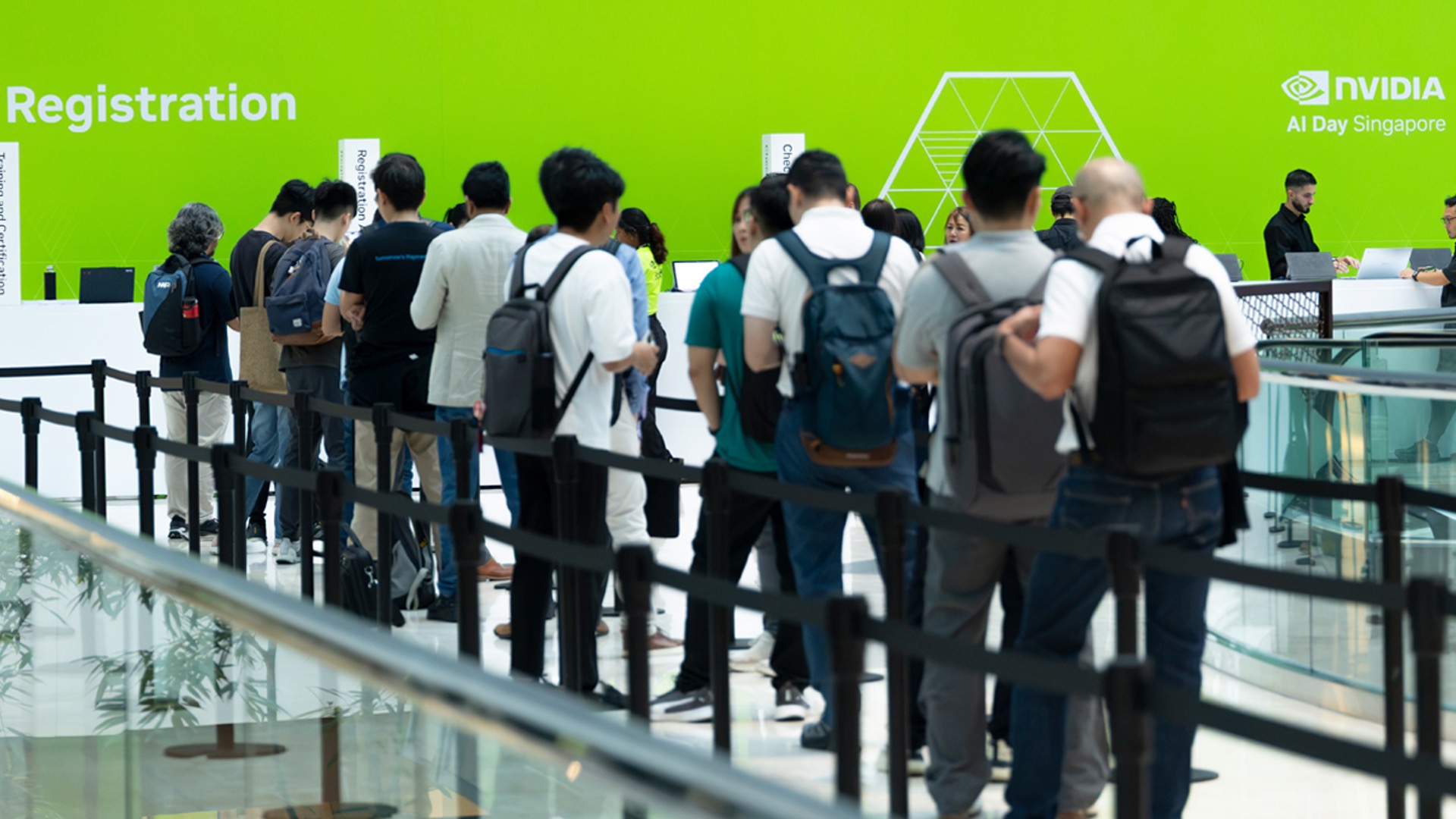
At AI Day Singapore, NVIDIA and Partners Showcase AI Advancements Across Southeast Asia
NVIDIA AI Day Singapore convenes industry leaders, developers, and enterprises across Southeast Asia to explore accelerated computing, generative AI, and HPC advancements. The event highlights NVIDIA's expanding regional partnerships, hands-on training in CUDA and Tensor Core optimization, and deployment of AI infrastructure spanning sovereign AI models, digital twins, and enterprise generative AI applications.
Key Takeaways
- Key Highlight:NVIDIA AI Day Singapore convenes industry leaders, developers, and enterprises across Southeast Asia to explore accelerated computing, generative AI, and HPC advancements. The event highlights NVIDIA's expanding regional partnerships, hands-on training in CUDA and Tensor Core optimization, and deployment of AI infrastructure spanning sovereign AI models, digital twins, and enterprise generative AI applications.
- Innovation & Tech:Highlights advancements in NVIDIA, At, AI, demonstrating rapid progress in model capabilities.
- Industry Impact:Reported via NVIDIA Blog, offering actionable signals for developers and technology leaders.
【Executive Summary & Core Event】
NVIDIA AI Day Singapore, held September 22-23 at the Raffles City Convention Centre, represents a strategic inflection point for AI adoption across Southeast Asia's rapidly digitalizing economies. The two-day event brings together NVIDIA engineers, regional partners, government representatives, and enterprise customers for intensive hands-on training sessions, expert-led technical workshops, and demonstrations of advanced AI tooling. The program is designed to accelerate practical AI deployment across sectors including financial services, healthcare, manufacturing, and public sector infrastructure, with particular emphasis on high-performance computing workloads that leverage NVIDIA's full-stack accelerated computing platform.
The event occurs against a backdrop of surging AI investment across ASEAN nations, where governments and enterprises are racing to build sovereign AI capabilities, establish national compute infrastructure, and develop localized large language models tuned for regional languages and cultural contexts. NVIDIA's partner ecosystem in Southeast Asia has expanded significantly, encompassing cloud service providers, system integrators, independent software vendors, and research institutions. AI Day Singapore serves as both a technical training ground and a showcase for collaborative AI projects already in production, demonstrating real-world deployments of NVIDIA DGX systems, Omniverse digital twins, NeMo model customization frameworks, and Tensor Core-optimized inference pipelines running on H100 and H200 GPU architectures.
【Technical Architecture & Key Innovations】
The technical curriculum at AI Day Singapore centers on NVIDIA's full-stack accelerated computing architecture, spanning silicon through application layers. At the foundation sits the Hopper GPU architecture powering H100 and H200 accelerators, featuring fourth-generation Tensor Cores with native FP8 precision support, transformer engine acceleration, and the NVSwitch fabric enabling all-to-all GPU connectivity at 900GB/s bandwidth. The Transformer Engine dynamically selects between FP8 and FP16 computation per layer, delivering up to 6x speedup for large language model training and inference workloads compared to prior Ampere-based A100 systems. Workshops demonstrate CUDA 12.x optimizations, including dynamic programming APIs, warp-level primitives, and memory coalescing techniques critical for maximizing occupancy on Hopper's 144 streaming multiprocessors.
Above the silicon layer, the event showcases NVIDIA's software stack including NeMo for end-to-end LLM training and customization, TensorRT-LLM for production inference optimization with continuous batching and paged attention, and NIM microservices for containerized model deployment. Technical sessions dive into multi-node distributed training using NCCL collective operations across InfiniBand-connected DGX clusters, with specific attention to Southeast Asia deployment scenarios including tropical climate data center considerations, power grid constraints, and network latency optimization for cross-border AI inference. The Omniverse platform demonstrations highlight OpenUSD-based digital twin pipelines integrating RTX rendering, PhysX simulation, and real-time AI inference for industrial applications. Partners showcase Triton Inference Server deployments handling multi-model serving with dynamic GPU resource allocation, alongside cuOpt routing optimization and RAPIDS data processing frameworks adapted for regional enterprise workloads.
【Industry Context & Competitive Landscape】
NVIDIA's positioning in Southeast Asia differs markedly from competitive dynamics in North America and Europe, where AMD MI300X and Intel Gaudi accelerators have gained limited traction against NVIDIA's entrenched CUDA ecosystem. In ASEAN markets, NVIDIA faces minimal direct GPU competition but contends with cloud-based alternatives as enterprises weigh on-premise DGX investments against managed AI services from AWS, Google Cloud, and Microsoft Azure. The event emphasizes total cost of ownership calculations comparing sovereign AI infrastructure against hyperscaler dependencies, particularly relevant for Singapore, Indonesia, Malaysia, and Thailand where data sovereignty regulations increasingly mandate local processing of sensitive AI workloads. Regional cloud providers including Singtel, NCS Group, and ST Telemedia Global Data Centres showcase NVIDIA-powered AI cloud services positioned between global hyperscalers and pure on-premise deployments.
The competitive landscape extends beyond hardware to encompass AI model ecosystems, where Southeast Asian nations are developing sovereign alternatives to Western frontier models. Singapore's AI Singapore program has deployed SEA-LION, a regionally-tuned LLM trained on NVIDIA infrastructure, while Indonesia's Kominfo supports local model development through partnerships with NVIDIA. These initiatives position NVIDIA as the neutral infrastructure layer beneath sovereign AI strategies, contrasting with the model-level competition between OpenAI's GPT-4, Anthropic's Claude, Google's Gemini, and Meta's Llama family. NVIDIA's partnership strategy effectively makes regional AI independence dependent on NVIDIA hardware, creating durable demand regardless of which model providers dominate specific application layers. DeepSeek and Qwen model adoption in Southeast Asian research communities is also addressed, with sessions on optimizing Chinese-origin open models on NVIDIA infrastructure.
【Developer & Enterprise Implications】
For developers and enterprises attending AI Day Singapore, the practical implications center on reducing the friction between AI experimentation and production deployment. Hands-on labs provide guided experience with NVIDIA AI Enterprise software suite, including NIM microservices that package models in optimized containers deployable on any CUDA-capable infrastructure. This abstraction layer significantly reduces the integration complexity that has plagued enterprise AI adoption, allowing organizations to deploy models like Llama 3.1, Mistral Large, or NVIDIA's Nemotron variants without deep ML engineering expertise. The event workshops address specific deployment patterns relevant to Southeast Asian enterprises: edge AI on NVIDIA Jetson platforms for manufacturing quality inspection, hybrid cloud inference for financial services regulatory compliance, and multi-tenant GPU sharing for cost optimization in resource-constrained environments.
Hardware requirements and deployment costs receive detailed treatment, with sessions comparing DGX H100 cluster investments against HGX server deployments and cloud-based GPU instances. For regional enterprises, the economics often favor a hybrid approach: NVIDIA-certified servers for sustained inference workloads combined with burst capacity from NVIDIA GPU-equipped cloud providers. Power consumption and cooling requirements for H100 and H200 deployments present particular challenges in Southeast Asia's tropical climate, addressed through sessions on liquid-cooled DGX configurations and partnerships with regional data center operators offering purpose-built AI infrastructure. The business impact case studies demonstrate ROI timelines ranging from 6-18 months for high-frequency use cases like fraud detection and customer service automation, with longer payback periods for scientific computing and digital twin applications requiring significant domain expertise alongside GPU infrastructure.
【Key Takeaways & Strategic Outlook】
NVIDIA AI Day Singapore crystallizes several strategic dynamics shaping the AI landscape in Southeast Asia. First, NVIDIA's full-stack approach—from CUDA silicon optimization through NIM deployment containers—creates ecosystem lock-in that competitors will struggle to disrupt, particularly in emerging markets where CUDA expertise is still accumulating. Second, sovereign AI initiatives across ASEAN nations are accelerating demand for on-premise and regionally-hosted GPU infrastructure, positioning NVIDIA as essential infrastructure rather than optional acceleration. Third, the gap between AI experimentation and production deployment remains the primary bottleneck for enterprise value realization, making NVIDIA's investment in deployment tooling like NIM and Triton strategically critical for market expansion beyond early adopters.
Looking forward, the evolution of next-generation Blackwell GPU architecture, with its 208 billion transistor B200 chips delivering 20 petaflops of FP4 performance, will dramatically reshape the economics of large-scale AI training and inference in Southeast Asia. The convergence of sovereign AI mandates, regional language model development, and industrial digital twin adoption creates sustained multi-year demand for NVIDIA's platform. However, risks include potential supply chain constraints for next-generation GPUs, increasing regulatory scrutiny of AI compute concentration, and the possibility that simplified AI deployment tools could reduce the differentiation of CUDA expertise. For enterprises and developers in Southeast Asia, the strategic imperative is clear: building deep NVIDIA platform expertise now creates durable competitive advantage as AI capabilities become foundational infrastructure across all industries in the region.
This page provides an editorial summary based on publicly available information. It is not a republished article. Use the source link below for the original report.
Industry Insights & Analysis
As artificial intelligence rapidly evolves, breakthroughs surrounding NVIDIA, At, AI, Day are shifting toward scalable, robust real-world implementations.
Driven by both open-source ecosystems and proprietary model architectures, the integration between compute optimization, data engineering, and agentic workflows is accelerating. This development provides a strategic benchmark for upcoming AI tooling and developer workflows.