OpenAI Releases GPT-6 Sol and Luna: 50% Cheaper API Pricing and Benchmarks
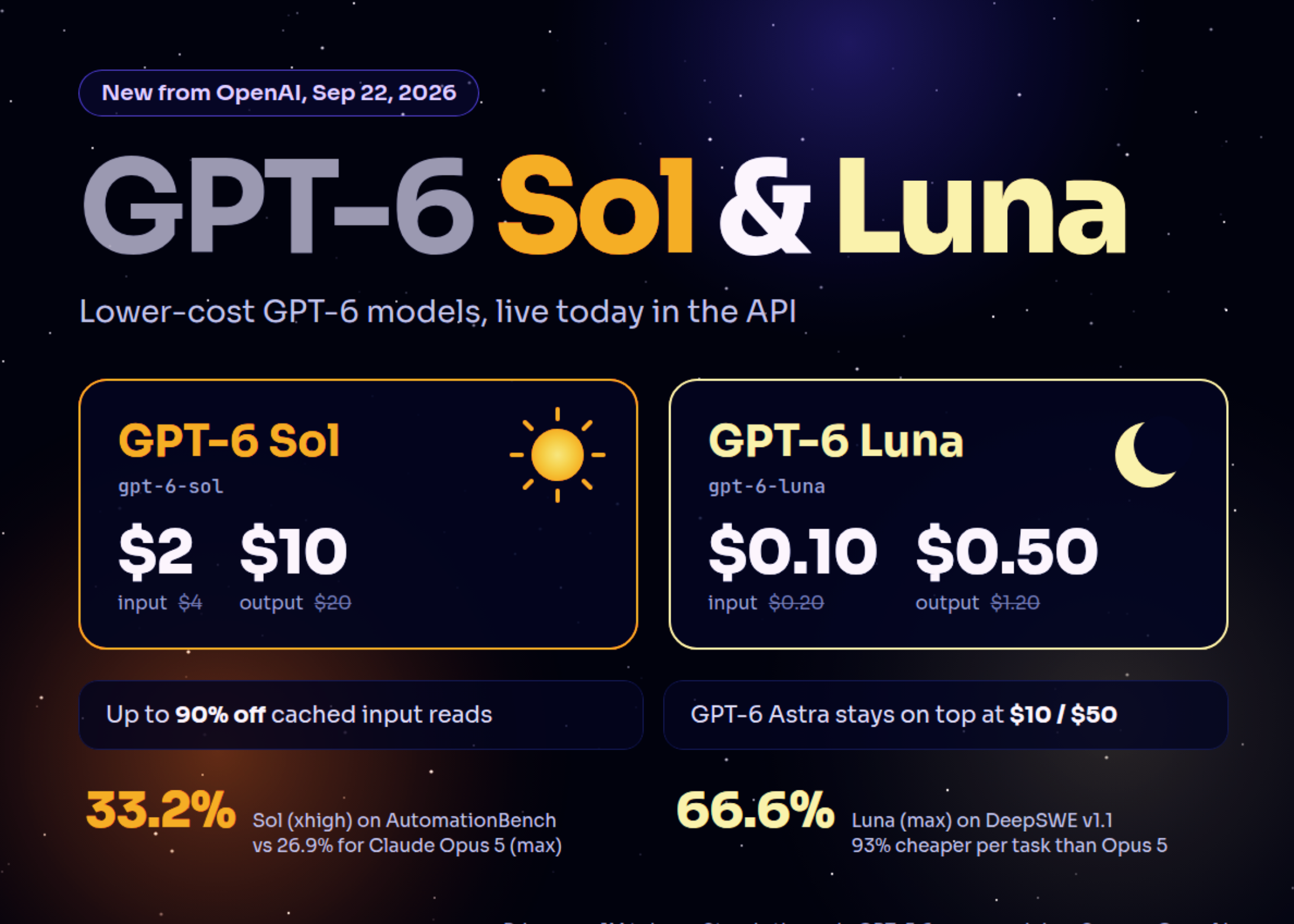
OpenAI has launched GPT-6 Sol and GPT-6 Luna, two cost-efficient variants trained using methodologies akin to GPT-6 Astra. Sol is priced at $2/$10 and Luna at $0.10/$0.50 per 1M tokens, making them among the cheapest frontier-tier models available. Both are accessible via API, ChatGPT Work, and Codex, featuring enhanced prompt caching for long-running agentic workflows.
Key Takeaways
- Key Highlight:OpenAI has launched GPT-6 Sol and GPT-6 Luna, two cost-efficient variants trained using methodologies akin to GPT-6 Astra. Sol is priced at $2/$10 and Luna at $0.10/$0.50 per 1M tokens, making them among the cheapest frontier-tier models available. Both are accessible via API, ChatGPT Work, and Codex, featuring enhanced prompt caching for long-running agentic workflows.
- Innovation & Tech:Highlights advancements in OpenAI, GPT, API, demonstrating rapid progress in model capabilities.
- Industry Impact:Reported via MarkTechPost, offering actionable signals for developers and technology leaders.
【Executive Summary & Core Event】
OpenAI has formally released GPT-6 Sol and GPT-6 Luna, two new lower-cost language models that extend the GPT-6 family beyond the flagship GPT-6 Astra released earlier this cycle. The announcement, surfaced through MarkTechPost and corroborated by OpenAI's developer documentation, positions Sol and Luna as tiered offerings targeting different segments of the API economy—Sol as a mid-tier workhorse for production-grade reasoning and Luna as an ultra-low-cost model optimized for high-volume, latency-sensitive workloads. Sol is priced at $2 per 1M input tokens and $10 per 1M output tokens, while Luna dramatically undercuts the market at $0.10 per 1M input and $0.50 per 1M output, a price point that places it in direct competition with lightweight models like Google's Gemini Flash and DeepSeek's distilled offerings.
According to the release details, both Sol and Luna were trained using methodologies similar to GPT-6 Astra, suggesting a shared foundational training pipeline—likely involving large-scale pretraining on curated multimodal corpora, reinforcement learning from human feedback (RLHF), and possibly reinforcement learning from verifiable rewards (RLVR) for structured tasks. The key differentiator appears to be model capacity and distillation rather than architectural divergence. Both models are immediately available across three surfaces: the public API, ChatGPT Work (OpenAI's enterprise productivity tier), and Codex (the code-generation platform). Critically, both ship with improved prompt caching mechanisms designed to reduce costs for long-running agentic applications—a signal that OpenAI is explicitly targeting the emerging agent orchestration market where context persistence and multi-turn reasoning dominate token consumption.
The strategic intent is clear: OpenAI is building a vertically tiered model portfolio that captures the full spectrum of developer needs—from ultra-cheap inference at the Luna tier to premium reasoning at the Astra tier—while maintaining a unified API surface. This mirrors the playbook successfully executed by Anthropic with Claude Haiku/Sonnet/Opus and Google with Gemini Flash/Pro. The inclusion of Codex integration suggests Sol and Luna are also being positioned as coding assistants, not just general-purpose chat models, which expands their addressable market into developer tooling and automated software engineering pipelines.
【Technical Architecture & Key Innovations】
While OpenAI has not disclosed full architectural specifications for Sol and Luna, the statement that they were trained using methods similar to GPT-6 Astra provides meaningful signal. GPT-6 Astra is widely understood to employ a mixture-of-experts (MoE) architecture with sparse expert routing, enabling high parameter counts with controlled activation during inference. Sol and Luna likely represent either smaller-scale MoE configurations or distilled dense variants trained through knowledge distillation from the Astra model. Distillation would explain the aggressive pricing: a smaller model inheriting Astra's reasoning capabilities through teacher-student training can achieve competitive benchmark performance at a fraction of the inference compute cost.
The improved prompt caching mechanism is architecturally significant. Prompt caching—where the key-value (KV) cache from prior context is persisted and reused across sequential API calls—has become a critical optimization for agentic workflows. OpenAI's enhancement likely involves more granular cache segmentation, allowing partial context reuse even when prompts are modified between turns. This reduces redundant prefill computation, which is typically the dominant cost in long-context inference. For Luna at $0.10/1M input tokens, effective caching could push real-world costs even lower, making sustained multi-turn agent loops economically viable at scale—a capability that directly addresses one of the primary bottlenecks in production agent deployments.
On benchmarks, the release references improved performance but specific comparative scores against GPT-6 Astra, Claude 4.5, or Gemini 3 Ultra were not detailed in the available lead. However, given the pricing tier, Sol is positioned to compete with Claude Sonnet-class models on reasoning-intensive tasks, while Luna targets the Flash/Lite tier for classification, summarization, and lightweight extraction. The latency profile for Luna is likely optimized for sub-second first-token response, given its target use case in high-throughput pipelines. Both models presumably support the same context window as Astra—potentially 1M+ tokens—though this awaits confirmation from full technical documentation.
【Industry Context & Competitive Landscape】
The pricing of Sol and Luna represents a significant escalation in the ongoing API price war. Luna's $0.10/$0.50 per 1M tokens is aggressively competitive with Google's Gemini 2.5 Flash ($0.075/$0.30) and DeepSeek V3 ($0.07/$0.28 for cached input), positioning OpenAI to reclaim market share in the high-volume inference segment where cost-per-token is the primary selection criterion. Sol's $2/$10 pricing slots directly against Anthropic's Claude Sonnet 4 ($3/$15) and Google's Gemini 2.5 Pro ($1.25/$10), offering a potentially superior value proposition if benchmark performance is comparable. This tiered pricing strategy effectively walls off competitors from the mid-market while maintaining Astra as the premium reasoning flagship.
The competitive landscape is intensifying on multiple fronts. Anthropic has been gaining enterprise traction with Claude's strong coding and reasoning performance, while DeepSeek's open-weight models have captured significant developer mindshare among cost-sensitive deployments. Meta's Llama 4 and Alibaba's Qwen 3 continue to pressure the open-source frontier. By launching Sol and Luna, OpenAI is signaling that it will not cede the low-cost tier to competitors—instead leveraging its infrastructure scale and model distillation pipeline to offer frontier-adjacent quality at commodity prices. The Codex integration is particularly strategic: it directly challenges GitHub Copilot's enterprise coding market and Anthropic's Claude Code, embedding Sol and Luna into developer workflows where switching costs are high once integrated.
The improved prompt caching feature also has competitive implications. Anthropic introduced prompt caching for Claude in mid-2024 with significant cost reductions, and Google has implemented similar optimizations for Gemini. OpenAI's enhancement suggests it is closing a gap where competitors had a structural advantage in agentic workloads. For the broader industry, this release will likely trigger another round of price adjustments—DeepSeek and Google may respond with further reductions, while Anthropic may need to reconsider its Sonnet pricing tier. The net effect is accelerating commoditization of mid-tier inference, pushing the competitive frontier toward specialized capabilities: multimodal reasoning, tool use, and autonomous agent reliability.
【Developer & Enterprise Implications】
For developers, the immediate impact of Sol and Luna is straightforward cost reduction with minimal integration friction. Both models are accessible through the existing OpenAI API surface, meaning migration from GPT-4o or GPT-6 Astra requires only a model name change in most implementations. The API compatibility extends to function calling, structured outputs, and tool use—features that are now table stakes for production deployments. Sol is the natural choice for applications requiring robust reasoning—customer support agents, code generation, document analysis—where the quality gap with Astra is acceptable given the 5-10x cost reduction. Luna is optimized for high-volume, low-complexity tasks: content moderation, classification, routing, summarization, and bulk data extraction where throughput matters more than deep reasoning.
The enhanced prompt caching has direct implications for agent architecture. Developers building multi-step agents with OpenAI's Assistants API or custom orchestration frameworks can now maintain persistent context across longer interaction sequences without incurring proportional prefill costs. This is particularly impactful for coding agents in Codex, where repository context and conversation history can be cached and reused across iterative code generation cycles. For enterprises, the ChatGPT Work integration means Sol and Luna are immediately available to internal teams without API development—lowering the barrier to deployment for non-technical business units. The total cost of ownership for AI-powered internal tools drops substantially, potentially enabling use cases that were previously cost-prohibitive at Astra pricing.
On hardware and deployment, both models are served through OpenAI's managed infrastructure, eliminating the need for organizations to provision GPU capacity. This is a critical advantage over open-weight alternatives like Llama or DeepSeek, which require significant capital expenditure for self-hosted inference at scale. However, organizations with strict data residency requirements or those needing on-premise deployment will still need to rely on open-source models. The trade-off is clear: Sol and Luna offer frontier-adjacent quality and zero infrastructure overhead at historically low prices, but with the vendor lock-in and data processing considerations inherent to any managed API service.
【Key Takeaways & Strategic Outlook】
The release of GPT-6 Sol and Luna marks a pivotal moment in the commercial maturation of large language models. OpenAI is executing a classic platform strategy: dominate the full pricing spectrum from ultra-low-cost (Luna) to premium reasoning (Astra), making it economically irrational for most developers to build on competing platforms unless they require open-weight deployment or specialized capabilities. The pricing pressure will force competitors—particularly Anthropic and Google—to respond, likely accelerating the broader trend toward sub-$1 per 1M token inference for mid-tier models within the next 6-12 months.
The enhanced prompt caching and Codex integration signal that OpenAI's next competitive frontier is not raw model quality but agentic workflow economics. As AI applications shift from single-turn chat to multi-step autonomous agents, the cost of sustained context management becomes the dominant expense. By optimizing for this workload pattern, OpenAI is positioning Sol and Luna as the default infrastructure for the agent era. Developers and enterprises should evaluate Sol as an immediate drop-in replacement for current GPT-4o or Claude Sonnet workloads, while Luna warrants pilot testing for high-volume classification and extraction pipelines. The strategic outlook is clear: model differentiation is shifting from benchmark scores to total cost of ownership, and OpenAI is leveraging its scale to set the terms of that transition.
This page provides an editorial summary based on publicly available information. It is not a republished article. Use the source link below for the original report.
Industry Insights & Analysis
As artificial intelligence rapidly evolves, breakthroughs surrounding OpenAI, GPT, API, Releases are shifting toward scalable, robust real-world implementations.
Driven by both open-source ecosystems and proprietary model architectures, the integration between compute optimization, data engineering, and agentic workflows is accelerating. This development provides a strategic benchmark for upcoming AI tooling and developer workflows.