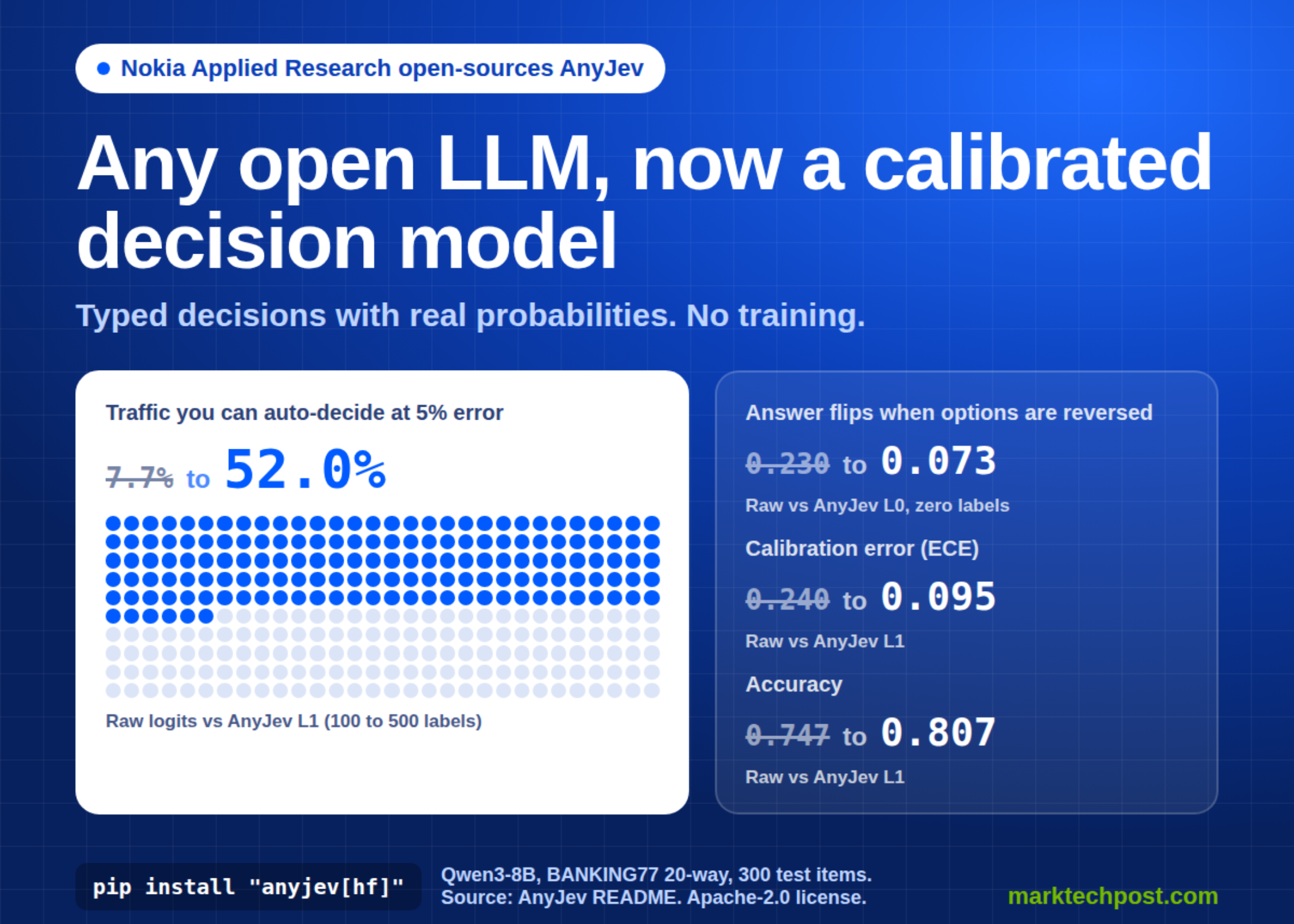
Nokia Open-Sources AnyJev: A Training-Free Layer That Turns Any Open LLM Into a Calibrated Decision Model
Nokia's applied research division has open-sourced AnyJev, a training-free Python library that transforms any open LLM into a calibrated decision model capable of selecting from fixed answer sets. By eliminating fine-tuning while adding probabilistic calibration, AnyJev bridges generative and discriminative AI for production classification tasks at reduced cost and complexity.
Key Takeaways
- Key Highlight:Nokia's applied research division has open-sourced AnyJev, a training-free Python library that transforms any open LLM into a calibrated decision model capable of selecting from fixed answer sets. By eliminating fine-tuning while adding probabilistic calibration, AnyJev bridges generative and discriminative AI for production classification tasks at reduced cost and complexity.
- Innovation & Tech:Highlights advancements in Nokia, Open-Sources, AnyJev, demonstrating rapid progress in model capabilities.
- Industry Impact:Reported via MarkTechPost, offering actionable signals for developers and technology leaders.
【Executive Summary & Core Event】
Nokia's applied research team has released AnyJev as an open-source Python library designed to address a persistent production challenge in large language model deployment: converting free-form text generation into reliable, calibrated decision-making over a fixed set of options. Rather than requiring organizations to fine-tune models for classification tasks or rely on brittle prompt engineering, AnyJev operates as a post-hoc layer that wraps any open-weight LLM and exposes a decision-model interface. The library targets scenarios where the model must pick one answer from a constrained set—classification, routing, triage, intent detection, and multiple-choice reasoning—rather than producing open-ended prose. This is a fundamentally different operating mode from standard LLM generation, and it reflects a growing industry recognition that many enterprise AI workloads are decision problems dressed in language clothing.
The release is notable for several reasons. First, it comes from Nokia, a telecommunications and networking infrastructure company whose applied research arm has historically contributed to signal processing, network optimization, and information theory rather than frontier AI model development. The fact that Nokia is investing in open-source AI tooling signals that large industrial players see decision-layer infrastructure as strategically important for their own AI deployments—likely in network management, customer support automation, and operational triage. Second, AnyJev is explicitly training-free, meaning it requires no gradient updates, no labeled training data in the traditional sense, and no additional GPU compute beyond what the base LLM already consumes. Third, the library is designed to be calibration-aware, producing not just a selected answer but a calibrated probability distribution over the candidate set, which is critical for downstream systems that need to know when to defer to human review or escalate uncertainty.
【Technical Architecture & Key Innovations】
AnyJev's core technical innovation lies in its training-free calibration mechanism. Rather than fine-tuning model weights to produce calibrated probabilities, the library likely extracts the logits or token-level probabilities that the base LLM assigns to each candidate answer when presented in a structured prompt, then applies a calibration transformation to map these raw scores into a proper probability distribution. This approach draws on established statistical techniques—Platt scaling, isotonic regression, temperature scaling, and beta calibration—that have been used in classical machine learning to correct the overconfidence of discriminative classifiers. The key insight is that LLMs, despite being generative models trained on next-token prediction, already encode rich information about the relative likelihood of different answers. AnyJev surfaces and refines this information without modifying the underlying model. The library likely supports multiple calibration strategies and allows developers to select the one best suited to their distribution characteristics.
The architecture is model-agnostic by design, meaning it can wrap any open-weight LLM—Meta's Llama family, Mistral's models, Alibaba's Qwen, DeepSeek's reasoning models, or smaller specialized models like Phi. This is achieved through a standardized interface that abstracts away the specifics of each model's tokenizer and generation pipeline, presenting a uniform decision-model API regardless of the backend. The library likely handles the mechanics of presenting candidate answers to the model in a format that elicits comparable logit scores—potentially using techniques like logit biasing, constrained decoding, or scoring each candidate via separate forward passes and comparing the resulting likelihoods. For production deployment, AnyJev would need to manage batching efficiently to keep latency acceptable, since scoring multiple candidates per query multiplies the computational cost. The training-free nature also means calibration quality depends on the base model's inherent representations, so performance will vary across model families and sizes, with larger models generally offering better-calibrated raw scores due to their more comprehensive pretraining.
【Industry Context & Competitive Landscape】
AnyJev enters a competitive landscape where several approaches vie for the decision-model workload. OpenAI's structured outputs and function calling features address similar needs but are proprietary, tied to OpenAI's API, and require payment per token. Anthropic's Claude offers classification through tool use and structured responses, but again within a closed ecosystem. Google's Gemini provides similar capabilities. On the open-source side, approaches like logits-based classification, LM-Format-Enforcer, and Outlines offer constrained generation, but these focus on format compliance rather than calibration. AnyJev differentiates itself by combining decision selection with explicit probability calibration, which is a gap in most existing tooling. The library competes most directly with lightweight fine-tuning approaches—LoRA adapters trained on classification data—but eliminates the need for training data collection, GPU training infrastructure, and adapter management.
The strategic positioning is interesting. By making AnyJev open-source, Nokia is not attempting to build a model business or compete with frontier labs. Instead, it is contributing infrastructure that makes open LLMs more viable for enterprise decision workloads—workloads that currently default to OpenAI or Anthropic APIs because of their reliability and ease of use. If AnyJev can deliver calibrated decision-making with open models at a fraction of the API cost, it strengthens the business case for self-hosted LLM deployments. This aligns with broader industry trends: DeepSeek's cost-efficient reasoning models, Meta's open-weight Llama releases, and the growing ecosystem of inference optimization tools (vLLM, TensorRT-LLM, SGLang) are collectively making self-hosted AI increasingly competitive. AnyJev adds a missing piece—calibrated decision layers—that makes open models more drop-in replaceable for production classification pipelines.
【Developer & Enterprise Implications】
For developers and enterprises, AnyJev's appeal centers on deployment simplicity and cost reduction. The library installs as a standard Python package and wraps existing LLM inference pipelines, meaning teams already running open models via vLLM, Hugging Face Transformers, or similar frameworks can integrate it with minimal code changes. The training-free design eliminates the need for labeled datasets, GPU training clusters, MLOps pipelines for fine-tuning, and the associated iteration cycles. For organizations that have already deployed an open LLM for generation tasks, adding decision-model capability becomes a software update rather than a model engineering project. This is particularly valuable for smaller teams and organizations that lack dedicated ML engineering resources but need reliable classification from their language models. The calibration output—proper probability distributions rather than raw scores—enables downstream systems to implement confidence-based routing, human-in-the-loop escalation, and risk-aware decision policies.
However, practical deployment considerations remain. Since AnyJev scores multiple candidate answers per query, latency and throughput implications must be managed. For a decision over N candidates, the library may require N forward passes or a single batched pass, and the computational cost scales with the candidate set size. Teams will need to optimize batching, potentially using continuous batching frameworks, to keep response times acceptable for real-time applications. Hardware requirements are essentially those of the base LLM—a GPU with sufficient memory for the model and KV cache—but the multiplier effect of candidate scoring means throughput planning must account for the decision workload, not just single-query generation. Cost-wise, self-hosted decision models using AnyJev can be significantly cheaper than per-token API calls to proprietary services, especially at high volume, but the total cost of ownership includes GPU infrastructure, model serving, monitoring, and the engineering effort to maintain the stack. For high-volume classification workloads—customer support routing, content moderation, intent detection—the economics likely favor AnyJev with open models.
【Key Takeaways & Strategic Outlook】
AnyJev represents a meaningful contribution to the open-source AI infrastructure stack. By addressing the calibration gap—the problem that LLMs produce overconfident or poorly scaled probability estimates—it tackles one of the key barriers to using open language models in production decision systems. The training-free approach is strategically significant: it lowers the adoption barrier to near zero for organizations already running open LLMs, and it avoids the data and compute overhead of fine-tuning. As open models continue to close the quality gap with frontier proprietary models, tools like AnyJev that make those models production-ready for specific workloads become increasingly valuable. The release also signals that industrial AI consumers—telecom, manufacturing, logistics—are building and sharing the middleware they need, rather than waiting for AI labs to address every deployment scenario.
Looking forward, the evolution of training-free decision layers will likely track several trajectories. First, as reasoning models like DeepSeek-R1 and OpenAI's o1-series become more prevalent, AnyJev-style calibration will need to account for chain-of-thought reasoning traces, where the decision probability depends on intermediate steps rather than a single forward pass. Second, integration with structured output frameworks—JSON schema enforcement, grammar-constrained decoding—will make AnyJev more powerful for complex decision tasks. Third, the library's calibration quality will benefit from advances in uncertainty quantification for LLMs, including techniques like conformal prediction and ensemble-based approaches. The broader trend is clear: the open-source AI ecosystem is maturing beyond model weights toward the full middleware stack—inference, calibration, evaluation, and deployment tooling—that enterprises need. AnyJev is a small but important piece of that maturation, and its adoption will be worth watching as a signal of how quickly open LLMs can capture production decision workloads from proprietary APIs.
This page provides an editorial summary based on publicly available information. It is not a republished article. Use the source link below for the original report.
Industry Insights & Analysis
As artificial intelligence rapidly evolves, breakthroughs surrounding Nokia, Open-Sources, AnyJev, Training-Free are shifting toward scalable, robust real-world implementations.
Driven by both open-source ecosystems and proprietary model architectures, the integration between compute optimization, data engineering, and agentic workflows is accelerating. This development provides a strategic benchmark for upcoming AI tooling and developer workflows.