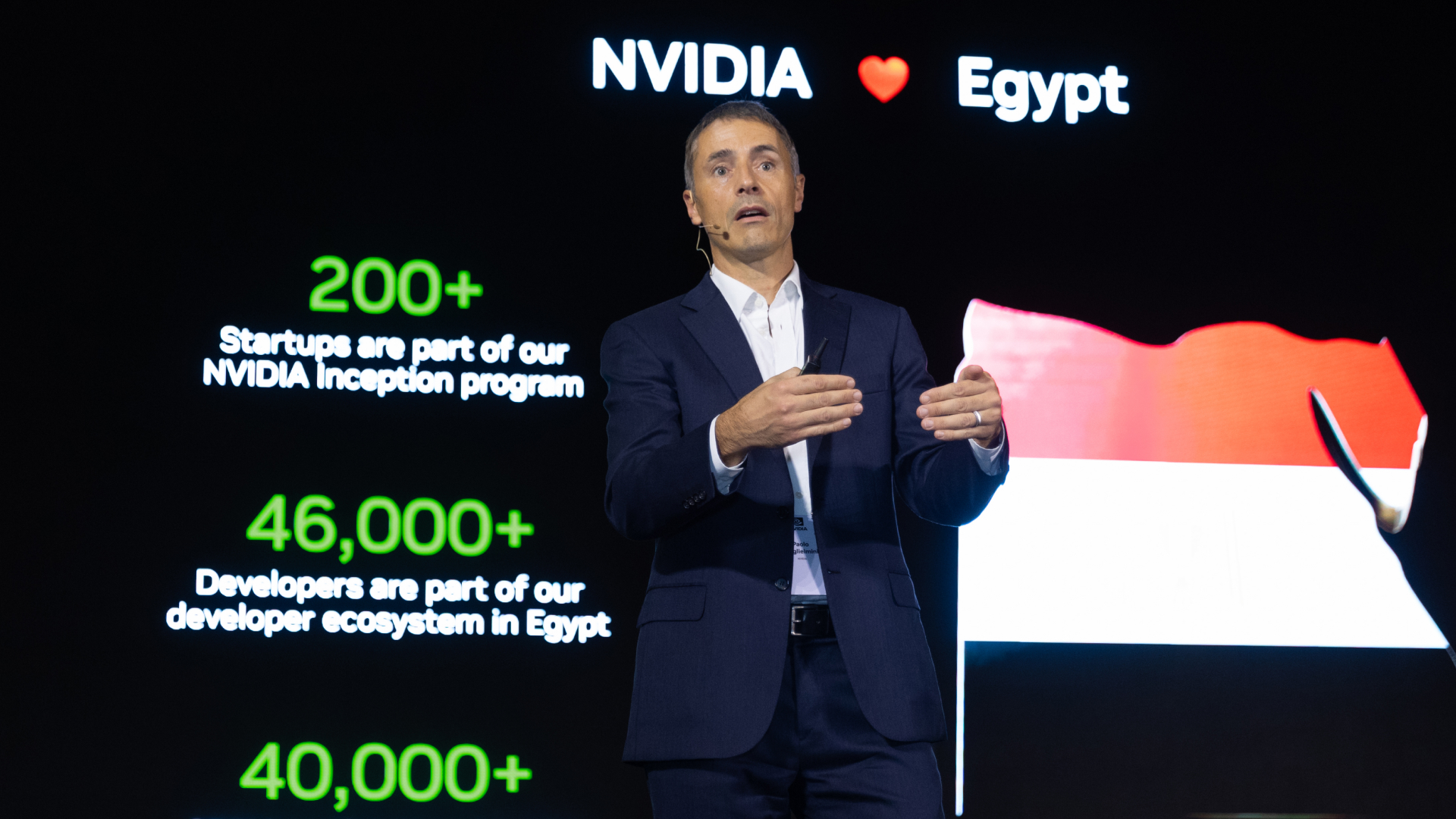
From Enablement to Execution, Egypt’s AI Ecosystem Reaches Production Scale
Egypt's AI ecosystem has reached production scale, with NVIDIA hosting a landmark event at the Grand Egyptian Museum that convened AI natives, developers, researchers, startups and enterprises. The gathering signals Egypt's transition from AI enablement to execution, leveraging NVIDIA's accelerated computing stack to build domain-specific applications across industries.
Key Takeaways
- Key Highlight:Egypt's AI ecosystem has reached production scale, with NVIDIA hosting a landmark event at the Grand Egyptian Museum that convened AI natives, developers, researchers, startups and enterprises. The gathering signals Egypt's transition from AI enablement to execution, leveraging NVIDIA's accelerated computing stack to build domain-specific applications across industries.
- Innovation & Tech:Highlights advancements in NVIDIA, From, Enablement, demonstrating rapid progress in model capabilities.
- Industry Impact:Reported via NVIDIA Blog, offering actionable signals for developers and technology leaders.
【Executive Summary & Core Event】
The Grand Egyptian Museum reception, hosted by NVIDIA, marked a pivotal inflection point for Egypt's artificial intelligence trajectory — transitioning from capacity-building and academic enablement to production-scale deployment across enterprise and startup environments. The event convened the full spectrum of Egypt's AI value chain: AI-native startups, enterprise developers, academic researchers, and industry vertical leaders building applications spanning financial services, healthcare, agriculture, logistics, and public sector modernization. NVIDIA's presence underscores a strategic bet on Egypt as a North African AI hub, leveraging the nation's large technical workforce, government-backed digital transformation initiatives, and growing cloud infrastructure partnerships. The gathering also served as a catalyst for ecosystem densification — connecting GPU compute providers, MLOps tooling vendors, and domain experts into operational clusters rather than isolated proof-of-concept teams.
Egypt's AI journey has been years in formation, anchored by the National AI Strategy launched in 2019 and reinforced by the establishment of the National Council for Artificial Intelligence. The strategy targets six pillars: governance, technology, infrastructure, data, ethics, and international cooperation. NVIDIA's engagement aligns with these pillars by providing the accelerated computing substrate — CUDA-enabled GPUs, Tensor Core architectures, and the NVIDIA AI Enterprise software stack — that Egyptian organizations need to train and deploy large models at scale. The event highlighted concrete production deployments rather than research demos, signaling that Egyptian enterprises have crossed the chasm from experimentation to operationalized ML pipelines serving real users and business workflows. Key participants included representatives from Cairo University, the Information Technology Industry Development Agency, and a cohort of Series A and B-stage AI startups building vertical applications for Arabic-language NLP, computer vision for industrial inspection, and predictive analytics for energy grid management.
【Technical Architecture & Key Innovations】
The technical backbone of Egypt's AI production scale rests on NVIDIA's full-stack accelerated computing architecture, which provides the foundational layers Egyptian developers leverage. At the hardware level, deployments utilize NVIDIA H100 and A100 Tensor Core GPUs in both on-premise data center configurations and through cloud partnerships with regional providers. The software stack encompasses CUDA 12.x for parallel compute, cuDNN for deep learning primitives, TensorRT for inference optimization, and Triton Inference Server for multi-model serving. Egyptian organizations are building on this substrate with frameworks including PyTorch, TensorFlow, and increasingly JAX for research workloads. The NVIDIA AI Enterprise suite provides production-grade containers, pre-trained models via NVIDIA NGC registry, and the NeMo framework for building domain-specific large language models — particularly relevant for Arabic-language applications where Egyptian teams are fine-tuning transformer architectures on local dialectal Arabic data.
A critical technical dimension is the emergence of Retrieval-Augmented Generation pipelines and agentic workflows built on NVIDIA NIM microservices, which allow Egyptian enterprises to deploy domain-specific AI without training foundation models from scratch. Startups showcased architectures combining open-source base models — including Llama 3, Mistral, and Qwen variants — with vector databases like Milvus and pgvector, orchestrated through LangChain and LlamaIndex frameworks. For computer vision workloads, the TensorRT optimization layer delivers 3-8x inference acceleration over native framework execution, critical for real-time industrial inspection and medical imaging applications where latency budgets are sub-50ms. The technical discourse also covered multi-tenant GPU sharing via NVIDIA Multi-Instance GPU technology, enabling Egyptian cloud providers to partition single H100 GPUs into up to seven isolated instances, dramatically lowering the unit economics for startup teams that cannot justify dedicated GPU procurement. MLOps maturity was evident in discussions of Kubernetes-native deployment patterns, model versioning with MLflow, and monitoring pipelines using NVIDIA DCM for drift detection in production.
【Industry Context & Competitive Landscape】
Egypt's AI ecosystem occupies a strategically significant position within the broader Middle East and North Africa competitive landscape, distinct from but adjacent to the Gulf states' sovereign AI investments. While the UAE and Saudi Arabia have pursued multi-billion-dollar infrastructure plays — including G42's partnership with Microsoft and the Saudi Public Investment Fund's investments in GPU clusters — Egypt's advantage lies in its deep technical talent pool, with over 500,000 STEM graduates annually and a software development workforce estimated at 300,000+. This human capital density positions Egypt as a build-and-export economy for AI applications, rather than primarily an infrastructure-consumption market. The competitive dynamic also involves global hyperscalers: Microsoft Azure, AWS, and Google Cloud all maintain Egypt presence, but NVIDIA's direct ecosystem engagement provides a vendor-neutral acceleration layer that spans cloud providers. Egyptian startups are effectively benchmarking their solutions against global incumbents — OpenAI's GPT-4 for Arabic NLP tasks, Anthropic's Claude for enterprise knowledge work, and Google's Gemini for multimodal applications — while building differentiated offerings tuned to local regulatory, linguistic, and domain requirements.
The competitive landscape also includes regional AI players such as Jordan-based Asaat and UAE-based Falcon LLM initiatives, creating a MENA-wide race for Arabic-language AI dominance. Egyptian enterprises are increasingly adopting hybrid strategies: leveraging DeepSeek's cost-efficient models for internal tooling, Meta's Llama family for customizable deployments, and Qwen for multilingual workloads requiring strong Arabic-English code-switching performance. The event highlighted that Egyptian AI startups have begun competing not just domestically but in African and European markets, particularly in Arabic NLP, agricultural AI, and fintech applications. NVIDIA's competitive positioning in Egypt faces emerging pressure from AMD's Instinct accelerators and Intel's Gaudi offerings, though the CUDA software ecosystem creates substantial switching costs. The strategic implication is that Egypt represents a high-value, high-volume market where GPU vendor loyalty is being established through developer relationships, not just enterprise procurement cycles. For Egyptian organizations, the multi-vendor AI landscape provides optionality but also integration complexity, driving demand for abstraction layers and standardized deployment patterns.
【Developer & Enterprise Implications】
For Egyptian developers and enterprises, the transition to production-scale AI carries significant operational and financial implications. Integration complexity remains a primary challenge: organizations must bridge legacy IT systems, often running on-premise Oracle and Microsoft stacks, with modern GPU-accelerated inference infrastructure. The event showcased practical deployment patterns including containerized model serving on Red Hat OpenShift, edge inference using NVIDIA Jetson modules for agricultural and industrial IoT applications, and hybrid cloud architectures where training occurs on cloud H100 clusters while inference runs on local infrastructure to satisfy data residency requirements under Egypt's Personal Data Protection Law. Cost structures vary dramatically: cloud-based GPU inference for a mid-sized NLP application serving 100,000 monthly users ranges from $8,000-15,000 monthly, while on-premise H100 clusters require $200,000-400,000 capital expenditure per node but deliver lower long-term unit economics for high-throughput workloads. Egyptian startups are navigating these economics through GPU cloud credits from NVIDIA Inception and hyperscaler startup programs, effectively subsidizing early-stage development.
The business impact for Egyptian enterprises is becoming quantifiable. Financial services organizations reported 30-45% reduction in document processing costs through AI-powered OCR and extraction pipelines, while healthcare providers demonstrated diagnostic imaging triage systems achieving radiologist-level sensitivity for specific pathologies. Agricultural AI applications, leveraging satellite imagery and ground-level sensor data, are delivering yield prediction accuracy improvements of 15-20% for key crops including wheat and cotton. The developer tooling landscape in Egypt is maturing rapidly: local teams now have access to NVIDIA's Deep Learning Institute certifications, community-led PyTorch and TensorFlow meetups in Cairo and Alexandria, and university partnerships producing graduates with hands-on GPU computing experience. However, challenges persist in talent retention — Egyptian AI engineers face competitive pressure from Gulf states offering 2-3x salary premiums — and in compute access, where GPU availability constraints during peak training cycles force teams into suboptimal scheduling. The practical path forward involves densified ecosystem partnerships: shared GPU infrastructure, collaborative model development, and government-backed compute procurement programs that aggregate demand across institutions.
【Key Takeaways & Strategic Outlook】
Egypt's emergence as a production-scale AI ecosystem represents a structural shift in the global AI landscape — demonstrating that AI capability is diffusing beyond traditional hubs in Silicon Valley, London, and Beijing into regions with deep technical talent and strategic government investment. The NVIDIA-backed event at the Grand Egyptian Museum was not merely symbolic; it crystallized a network effect where Egyptian startups, enterprises, academic institutions, and infrastructure providers are now sufficiently dense to sustain compounding innovation. The critical insight is that Egypt's competitive advantage lies not in training frontier foundation models — a capital-intensive game dominated by hyperscalers — but in building applied, domain-specific AI solutions where Arabic language proficiency, local regulatory compliance, and vertical market knowledge create durable moats. This positioning mirrors successful strategies seen in Israel and India, where ecosystem density and talent depth generated disproportionate AI innovation relative to infrastructure spend.
Looking forward, Egypt's AI trajectory faces both tailwinds and structural challenges. Tailwinds include continued government commitment to digital transformation, growing venture capital interest in MENA-region AI startups, and the cost-performance improvements in open-source models that lower barriers to entry. The next 18-24 months will likely see Egyptian teams building increasingly sophisticated agentic AI systems, multimodal applications combining text, vision, and audio for Arabic-language use cases, and industry-specific models fine-tuned on proprietary enterprise data. Structural challenges include GPU supply constraints that may intensify as global demand accelerates, talent drain to higher-paying Gulf markets, and the need for deeper integration between academic research output and commercial deployment pipelines. The strategic outlook suggests Egypt will solidify its position as the MENA region's primary AI application development hub, with NVIDIA's ecosystem engagement serving as both technical enabler and market signal. For global AI leaders, Egypt represents both a market opportunity and a talent source — the organizations that build genuine partnerships with Egyptian institutions today will capture disproportionate value as the ecosystem matures over the coming decade.
This page provides an editorial summary based on publicly available information. It is not a republished article. Use the source link below for the original report.
Industry Insights & Analysis
As artificial intelligence rapidly evolves, breakthroughs surrounding NVIDIA, From, Enablement, Execution are shifting toward scalable, robust real-world implementations.
Driven by both open-source ecosystems and proprietary model architectures, the integration between compute optimization, data engineering, and agentic workflows is accelerating. This development provides a strategic benchmark for upcoming AI tooling and developer workflows.