Jina AI Releases jina-ocr-v1: A 3.4B MoE Document Parser With Built-In Speculative Decoding for Low-Budget GPUs
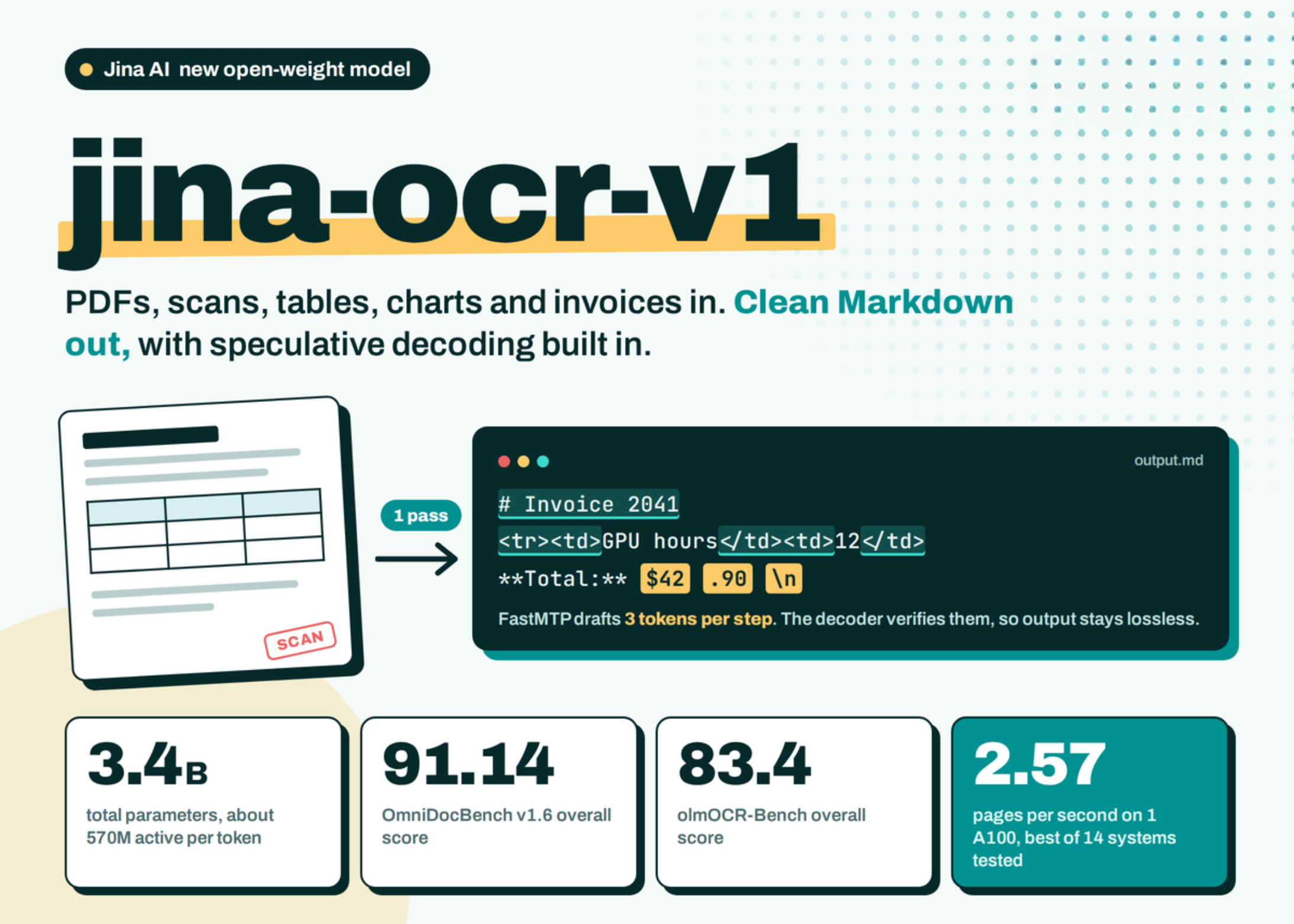
Jina AI released jina-ocr-v1, a 3.4B parameter Mixture-of-Experts document parser with ~570M active parameters per token. Built on DeepSeek-OCR, it uses speculative decoding to run efficiently on low-budget GPUs.
Key Takeaways
- Key Highlight:Jina AI released jina-ocr-v1, a 3.4B parameter Mixture-of-Experts document parser with ~570M active parameters per token. Built on DeepSeek-OCR, it uses speculative decoding to run efficiently on low-budget GPUs.
- Innovation & Tech:Highlights advancements in DeepSeek, Jina, AI, demonstrating rapid progress in model capabilities.
- Industry Impact:Reported via MarkTechPost, offering actionable signals for developers and technology leaders.
Jina AI has introduced jina-ocr-v1, a visual document parsing model designed to convert complex documents such as PDFs, scans, tables, charts, and invoices into structured Markdown output.
The model is built as a Mixture-of-Experts architecture with 3.4 billion total parameters, of which approximately 570 million are active per token. It builds upon DeepSeek-OCR and incorporates a FastMTP speculative decoding head that drafts multiple tokens in parallel, reducing inference cost.
Document parsing remains a challenging task for language models because it requires accurately interpreting layout, formatting, and embedded visual elements. By outputting Markdown, jina-ocr-v1 aims to make parsed content directly usable in downstream LLM workflows and retrieval pipelines.
The emphasis on low-budget GPU compatibility signals an effort to broaden access to capable document intelligence tools without requiring high-end inference hardware. This could make structured document extraction more practical for smaller teams and resource-constrained deployments.
This page provides an editorial summary based on publicly available information. It is not a republished article. Use the source link below for the original report.
Industry Insights & Analysis
As artificial intelligence rapidly evolves, breakthroughs surrounding DeepSeek, Jina, AI, Releases are shifting toward scalable, robust real-world implementations.
Driven by both open-source ecosystems and proprietary model architectures, the integration between compute optimization, data engineering, and agentic workflows is accelerating. This development provides a strategic benchmark for upcoming AI tooling and developer workflows.