GGUF vs GPTQ vs AWQ vs EXL2: LLM Model Formats Explained (2026)
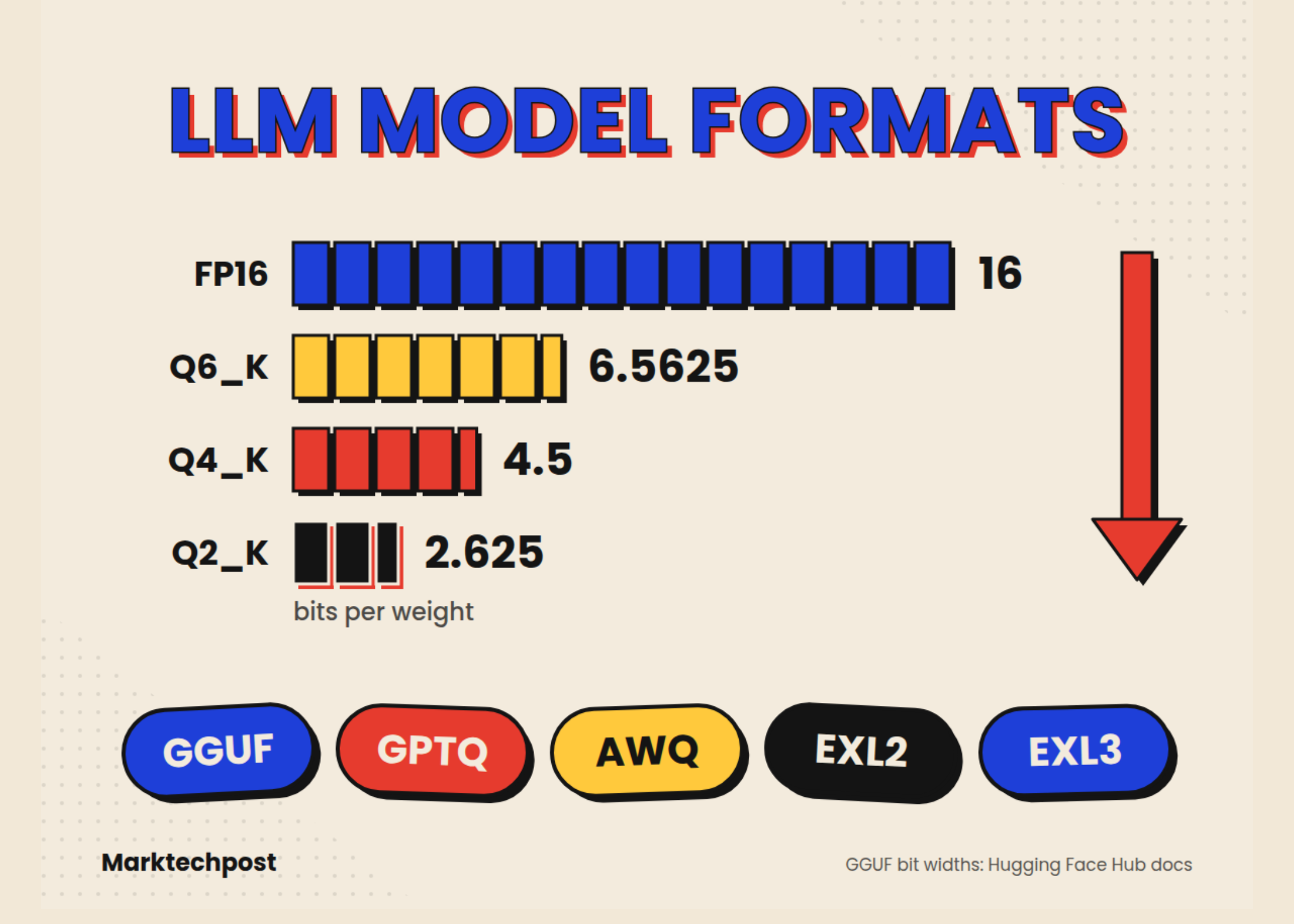
MarkTechPost explains key LLM file formats and quantization methods—GGUF, GPTQ, AWQ, EXL2, and EXL3—detailing bits per weight, calibration, and hardware fit for Macs, consumer GPUs, and production serving.
Key Takeaways
- Key Highlight:MarkTechPost explains key LLM file formats and quantization methods—GGUF, GPTQ, AWQ, EXL2, and EXL3—detailing bits per weight, calibration, and hardware fit for Macs, consumer GPUs, and production serving.
- Innovation & Tech:Highlights advancements in GPT, GGUF, GPTQ, demonstrating rapid progress in model capabilities.
- Industry Impact:Reported via MarkTechPost, offering actionable signals for developers and technology leaders.
As large language models grow larger, fitting them onto consumer and enterprise hardware requires quantization: reducing the precision of model weights to shrink file size and memory usage. Formats like GGUF, GPTQ, AWQ, and EXL2 have emerged as leading solutions, each taking a distinct approach to this compression challenge.
The guide clarifies an important distinction between file containers and the quantization algorithms themselves. GGUF functions as a flexible container optimized for CPU and Apple Silicon inference, while GPTQ, AWQ, and EXL2 represent different quantization strategies that prioritize calibration and accuracy retention for GPU acceleration.
Choosing the right format depends heavily on the deployment target. GGUF is generally preferred for Mac and CPU-based environments, whereas EXL2 and AWQ are tailored for consumer GPUs and high-throughput production serving where memory bandwidth is the primary bottleneck.
By breaking down concepts like bits per weight and calibration datasets, the explanation helps developers avoid common deployment pitfalls. Understanding these tradeoffs is critical for balancing inference speed, memory footprint, and model quality across diverse hardware setups.
This page provides an editorial summary based on publicly available information. It is not a republished article. Use the source link below for the original report.
Industry Insights & Analysis
As artificial intelligence rapidly evolves, breakthroughs surrounding GPT, GGUF, GPTQ, AWQ are shifting toward scalable, robust real-world implementations.
Driven by both open-source ecosystems and proprietary model architectures, the integration between compute optimization, data engineering, and agentic workflows is accelerating. This development provides a strategic benchmark for upcoming AI tooling and developer workflows.