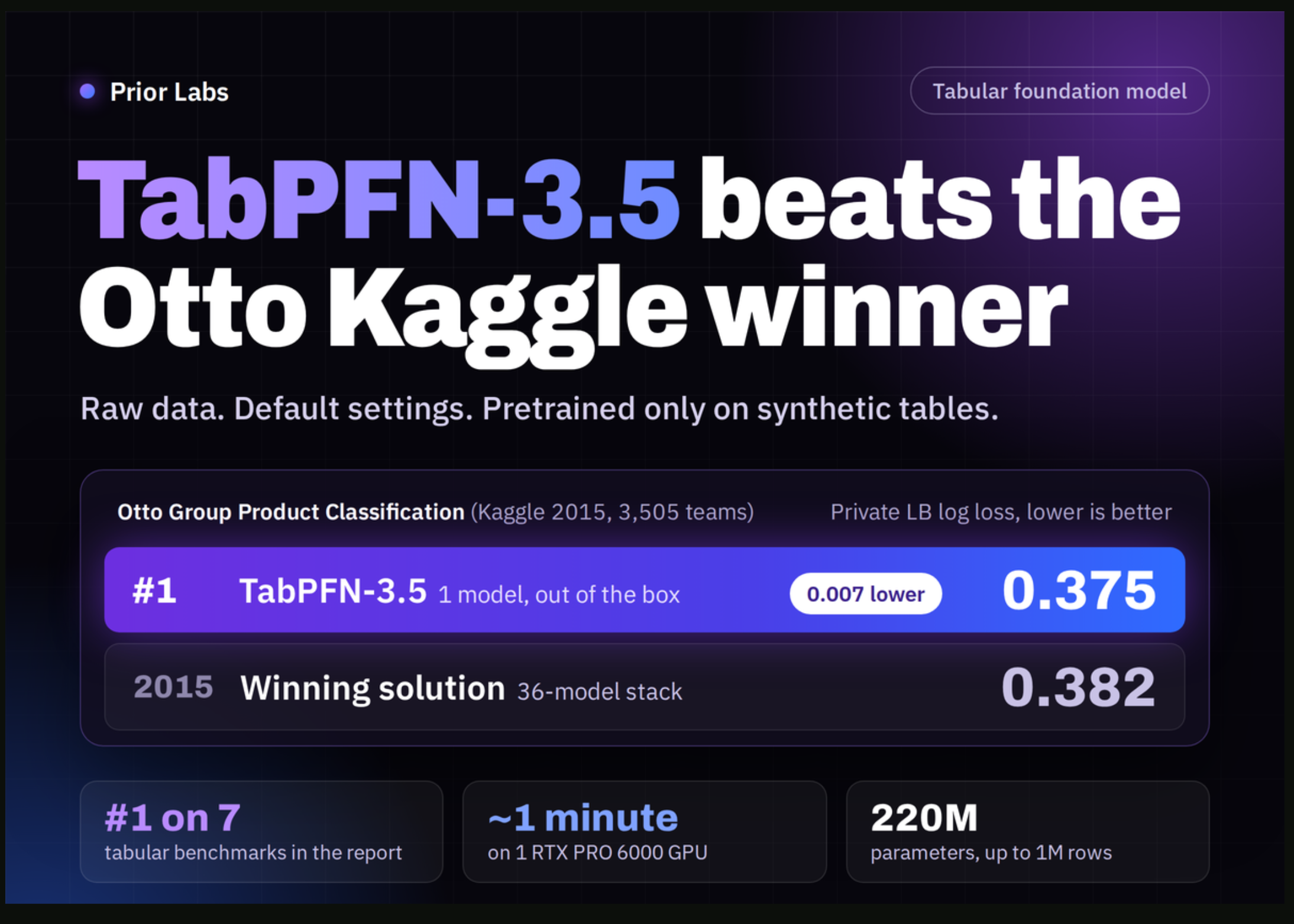
Prior Labs Releases TabPFN-3.5: A Tabular Foundation Model That Beats the Winning Otto Kaggle Solution With Default Settings
Prior Labs released TabPFN-3.5, a tabular foundation model pretrained on synthetic data. Using default settings, it reportedly outperformed the winning solution from the Otto Kaggle competition.
Key Takeaways
- Key Highlight:Prior Labs released TabPFN-3.5, a tabular foundation model pretrained on synthetic data. Using default settings, it reportedly outperformed the winning solution from the Otto Kaggle competition.
- Innovation & Tech:Highlights advancements in Prior, Labs, Releases, demonstrating rapid progress in model capabilities.
- Industry Impact:Reported via MarkTechPost, offering actionable signals for developers and technology leaders.
Prior Labs has introduced TabPFN-3.5, a foundation model designed specifically for tabular data. Unlike traditional machine learning approaches that require extensive tuning, this model aims to deliver strong performance straight out of the box.
A notable aspect of TabPFN-3.5 is its pretraining methodology. The model was trained exclusively on synthetic data, demonstrating that artificial datasets can effectively prepare a model for real-world structured data challenges.
The release is significant because tabular data remains the backbone of most enterprise analytics. Existing gradient-boosting methods often demand careful feature engineering and hyperparameter optimization, whereas a pretrained foundation model could streamline this workflow.
By reportedly surpassing the winning Otto Kaggle solution with default settings, TabPFN-3.5 suggests a potential shift in how practitioners approach tabular tasks. If the benchmark holds across broader datasets, it could reduce the time and expertise needed to build competitive predictive models.
This page provides an editorial summary based on publicly available information. It is not a republished article. Use the source link below for the original report.
Industry Insights & Analysis
As artificial intelligence rapidly evolves, breakthroughs surrounding Prior, Labs, Releases, TabPFN-3.5 are shifting toward scalable, robust real-world implementations.
Driven by both open-source ecosystems and proprietary model architectures, the integration between compute optimization, data engineering, and agentic workflows is accelerating. This development provides a strategic benchmark for upcoming AI tooling and developer workflows.