Fly Language Model (FLM) Wires the Full Fruit Fly Connectome Into a Frozen 1.2B LLM, and Its Own Controls Show the Wiring Does Not Help
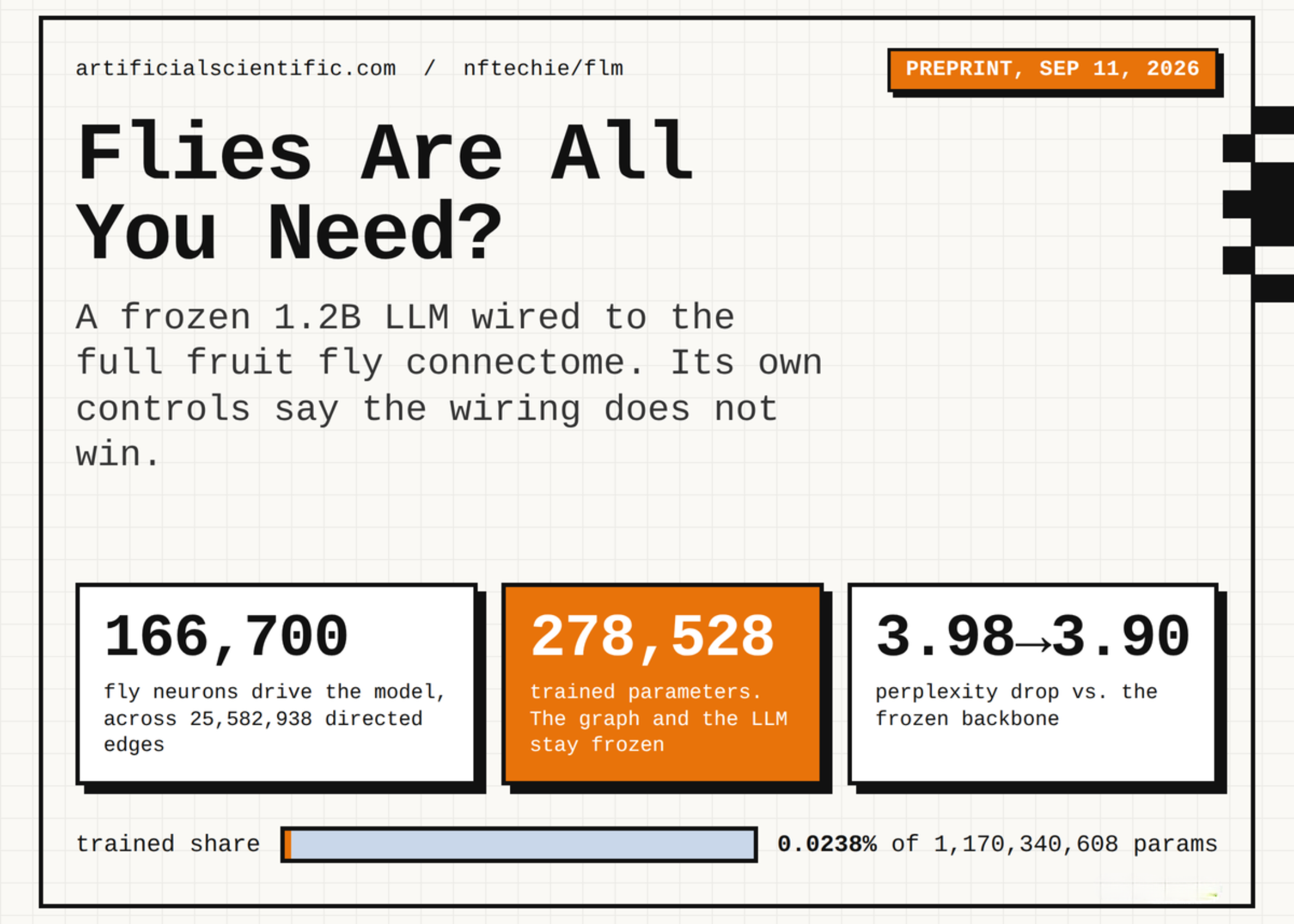
Researchers built the Fly Language Model, wiring a 1.2B frozen LLM to the full fruit fly connectome of 166,700 neurons. Only ~278K parameters trained, but controls showed the biological wiring did not improve performance.
Key Takeaways
- Key Highlight:Researchers built the Fly Language Model, wiring a 1.2B frozen LLM to the full fruit fly connectome of 166,700 neurons. Only ~278K parameters trained, but controls showed the biological wiring did not improve performance.
- Innovation & Tech:Highlights advancements in Fly, Language, Model, demonstrating rapid progress in model capabilities.
- Industry Impact:Reported via MarkTechPost, offering actionable signals for developers and technology leaders.
The Fly Language Model (FLM) project integrates the complete male fruit fly connectome—166,700 neurons and 25.6 million synaptic edges—into a frozen LFM2.5-1.2B-Instruct language model using token embeddings.
Rather than training the entire model, researchers kept the LLM backbone frozen and trained only a small learned correction layer comprising roughly 278,528 parameters. This approach let them test whether injecting biological wiring patterns into an AI model would enhance its capabilities.
The study is notable for its rigorous ablation testing. The researchers' own control experiments indicated that the fly connectome wiring did not actually improve the model's performance, offering a sobering data point on the direct transferability of biological neural architectures to artificial systems.
This work contributes to the broader neuromorphic AI field, where scientists explore whether insights from natural nervous systems can inform better machine learning designs. The negative result suggests that simply porting biological connectivity into existing transformer architectures may not yield straightforward gains.
The outcome underscores the complexity of translating neurobiology into AI advances, pointing researchers toward more nuanced methods rather than direct structural mimicry when bridging these two domains.
This page provides an editorial summary based on publicly available information. It is not a republished article. Use the source link below for the original report.
Industry Insights & Analysis
As artificial intelligence rapidly evolves, breakthroughs surrounding Fly, Language, Model, FLM are shifting toward scalable, robust real-world implementations.
Driven by both open-source ecosystems and proprietary model architectures, the integration between compute optimization, data engineering, and agentic workflows is accelerating. This development provides a strategic benchmark for upcoming AI tooling and developer workflows.