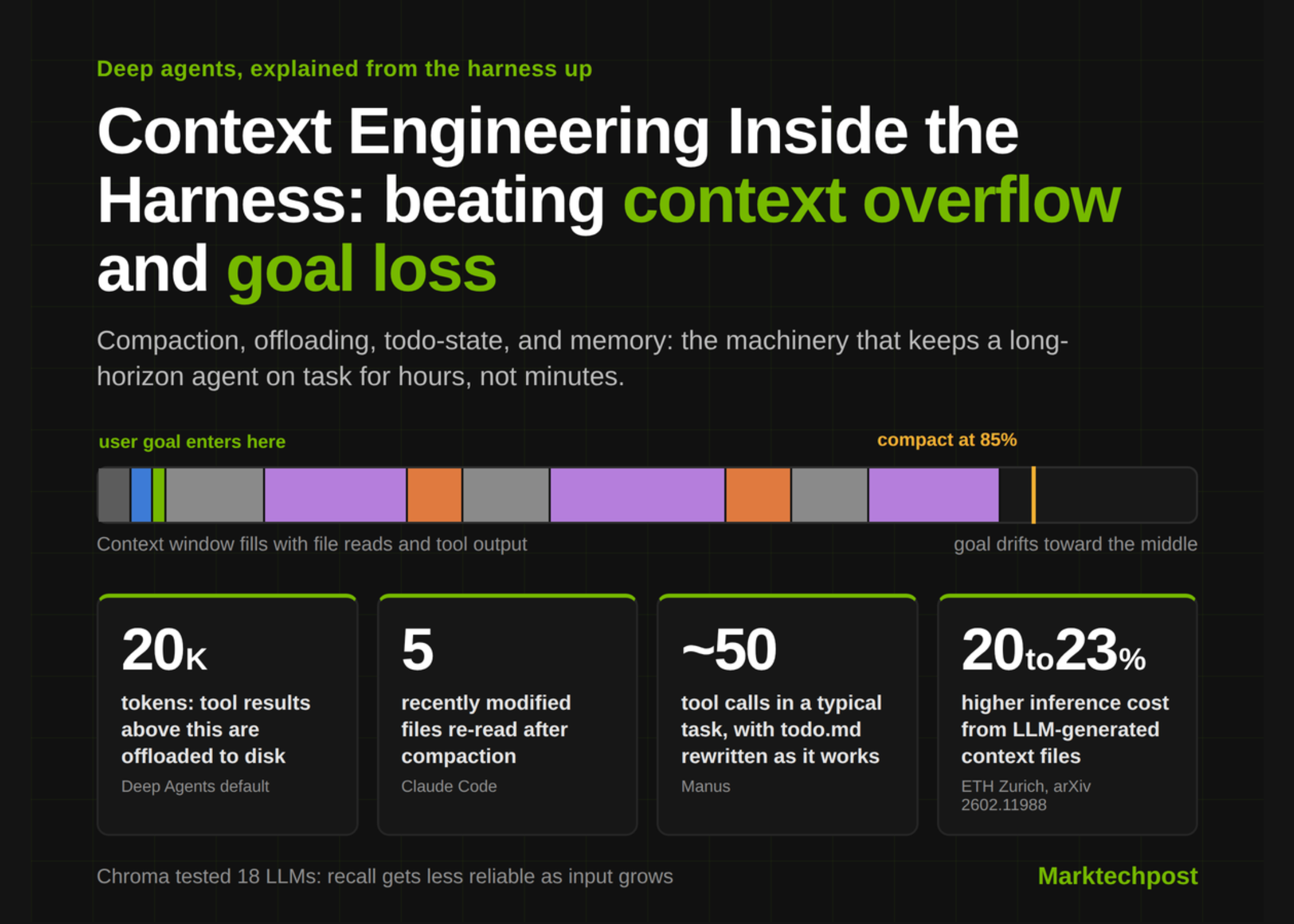
Context Engineering Inside the Harness: 4 Mechanisms That Beat Context Overflow and Goal Loss on Long-Horizon Tasks
An article examines how agent harnesses from LangChain, Claude Code, Manus, OpenAI Codex, and Amazon tackle context overflow and goal loss in long-horizon LLM tasks. It details four context engineering mechanisms.
Key Takeaways
- Key Highlight:An article examines how agent harnesses from LangChain, Claude Code, Manus, OpenAI Codex, and Amazon tackle context overflow and goal loss in long-horizon LLM tasks. It details four context engineering mechanisms.
- Innovation & Tech:Highlights advancements in OpenAI, Amazon, Claude, demonstrating rapid progress in model capabilities.
- Industry Impact:Reported via MarkTechPost, offering actionable signals for developers and technology leaders.
The article addresses a core limitation of current LLM agents: when tasks extend over many steps, the models either exceed their context windows or drift from their original objectives. It argues that a simple loop of tool-calling is insufficient for these long-horizon challenges.
To resolve this, developers are building intelligence into the "harness," the orchestration layer surrounding the LLM. The piece examines how platforms like LangChain Deep Agents, Claude Code, Manus, OpenAI Codex, and Amazon implement specific context engineering mechanisms to maintain operational stability.
These mechanisms focus on actively managing what information remains in the model's context window and reinforcing the primary goal throughout the process. By structuring the agent's environment and memory, the harness prevents the degradation of performance that typically occurs as token counts rise.
Understanding these orchestration techniques is critical for developers building reliable autonomous agents. As the industry shifts from simple chatbots to complex workflows, the architecture of the harness layer becomes just as important as the underlying foundation model.
This page provides an editorial summary based on publicly available information. It is not a republished article. Use the source link below for the original report.
Industry Insights & Analysis
As artificial intelligence rapidly evolves, breakthroughs surrounding OpenAI, Amazon, Claude, Context are shifting toward scalable, robust real-world implementations.
Driven by both open-source ecosystems and proprietary model architectures, the integration between compute optimization, data engineering, and agentic workflows is accelerating. This development provides a strategic benchmark for upcoming AI tooling and developer workflows.