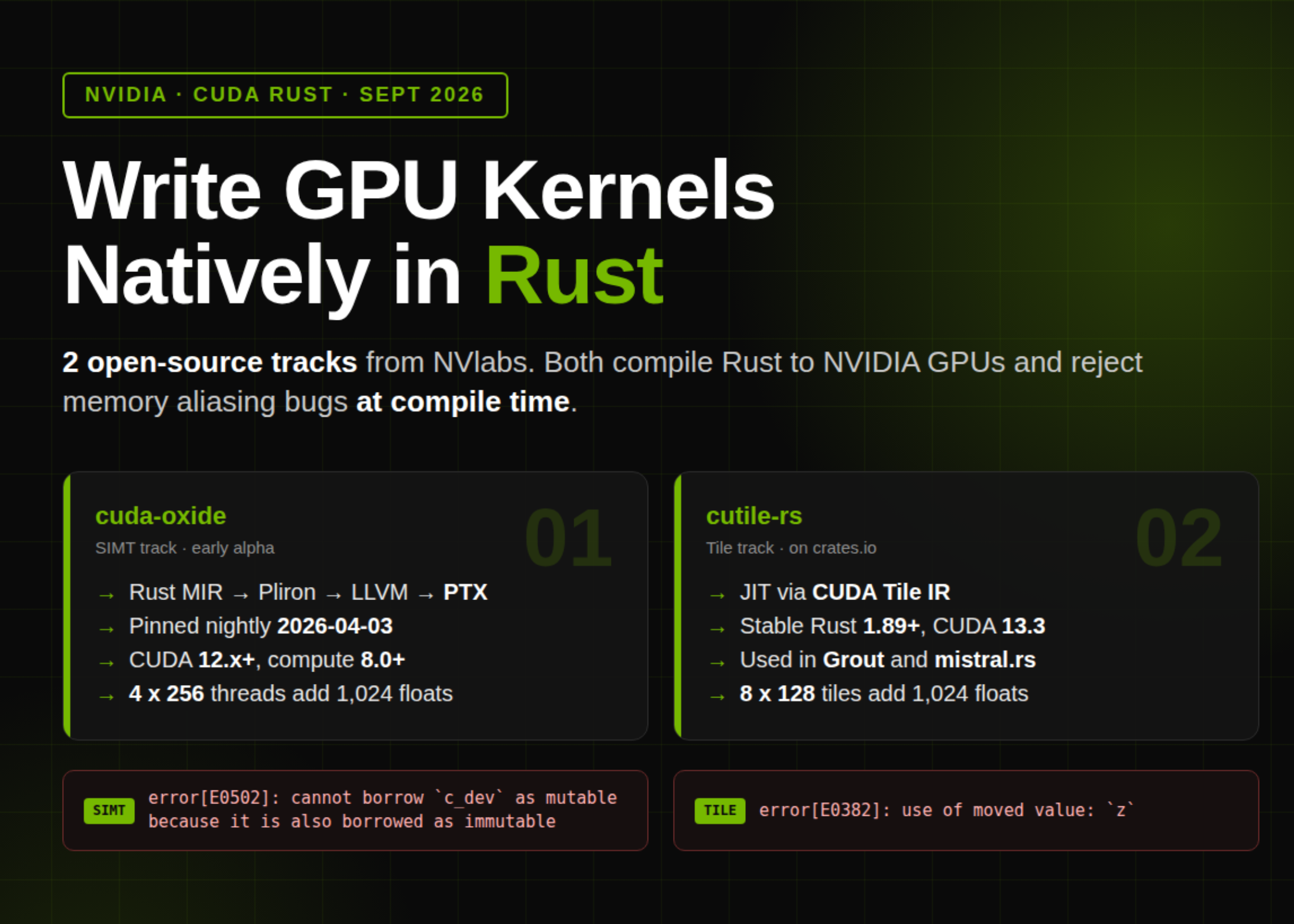
NVIDIA Announces CUDA Rust with cuda-oxide (SIMT) and cutile-rs (Tile) for Compile-Time-Safe GPU Kernels
NVIDIA announced CUDA Rust, bringing Rust to GPU kernels via two NVlabs projects: cuda-oxide for SIMT kernels and cutile-rs for Tile kernels, aiming for compile-time-safe, high-performance CUDA code.
Key Takeaways
- Key Highlight:NVIDIA announced CUDA Rust, bringing Rust to GPU kernels via two NVlabs projects: cuda-oxide for SIMT kernels and cutile-rs for Tile kernels, aiming for compile-time-safe, high-performance CUDA code.
- Innovation & Tech:Highlights advancements in NVIDIA, Announces, CUDA, demonstrating rapid progress in model capabilities.
- Industry Impact:Reported via MarkTechPost, offering actionable signals for developers and technology leaders.
NVIDIA has introduced CUDA Rust, an initiative to make Rust a first-class language for writing GPU kernels. The announcement highlights two open-source projects from NVlabs that align Rust with the two primary CUDA programming models.
cuda-oxide handles SIMT kernels, compiling Rust's mid-level representation through Pliron and LLVM down to PTX. cutile-rs targets the Tile model and JIT-compiles kernels, offering developers compile-time safety while keeping low-level control.
This matters because Rust's memory safety and concurrency guarantees can catch many bug classes before runtime, a significant advantage for complex AI and ML kernels running at scale. Safer kernel development could reduce subtle correctness and security issues in GPU software.
The likely impact is wider adoption of Rust in GPU computing and a stronger ecosystem around CUDA. It may also position Rust as a more compelling alternative to C++ in performance-critical AI infrastructure.
This page provides an editorial summary based on publicly available information. It is not a republished article. Use the source link below for the original report.
Industry Insights & Analysis
As artificial intelligence rapidly evolves, breakthroughs surrounding NVIDIA, Announces, CUDA, Rust are shifting toward scalable, robust real-world implementations.
Driven by both open-source ecosystems and proprietary model architectures, the integration between compute optimization, data engineering, and agentic workflows is accelerating. This development provides a strategic benchmark for upcoming AI tooling and developer workflows.