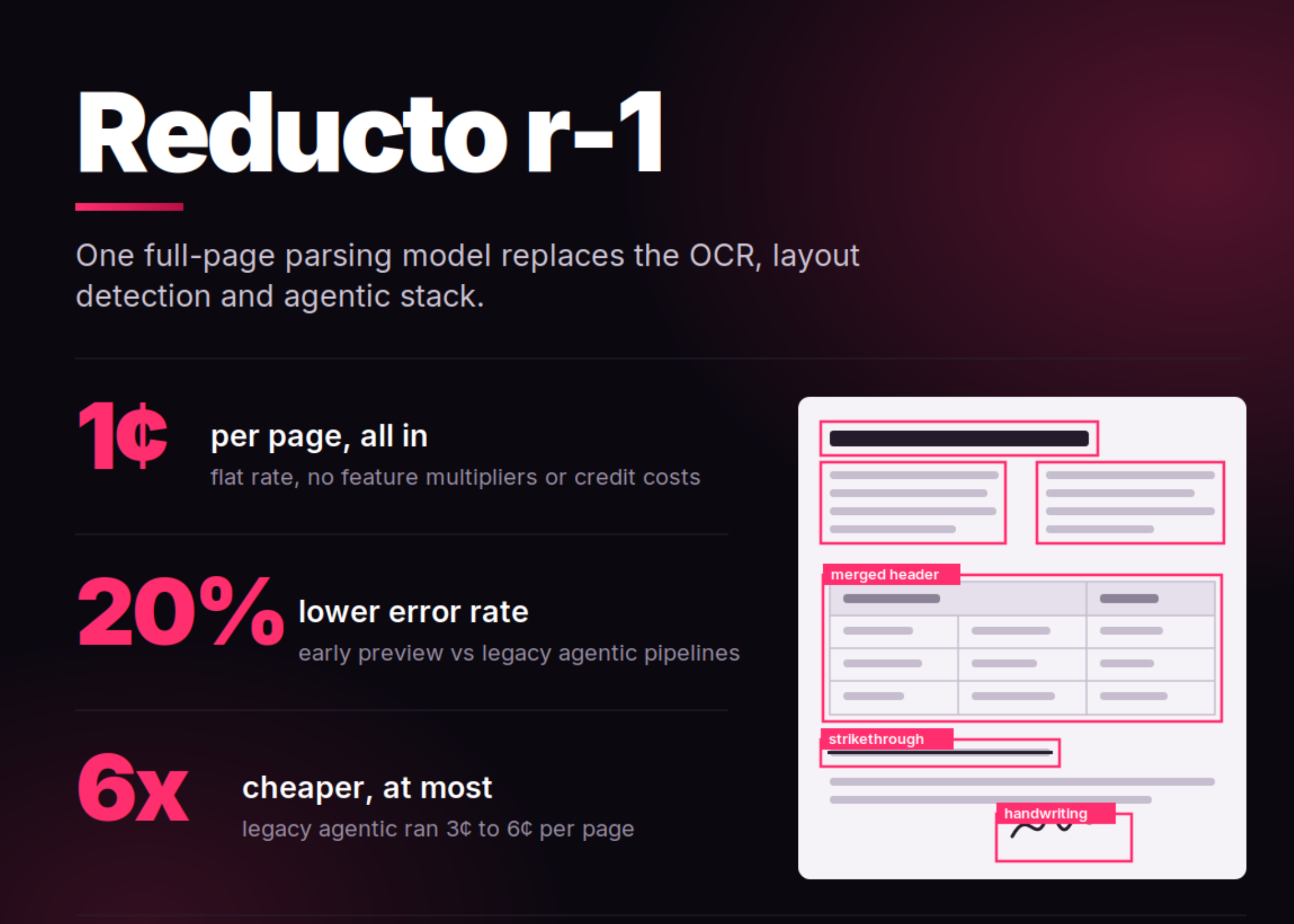
Reducto Releases r-1: A Single Pass Document Parsing Model That Cuts Errors 20% at 1 Cent Per Page
Reducto released r-1, a single-pass document parsing model that cuts errors by 20% at roughly one cent per page, replacing multi-stage agentic pipelines.
Key Takeaways
- Key Highlight:Reducto released r-1, a single-pass document parsing model that cuts errors by 20% at roughly one cent per page, replacing multi-stage agentic pipelines.
- Innovation & Tech:Highlights advancements in Reducto, Releases, r-1, demonstrating rapid progress in model capabilities.
- Industry Impact:Reported via MarkTechPost, offering actionable signals for developers and technology leaders.
Reducto has introduced r-1, a document parsing model designed to handle OCR, layout detection, tables, formatting, and grounding in a single full-page pass. The company positions it as a streamlined alternative to the multi-stage agentic pipeline it also ships alongside.
The model reportedly reduces parsing errors by about 20% while keeping costs near one cent per page, a combination that could make high-quality document extraction more affordable at scale. Earlier pipelines typically split parsing into separate steps, each with its own failure modes and latency overhead.
By collapsing those steps into one pass, r-1 targets workloads like enterprise document processing, retrieval-augmented generation, and automated data extraction. The release reflects a broader trend toward consolidating compound AI systems into simpler, faster, and cheaper single-model approaches.
If the performance claims hold, r-1 may put pressure on other document AI vendors to match both accuracy and cost, even as agentic frameworks remain popular for more complex reasoning tasks.
This page provides an editorial summary based on publicly available information. It is not a republished article. Use the source link below for the original report.
Industry Insights & Analysis
As artificial intelligence rapidly evolves, breakthroughs surrounding Reducto, Releases, r-1, Single are shifting toward scalable, robust real-world implementations.
Driven by both open-source ecosystems and proprietary model architectures, the integration between compute optimization, data engineering, and agentic workflows is accelerating. This development provides a strategic benchmark for upcoming AI tooling and developer workflows.