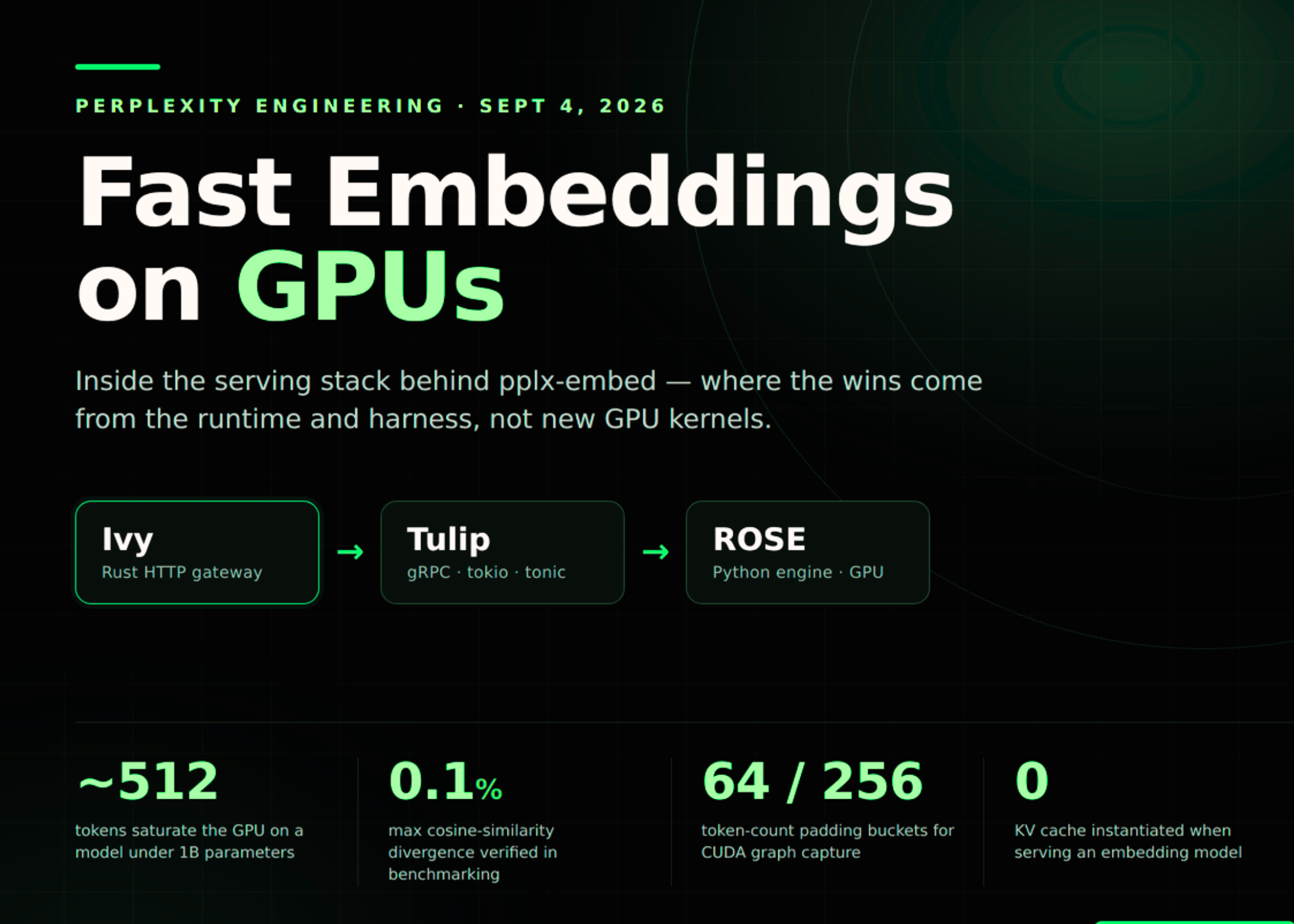
Perplexity Details Its GPU Embedding Stack: How Ivy, Tulip and ROSE Serve pplx-embed
Perplexity Engineering published a technical post detailing its GPU serving stack for pplx-embed, using clusters named Ivy, Tulip, and ROSE to make embedding inference cost-efficient at scale.
Key Takeaways
- Key Highlight:Perplexity Engineering published a technical post detailing its GPU serving stack for pplx-embed, using clusters named Ivy, Tulip, and ROSE to make embedding inference cost-efficient at scale.
- Innovation & Tech:Highlights advancements in Perplexity, Details, Its, demonstrating rapid progress in model capabilities.
- Industry Impact:Reported via MarkTechPost, offering actionable signals for developers and technology leaders.
Perplexity has released a behind-the-scenes look at how it serves its pplx-embed model on GPUs. The engineering post, titled "Fast Embeddings on GPUs," describes a serving infrastructure built around clusters codenamed Ivy, Tulip, and ROSE.
The post focuses on the serving side of retrieval quality: while the embedding model determines how well search results match queries, the cost and speed of running that model across a large index are what make the product viable. Perplexity explains how its GPU stack handles those constraints.
The write-up is aimed at engineers working on AI search and retrieval. It offers insight into design choices that balance throughput, latency, and infrastructure spend when embeddings are served at scale.
For the broader AI industry, the post is an example of how leading search products are optimizing inference infrastructure. It also highlights the growing importance of efficient embedding serving as retrieval-augmented and semantic search workloads expand.
This page provides an editorial summary based on publicly available information. It is not a republished article. Use the source link below for the original report.
Industry Insights & Analysis
As artificial intelligence rapidly evolves, breakthroughs surrounding Perplexity, Details, Its, GPU are shifting toward scalable, robust real-world implementations.
Driven by both open-source ecosystems and proprietary model architectures, the integration between compute optimization, data engineering, and agentic workflows is accelerating. This development provides a strategic benchmark for upcoming AI tooling and developer workflows.