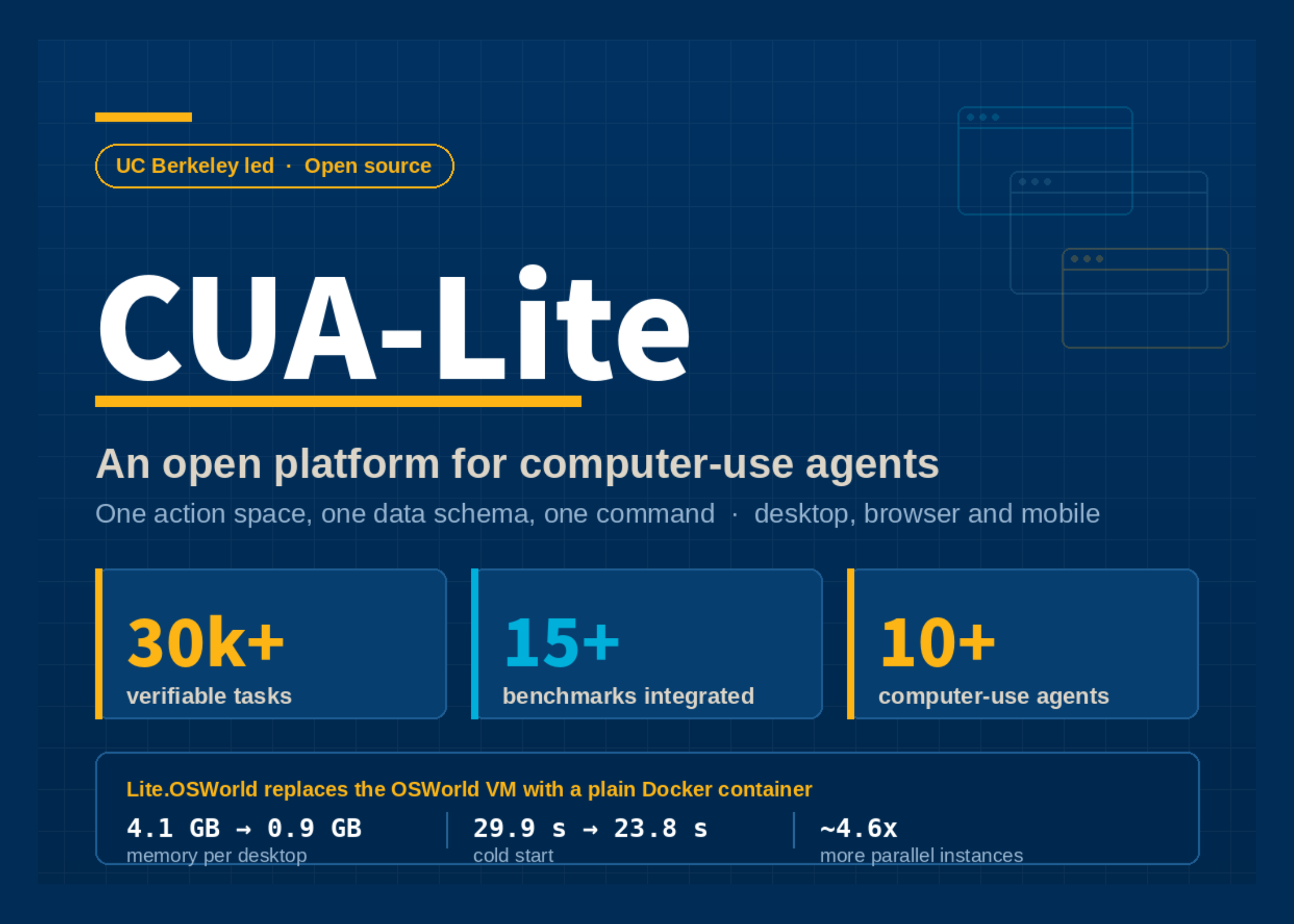
UC Berkeley Researchers Release CUA-Lite, an Open Platform Unifying Sandboxes, Data, Evaluation and RL for Computer-Use Agents
UC Berkeley researchers released CUA-Lite, an open platform that unifies sandboxes, data, evaluation, and reinforcement learning for computer-use agents.
Key Takeaways
- Key Highlight:UC Berkeley researchers released CUA-Lite, an open platform that unifies sandboxes, data, evaluation, and reinforcement learning for computer-use agents.
- Innovation & Tech:Highlights advancements in Agent, UC, Berkeley, demonstrating rapid progress in model capabilities.
- Industry Impact:Reported via MarkTechPost, offering actionable signals for developers and technology leaders.
CUA-Lite is a new open platform from a UC Berkeley-led research team designed for building and evaluating computer-use agents. It brings together four core components—agent environments, data traces, evaluation tools, and reinforcement learning infrastructure—into a single framework.
Currently, these pieces are typically shipped in incompatible formats, forcing researchers to assemble custom pipelines for each project. By standardizing them behind one action space and one data schema, CUA-Lite aims to remove a major bottleneck in training and benchmarking agents that interact with graphical user interfaces.
The project is significant because reproducibility and fair comparison have been persistent challenges in computer-use agent research. A unified open platform could make it easier for different labs to share setups, compare results, and build on each other's work.
In practice, this could accelerate progress in areas like GUI automation, software testing, and digital assistants. By lowering the infrastructure barrier, CUA-Lite may enable more research groups to focus on agent learning and evaluation rather than building yet another set of incompatible tools.
This page provides an editorial summary based on publicly available information. It is not a republished article. Use the source link below for the original report.
Industry Insights & Analysis
As artificial intelligence rapidly evolves, breakthroughs surrounding Agent, UC, Berkeley, Researchers are shifting toward scalable, robust real-world implementations.
Driven by both open-source ecosystems and proprietary model architectures, the integration between compute optimization, data engineering, and agentic workflows is accelerating. This development provides a strategic benchmark for upcoming AI tooling and developer workflows.