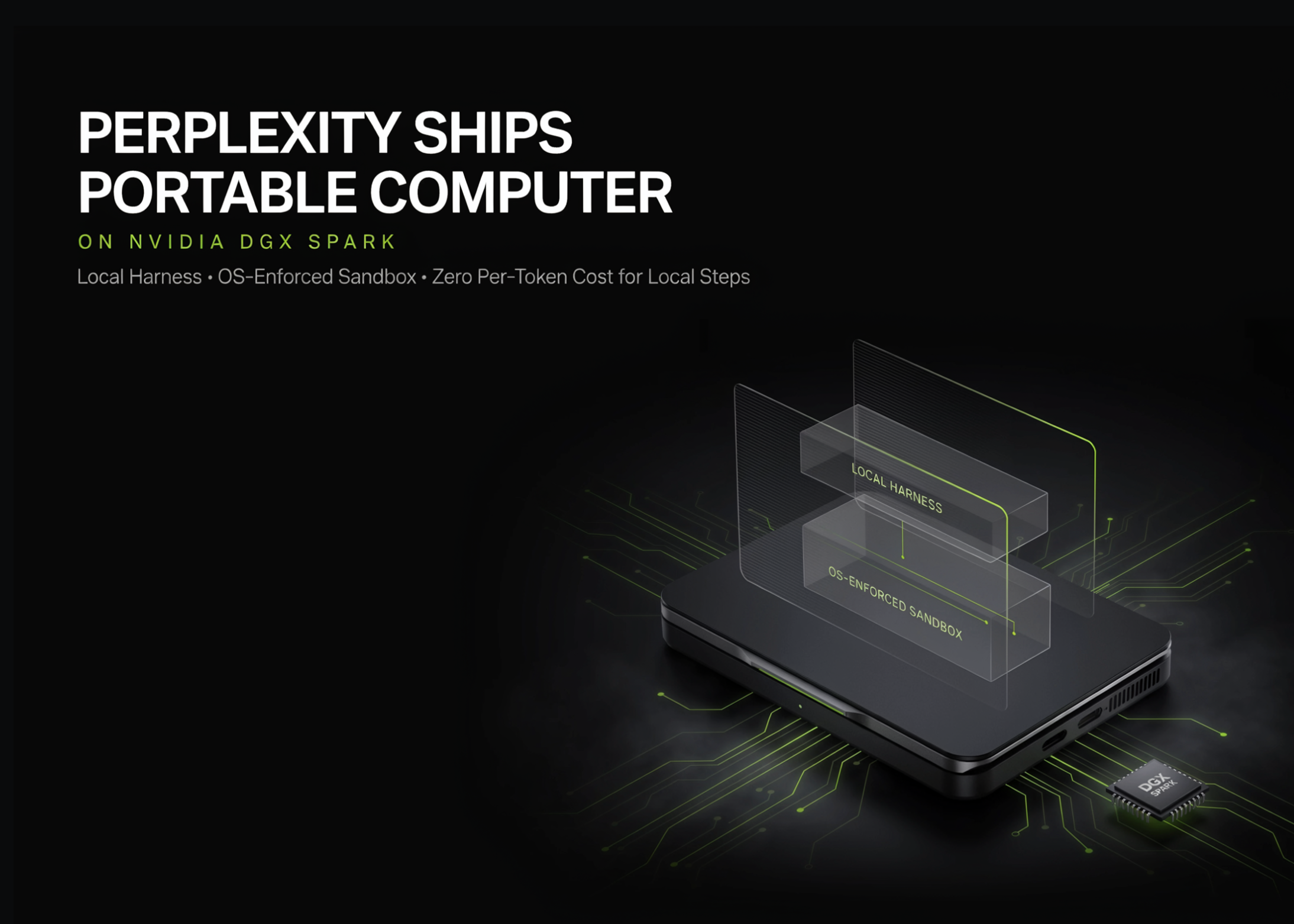
Perplexity Ships Portable Computer on NVIDIA DGX Spark: Local Harness, OS-Enforced Sandbox, and Zero Per-Token Cost for Local Steps
Perplexity launches Portable Computer, an integrated AI system running on NVIDIA DGX Spark that bundles local models, an execution harness, OS-enforced sandboxing, and connectors into a single deployable unit. This enables zero per-token cost for local inference steps, marking a significant shift toward self-contained enterprise AI agents with privacy guarantees.
Key Takeaways
- Key Highlight:Perplexity launches Portable Computer, an integrated AI system running on NVIDIA DGX Spark that bundles local models, an execution harness, OS-enforced sandboxing, and connectors into a single deployable unit. This enables zero per-token cost for local inference steps, marking a significant shift toward self-contained enterprise AI agents with privacy guarantees.
- Innovation & Tech:Highlights advancements in NVIDIA, Perplexity, Ships, demonstrating rapid progress in model capabilities.
- Industry Impact:Reported via MarkTechPost, offering actionable signals for developers and technology leaders.
【Executive Summary & Core Event】
Perplexity AI has announced the release of Portable Computer, a novel integrated system that packages local AI models, an execution harness, an OS-enforced sandbox environment, and pre-built connectors into a unified runtime deployed on NVIDIA's DGX Spark platform. This represents a fundamental departure from Perplexity's traditional cloud-centric architecture, where all inference and retrieval steps are executed on remote infrastructure. Instead, Portable Computer enables organizations to run substantial portions of Perplexity's agentic AI pipeline—particularly local reasoning, tool-use, and intermediate processing steps—entirely on-premises or at the edge, with only specific cloud-dependent steps (such as large-scale web retrieval) requiring external connectivity. The system is built atop the NVIDIA DGX Spark, a compact, single-GPU AI workstation powered by the NVIDIA H100 or L40S Tensor Core GPU, designed to deliver enterprise-grade AI inference and fine-tuning capabilities in a form factor suitable for individual workstations or small server racks.
The announcement carries significant strategic weight for Perplexity, which has positioned itself as an AI-powered answer engine and agentic search platform. By introducing Portable Computer, Perplexity addresses a critical enterprise concern: data sovereignty and cost predictability. The zero per-token cost for local steps means that organizations running Portable Computer will not incur inference charges for the reasoning, planning, and tool-execution phases that occur on their own hardware. This model fundamentally changes the economics of deploying Perplexity's agentic capabilities in regulated industries—healthcare, finance, legal, and government—where data cannot leave organizational boundaries. The system includes a local harness that manages model orchestration, an OS-enforced sandbox that provides hardware-level isolation for untrusted code execution, and connectors that enable integration with enterprise data sources, APIs, and workflow systems.
The DGX Spark platform serves as the hardware foundation, providing 80GB of H100 memory or 48GB of L40S memory, sufficient to run models in the 7B to 34B parameter range with comfortable headroom for context windows and KV cache. Perplexity has optimized its local model stack to fit within these constraints, likely employing a combination of quantized large language models for reasoning, specialized smaller models for classification and routing tasks, and retrieval-augmented generation (RAG) pipelines that can operate on locally indexed corpora. The OS-enforced sandbox is particularly notable: rather than relying on software-level containerization alone, the system leverages the underlying operating system's security primitives—likely including seccomp filters, namespace isolation, and mandatory access controls—to create a hardened execution environment where agent-generated code can run without risking compromise of the host system.
【Technical Architecture & Key Innovations】
The technical architecture of Portable Computer reflects a multi-layered design optimized for the DGX Spark's hardware constraints while maintaining the agentic capabilities that define Perplexity's platform. At the core lies a local model harness that manages the lifecycle of multiple AI models running simultaneously on the GPU. This harness is responsible for model loading and unloading (swapping models in and out of GPU memory as needed), inference scheduling (prioritizing requests and managing batch sizes for throughput optimization), and context management (maintaining conversation history and tool-use state across extended agent sessions). The harness likely implements a custom inference engine optimized for the specific model architectures Perplexity uses, potentially leveraging TensorRT-LLM or a similar NVIDIA-optimized inference framework to maximize tokens-per-second on the H100 or L40S GPU.
The OS-enforced sandbox represents a sophisticated security architecture that goes beyond traditional container-based isolation. By leveraging operating system-level security mechanisms—such as Linux kernel namespaces for resource isolation, seccomp-bpf for syscall filtering, AppArmor or SELinux profiles for mandatory access control, and potentially hardware-assisted isolation features—the sandbox creates a hardened execution boundary. This is critical for Perplexity's agentic use case, where AI agents may generate and execute arbitrary code (Python scripts, shell commands, API calls) as part of their reasoning process. The sandbox ensures that even if an agent generates malicious or erroneous code, the blast radius is contained to the sandboxed environment without affecting the host system, other running processes, or sensitive data stores. This architecture enables safe execution of untrusted agent-generated code, a prerequisite for deploying autonomous AI agents in enterprise environments.
The connectors layer provides pre-built integrations with common enterprise systems and data sources, enabling Portable Computer to access and process organizational data without requiring custom development. These connectors likely include integrations with enterprise search platforms (Elasticsearch, Solr), document management systems (SharePoint, Google Drive), code repositories (GitHub, GitLab), databases (PostgreSQL, MongoDB), and API gateways. The connectors operate within the sandbox's security model, meaning that data access is governed by the same OS-enforced policies that protect the broader system. The architecture also supports a hybrid execution model where certain steps—particularly those requiring large-scale web retrieval or access to Perplexity's proprietary knowledge graph—can be offloaded to cloud infrastructure, while all sensitive data processing and reasoning remain local. This hybrid approach balances the need for comprehensive information access with strict data sovereignty requirements.
【Industry Context & Competitive Landscape】
Portable Computer enters a competitive landscape that has rapidly evolved around the concept of local and edge AI deployment. NVIDIA's DGX Spark itself was launched as a response to enterprise demand for compact, affordable AI hardware that could run sophisticated models outside of traditional data centers. Competing offerings in this space include Anthropic's Claude API with its enterprise deployment options, OpenAI's Azure OpenAI Service with private endpoint configurations, and Meta's Llama models which have become the de facto standard for open-weight local deployment. However, Perplexity's Portable Computer differentiates itself by offering a complete, pre-integrated system rather than requiring organizations to assemble their own local AI stack from disparate components. This turnkey approach reduces deployment complexity significantly compared to alternatives that require organizations to independently manage model selection, inference optimization, sandboxing, and connector development.
Against the backdrop of major AI provider strategies, Perplexity's move signals a recognition that enterprise adoption of agentic AI will be constrained by data residency requirements and cost unpredictability. OpenAI's approach has been primarily cloud-centric, with enterprise features like Azure OpenAI Service providing some degree of data isolation but still requiring data to traverse cloud infrastructure. Anthropic's Claude offers enterprise API features and has explored on-premises deployment through partnerships, but has not released a comparable turnkey local system. Google's Gemini models are available through Vertex AI with various deployment options, but again lack a dedicated portable local agent system. DeepSeek and Qwen have focused on open-weight model releases that enable local deployment, but without the integrated harness, sandbox, and connector ecosystem that Portable Computer provides.
The competitive positioning of Portable Computer also intersects with the broader trend toward AI agents that can operate autonomously across multiple tools and data sources. Companies like Cognition (Devin), Anthropic (Claude Computer Use), and OpenAI (Operator) are all pursuing agentic AI capabilities, but Perplexity's approach of combining these capabilities with a local, sandboxed execution environment addresses a specific enterprise pain point. The zero per-token cost model for local steps also creates a fundamentally different pricing dynamic compared to competitors who charge per token regardless of where inference occurs. For organizations with high-volume agent workloads, this could result in significant cost savings, particularly for the iterative reasoning and tool-use steps that constitute the majority of an agent's computational budget.
【Developer & Enterprise Implications】
For developers and enterprise IT teams, Portable Computer offers a streamlined deployment path that significantly reduces the complexity typically associated with building local AI agent systems. The turnkey nature of the system means that organizations do not need to independently source and optimize models, build custom inference pipelines, implement sandboxing from scratch, or develop enterprise connectors. Instead, the system arrives pre-configured with Perplexity's model stack, harness, security architecture, and integration layer. This reduces deployment timelines from months (for a custom-built equivalent) to potentially days or weeks. The primary hardware requirement is the NVIDIA DGX Spark workstation, which starts at approximately $4,999 for the L40S configuration and $9,999 for the H100 configuration—significantly more accessible than traditional DGX systems that cost tens or hundreds of thousands of dollars.
Integration complexity for enterprise systems is addressed through the pre-built connector framework. Organizations can connect Portable Computer to their existing data infrastructure—document stores, databases, code repositories, and API endpoints—through standardized connectors rather than custom development. The OS-enforced sandbox also simplifies security compliance, as the sandbox's isolation guarantees can be demonstrated to security auditors and compliance teams in a way that software-only sandboxing cannot. For regulated industries, this hardware-assisted security boundary provides a stronger assurance model than traditional container-based approaches. The zero per-token cost for local steps also simplifies budgeting and cost forecasting, as organizations can predict their AI infrastructure costs based on hardware procurement rather than variable usage-based pricing.
However, there are practical considerations that organizations should evaluate. The DGX Spark's GPU memory constraints (80GB for H100, 48GB for L40S) limit the size of models that can be run locally, meaning that the most powerful frontier models cannot be deployed in this configuration. Organizations will need to assess whether Perplexity's local model stack provides sufficient capability for their use cases, or whether they need to supplement with cloud-based inference for complex tasks. The hybrid architecture also means that some steps still require cloud connectivity, which may be problematic for organizations with strict air-gapped requirements. Additionally, the system's effectiveness depends on the quality of Perplexity's local model stack, which has not been publicly benchmarked in the same way that open-weight models have been evaluated by the community.
【Key Takeaways & Strategic Outlook】
Perplexity's Portable Computer represents a strategic pivot toward enterprise-grade, self-contained AI agent systems that address the fundamental tension between AI capability and data sovereignty. By packaging local models, a hardened sandbox, and enterprise connectors into a single system running on accessible hardware, Perplexity is positioning itself as a provider of turnkey agentic AI infrastructure rather than solely a cloud-based answer engine. The zero per-token cost model for local steps fundamentally changes the economics of AI agent deployment, making high-volume agentic workloads economically viable for organizations that were previously deterred by unpredictable usage-based pricing.
The architectural choices—particularly the OS-enforced sandbox and the hybrid local-cloud execution model—reflect a mature understanding of enterprise deployment requirements. The sandbox addresses the security concerns inherent in autonomous AI agents that generate and execute code, while the hybrid model balances local processing with cloud-scale retrieval capabilities. These design decisions position Portable Computer as a credible alternative to custom-built local AI systems, particularly for organizations that lack the engineering resources to build and maintain such infrastructure independently. As the AI agent market matures and enterprise adoption accelerates, integrated systems like Portable Computer will likely become the dominant deployment model for organizations seeking to operationalize agentic AI at scale.
Looking forward, the success of Portable Computer will depend on several factors: the capability of Perplexity's local model stack relative to cloud-based alternatives, the breadth and quality of the connector ecosystem, and the ability to evolve the system as model architectures advance. The DGX Spark platform provides a solid hardware foundation, but future iterations may need to support larger models or more sophisticated multi-model orchestration. Perplexity's investment in this local-first architecture also signals a broader industry trend: as AI agents become more capable and autonomous, the deployment model will increasingly shift toward local, self-contained systems that provide both performance and privacy guarantees. Organizations that evaluate and adopt these systems early will be well-positioned to operationalize agentic AI in ways that cloud-only approaches cannot match.
This page provides an editorial summary based on publicly available information. It is not a republished article. Use the source link below for the original report.
Industry Insights & Analysis
As artificial intelligence rapidly evolves, breakthroughs surrounding NVIDIA, Perplexity, Ships, Portable are shifting toward scalable, robust real-world implementations.
Driven by both open-source ecosystems and proprietary model architectures, the integration between compute optimization, data engineering, and agentic workflows is accelerating. This development provides a strategic benchmark for upcoming AI tooling and developer workflows.