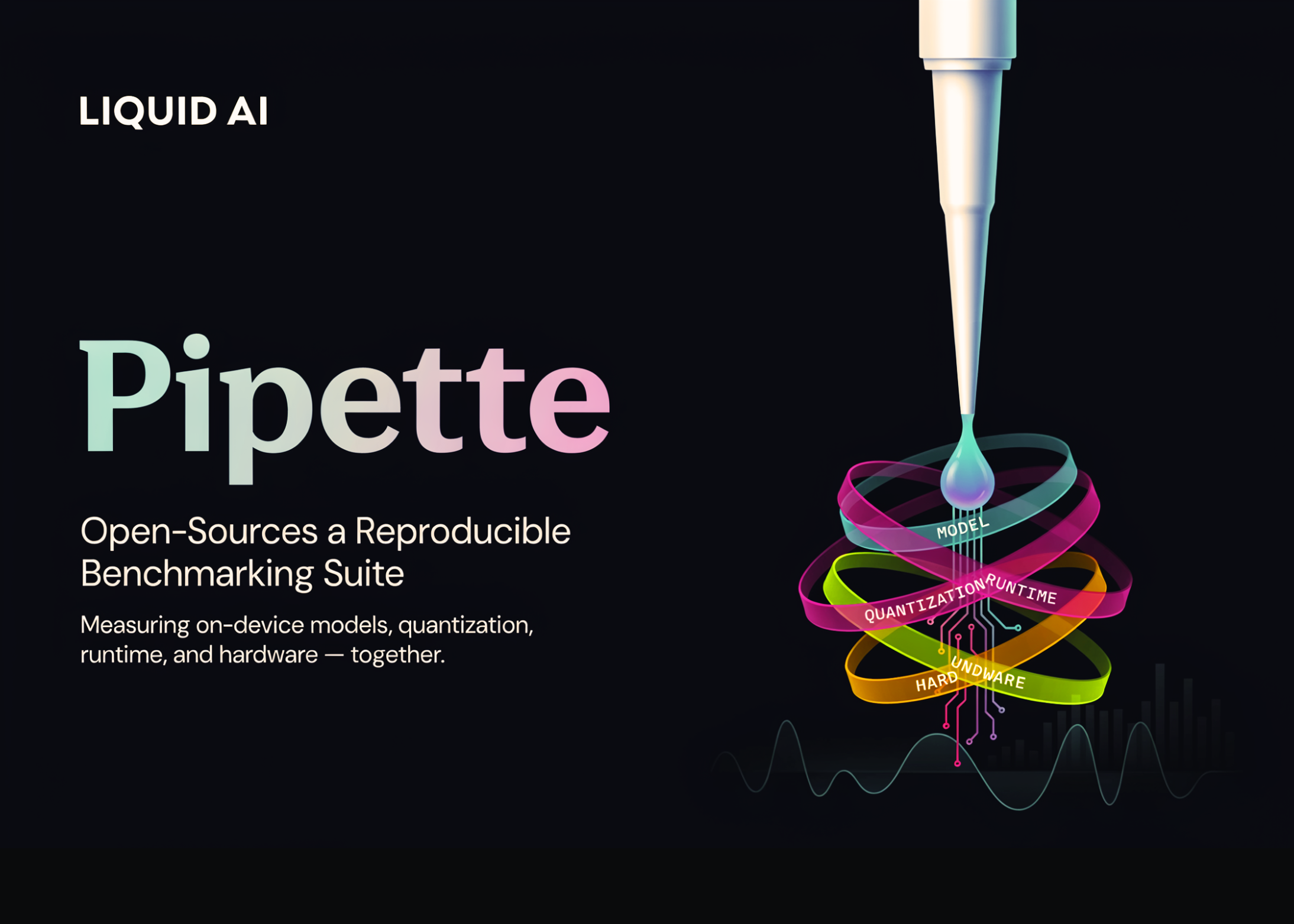
Liquid AI Open-Sources Pipette: A Reproducible Benchmarking Suite That Measures On-Device Models, Quantization, Runtime and Hardware Together
Liquid AI has open-sourced Pipette, a benchmarking suite that evaluates foundation models holistically across on-device hardware, quantization schemes, runtime environments, and inference quality — addressing the critical gap between server-class model cards and real-world edge deployment performance.
Key Takeaways
- Key Highlight:Liquid AI has open-sourced Pipette, a benchmarking suite that evaluates foundation models holistically across on-device hardware, quantization schemes, runtime environments, and inference quality — addressing the critical gap between server-class model cards and real-world edge deployment performance.
- Innovation & Tech:Highlights advancements in Liquid, AI, Open-Sources, demonstrating rapid progress in model capabilities.
- Industry Impact:Reported via MarkTechPost, offering actionable signals for developers and technology leaders.
【Executive Summary & Core Event】
Liquid AI, the company founded by Christopher Manning and known for pioneering mixture-of-experts (MoE) architectures optimized for edge deployment, has released Pipette as an open-source benchmarking platform. The core problem Pipette addresses is stark: model cards published by AI labs report perplexity, MMLU scores, and other quality metrics under idealized server-class conditions with full-precision (FP16 or BF16) computation on datacenter GPUs. These numbers bear almost no relationship to how the same model actually performs when deployed on a smartphone, laptop, or embedded device — where quantization to INT4 or INT8, memory bandwidth constraints, thermal throttling, and runtime overhead fundamentally alter both quality and latency characteristics.
Pipette was developed in partnership with industry stakeholders and represents a systematic effort to create reproducible, standardized evaluation methodology for on-device AI. Unlike existing benchmarks that measure either model quality in isolation or hardware throughput in isolation, Pipette measures the complete stack simultaneously: the model architecture, its quantization state, the inference runtime (such as MLC-LLM, llama.cpp, or vendor-specific engines), and the target hardware platform. This holistic approach acknowledges that on-device AI performance is an emergent property of all these layers interacting, not simply the sum of individually optimized components.
The open-source release of Pipette is strategically significant because it democratizes access to rigorous on-device benchmarking methodology. Previously, only well-resourced organizations with access to diverse hardware fleets and custom benchmarking infrastructure could conduct meaningful on-device evaluations. By open-sourcing the suite, Liquid AI enables researchers, developers, and smaller companies to reproduce benchmarking results, validate their own quantization and optimization choices, and make informed decisions about which models and configurations are actually viable for their target deployment scenarios.
【Technical Architecture & Key Innovations】
Pipette's technical architecture is designed around the principle of end-to-end measurement fidelity. The suite instruments the complete inference pipeline — from token loading through KV cache management, attention computation, quantization-dequantization cycles, and output token generation — capturing both qualitative metrics (perplexity on held-out datasets, task-specific accuracy on benchmarks like MMLU, HellaSwag, and GSM8K) and quantitative metrics (tokens per second, memory footprint, energy consumption per token, tail latency percentiles). This dual measurement approach is critical because aggressive quantization or runtime optimization might improve throughput while degrading quality in ways that are not captured by either metric alone.
The benchmarking suite supports multiple quantization schemes including GPTQ, AWQ, GGUF-based quantization (Q4_K_M, Q5_K_S, Q8_0), and FP8 variants, allowing systematic comparison of quality-throughput tradeoffs across the quantization spectrum. It also accommodates different attention implementations — standard FlashAttention, paged attention for long-context workloads, and quantized attention variants — recognizing that attention mechanism choice interacts significantly with both quantization and hardware characteristics. The runtime layer abstraction means Pipette can evaluate the same model-quantization pair across different inference engines, revealing which runtime best exploits a given hardware platform's capabilities.
Reproducibility is a foundational design principle of Pipette. The suite includes containerized execution environments, pinned dependency versions, standardized hardware initialization procedures, and automated result logging with full provenance tracking. This addresses a persistent problem in AI benchmarking where results are difficult to reproduce due to unstated environmental variables — different CUDA versions, different kernel implementations, different thermal states of the hardware. By controlling these variables and documenting them explicitly, Pipette enables genuine scientific comparison across studies and over time.
【Industry Context & Competitive Landscape】
The competitive landscape for on-device AI benchmarking has been fragmented and often opaque. OpenAI, Anthropic, and Google have published impressive model cards for GPT-4, Claude, and Gemini respectively, but these evaluations are conducted on proprietary infrastructure under conditions that cannot be independently verified. Meta's Llama series and Qwen's open-weight models have somewhat better transparency, but their published benchmarks still reflect server-class evaluation. DeepSeek's recent releases have pushed the frontier on cost-efficient training, but their benchmarking methodology similarly does not address the on-device deployment question. Pipette fills a genuine gap by providing a standardized methodology that can be applied to any model — open-weight or proprietary — on any edge hardware platform.
The timing of Pipette's release is particularly significant given the accelerating push toward on-device AI. Apple's deployment of Apple Intelligence across iPhone 15 Pro and later devices, Qualcomm's Snapdragon NPU roadmap targeting 45 TOPS of on-device inference, and MediaTek's Dimensity AI capabilities have all raised expectations for what foundation models can accomplish on consumer hardware. However, the gap between marketing claims and actual on-device performance has been substantial. Pipette provides the measurement infrastructure needed to ground these claims in reproducible evidence, which benefits both developers making deployment decisions and consumers evaluating device capabilities.
From a competitive standpoint, Liquid AI's release of Pipette positions the company as a methodology leader in the on-device AI space. By giving away the benchmarking tooling, Liquid AI creates a network effect: as more organizations adopt Pipette as the standard evaluation methodology, the value of Liquid AI's own optimized models (which naturally score well on Pipette) increases. This is analogous to how TensorFlow's ecosystem dominance was partly driven by the framework becoming the default evaluation and deployment target. The open-source strategy also builds goodwill with the research community and creates a feedback loop where benchmarking results inform Liquid AI's own model optimization efforts.
【Developer & Enterprise Implications】
For developers evaluating on-device model deployment, Pipette provides a decision framework that was previously unavailable. When choosing between deploying a 7B-parameter model at INT4 quantization versus a 3B-parameter model at INT8, the tradeoffs are not straightforward — the larger quantized model might offer better quality but worse latency, or the smaller model might fit in memory more comfortably but produce inferior outputs on complex tasks. Pipette quantifies these tradeoffs empirically rather than theoretically, enabling developers to make evidence-based decisions aligned with their specific quality requirements, latency budgets, and hardware constraints.
Enterprise adoption of Pipette requires consideration of integration complexity and hardware requirements. The suite is designed to run on standard edge hardware — smartphones, laptops, and embedded development boards — but comprehensive benchmarking across the full matrix of model-quantization-runtime-hardware combinations requires access to diverse hardware platforms. Organizations with existing device farms or development hardware inventories can integrate Pipette relatively straightforwardly, while those without such infrastructure may need to invest in hardware procurement or leverage cloud-based edge simulation platforms. The containerized execution model reduces software dependency friction, but hardware access remains the primary barrier to comprehensive evaluation.
The business impact of Pipette extends beyond individual deployment decisions to organizational AI strategy. Companies building AI-powered products face significant risk when their model selection is based on server-class benchmarks that do not reflect actual deployment conditions. A model that scores 85 on MMLU in FP16 on an A100 might score 72 on the same benchmark when quantized to INT4 and run on a mobile NPU — a degradation that could be unacceptable for production use. Pipette enables organizations to identify such quality cliffs before committing to deployment, reducing the risk of costly post-deployment model swaps and protecting user experience quality.
【Key Takeaways & Strategic Outlook】
The fundamental insight from Pipette is that on-device AI performance cannot be predicted from server-class benchmarks — the interaction between quantization, runtime, and hardware creates emergent behaviors that only end-to-end measurement can capture. This has profound implications for how the industry should approach model evaluation: rather than relying on model cards that reflect idealized conditions, organizations should adopt holistic benchmarking methodologies that measure the complete deployment stack. Pipette provides the tooling, but the industry must embrace the methodology for meaningful progress.
The open-sourcing of Pipette signals a maturation of the on-device AI ecosystem. Early-stage on-device AI development was characterized by proprietary benchmarking, marketing-driven claims, and limited reproducibility. As the space matures, standardized evaluation becomes essential for informed decision-making, fair competition, and user trust. Pipette represents a step toward this maturity, establishing a common measurement language that can align stakeholders from model developers to hardware vendors to end users.
Looking forward, the next evolution of on-device AI benchmarking will likely incorporate additional dimensions that Pipette's initial release may not fully address: multi-modal model evaluation (vision-language models running on-device), real-world task performance beyond synthetic benchmarks, user-perceived quality metrics, and continuous evaluation under dynamic conditions (varying thermal states, concurrent workloads, battery levels). Liquid AI's open-source approach positions Pipette as a foundation that the community can extend, and the methodology's emphasis on reproducibility provides a template for how future benchmarking efforts should be structured. Organizations investing in on-device AI capabilities should monitor Pipette's evolution and consider adopting it as their primary evaluation framework.
This page provides an editorial summary based on publicly available information. It is not a republished article. Use the source link below for the original report.
Industry Insights & Analysis
As artificial intelligence rapidly evolves, breakthroughs surrounding Liquid, AI, Open-Sources, Pipette are shifting toward scalable, robust real-world implementations.
Driven by both open-source ecosystems and proprietary model architectures, the integration between compute optimization, data engineering, and agentic workflows is accelerating. This development provides a strategic benchmark for upcoming AI tooling and developer workflows.