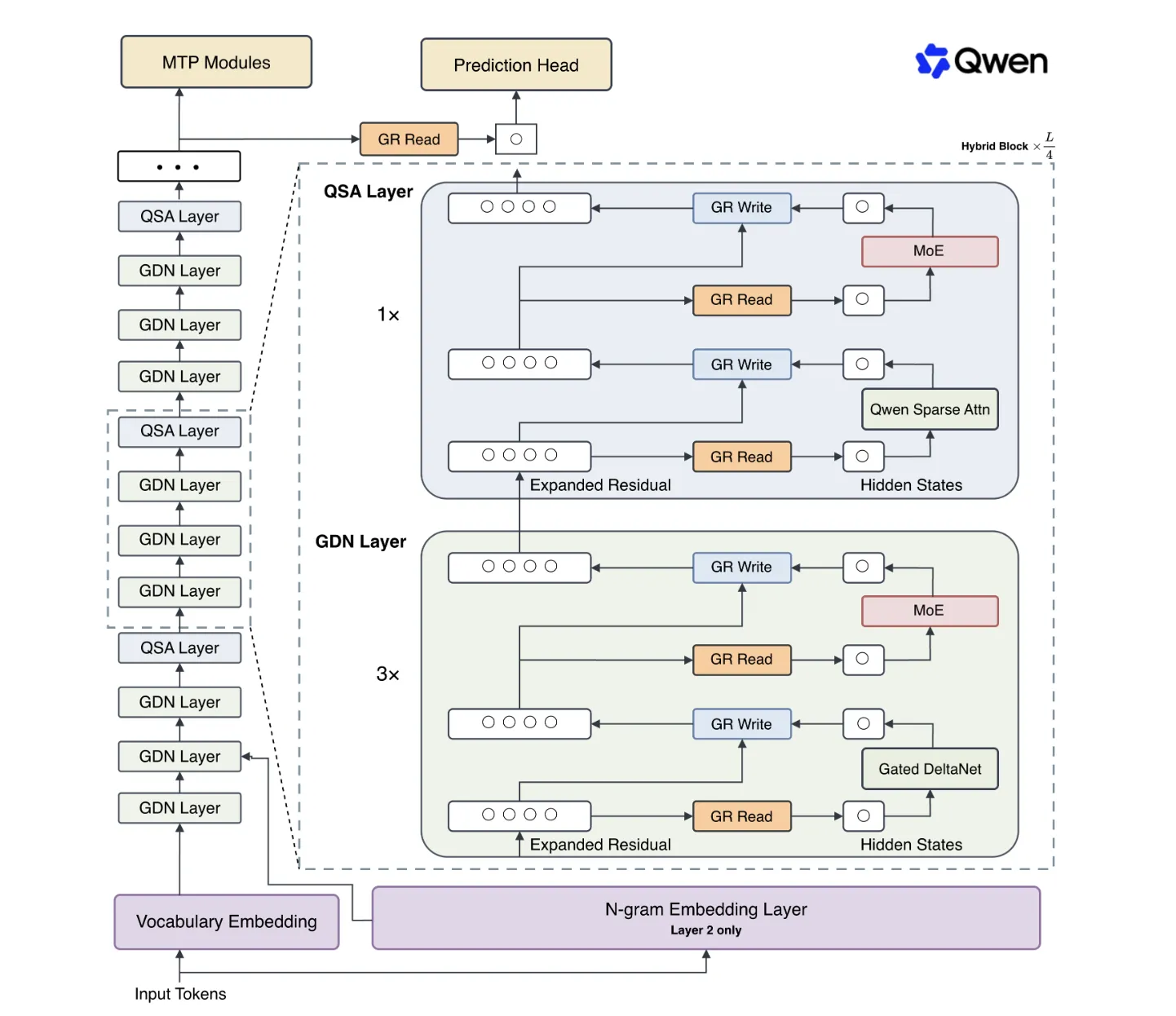
Alibaba’s Qwen Team Releases Qwen3.8-Flash-Next: A 125B Multimodal MoE With 6B Active Parameters Previewing the Qwen4 Architecture
Alibaba's Qwen team releases Qwen3.8-Flash-Next, an open-weight multimodal MoE model with 180B total parameters (125B backbone, 51B N-gram embedding table, 4B multi-token prediction module) but only 6B active parameters per forward pass, serving as a preview of the forthcoming Qwen4 architecture with radical efficiency gains.
Key Takeaways
- Key Highlight:Alibaba's Qwen team releases Qwen3.8-Flash-Next, an open-weight multimodal MoE model with 180B total parameters (125B backbone, 51B N-gram embedding table, 4B multi-token prediction module) but only 6B active parameters per forward pass, serving as a preview of the forthcoming Qwen4 architecture with radical efficiency gains.
- Innovation & Tech:Highlights advancements in Qwen, Alibaba, Team, demonstrating rapid progress in model capabilities.
- Industry Impact:Reported via MarkTechPost, offering actionable signals for developers and technology leaders.
【Executive Summary & Core Event】
Alibaba Cloud's Qwen research team has unveiled Qwen3.8-Flash-Next, an open-weight multimodal Mixture-of-Experts (MoE) language model that represents a significant architectural departure from the Qwen3 series and serves as a direct preview of the upcoming Qwen4 generation. The model's headline specification is striking: 180 billion total parameters distributed across three distinct subsystems — a 125 billion parameter transformer backbone, a 51 billion parameter N-gram embedding table, and a 4 billion parameter multi-token prediction module — yet only 6 billion parameters are activated during any single forward pass. This extreme sparsity ratio of approximately 30:1 (total to active) is among the most aggressive in the open-weight landscape and signals a fundamental rethinking of how parameter count relates to computational cost and capability.
The model is released under an open-weight license, consistent with Alibaba's strategy of competing on accessibility and ecosystem adoption rather than purely on closed-model performance benchmarks. The 'Flash-Next' nomenclature suggests this is an iterative refinement of the Qwen3-Flash family, which previously emphasized inference speed through speculative decoding techniques. By incorporating a dedicated multi-token prediction head and a massive N-gram embedding table directly into the model architecture, Qwen3.8-Flash-Next moves beyond post-hoc speed optimization into a fundamentally redesigned inference pipeline. The multimodal capability — supporting text, image, and potentially video inputs — positions it as a direct competitor to models like Google's Gemini Flash and OpenAI's GPT-4o-mini in the efficient multimodal tier.
The release timing is strategically significant, arriving during a period when the open-weight community is increasingly focused on inference efficiency rather than raw parameter scaling. With training costs for frontier models reaching billions of dollars and inference infrastructure becoming the dominant operational expense for AI deployments, models that deliver competitive quality at a fraction of the compute cost represent a compelling value proposition. Alibaba's decision to open-weight this model also serves as a strategic signal to the community about the Qwen4 architecture's design philosophy before the full release, allowing researchers and developers to begin experimentation and provide feedback on the architectural choices.
【Technical Architecture & Key Innovations】
The 125 billion parameter backbone employs a sparse Mixture-of-Experts architecture, where each transformer layer contains multiple expert sub-networks and a learned routing mechanism that activates only a subset per token. With 6 billion active parameters out of 125 billion in the backbone alone, the model likely utilizes a routing scheme where each token is processed by approximately 2 out of 20+ experts per layer, or a similar configuration that achieves extreme sparsity. This architecture draws from the lineage of DeepSeek-V3's MoE design and Google's Switch Transformer, but pushes the sparsity envelope further. The key technical challenge in such extreme sparsity is maintaining gradient flow and preventing expert collapse, which Qwen likely addresses through improved load-balancing losses, expert dropout strategies, and potentially auxiliary expert communication mechanisms.
The 51 billion parameter N-gram embedding table represents one of the most novel architectural components in this release. Rather than generating tokens one at a time through the standard autoregressive process, this table stores learned embeddings for common multi-token sequences (N-grams), enabling the model to directly retrieve representations for frequent phrases and patterns. This is analogous to how human readers process common words and phrases as single units rather than individual letters. The 51B parameter count suggests the table covers an extremely large vocabulary of N-gram sequences, potentially including technical terminology, code patterns, and common linguistic constructions across multiple languages. During inference, when the model predicts a token sequence that matches an entry in the N-gram table, it can skip multiple autoregressive steps, dramatically accelerating generation for predictable text patterns.
The 4 billion parameter multi-token prediction module operates as a dedicated head that predicts multiple subsequent tokens simultaneously, functioning as a learned speculative decoding mechanism embedded directly in the architecture. Unlike traditional speculative decoding, which uses a separate smaller draft model to propose tokens for verification by the main model, this integrated approach allows the multi-token predictor to leverage the full context of the backbone's representations. The module likely employs a parallel decoding strategy where it generates a sequence of candidate tokens that are then validated against the main backbone's distribution, accepting correct predictions and falling back to standard autoregressive generation when predictions fail. Combined with the N-gram table, this creates a two-tier acceleration system: the N-gram table handles highly predictable sequences with direct lookup, while the multi-token predictor handles moderately predictable sequences with learned generation.
The multimodal architecture likely employs a unified tokenization scheme where visual inputs are converted to patch embeddings that are interleaved with text tokens in the transformer's input sequence. The MoE routing mechanism presumably operates uniformly across modalities, allowing experts to specialize in different types of content — some experts may specialize in visual reasoning, others in code generation, and others in natural language understanding. This specialization is a natural consequence of MoE training, where experts develop distinct capabilities based on the data they are most frequently routed to. The integration of multimodal processing with the N-gram and multi-token prediction modules raises interesting questions about how these acceleration mechanisms handle cross-modal generation, such as when generating text descriptions of images or processing interleaved text-image conversations.
【Industry Context & Competitive Landscape】
In the competitive landscape, Qwen3.8-Flash-Next positions itself as a direct challenger to several key models. Compared to OpenAI's GPT-4o-mini and GPT-4.1-mini, which emphasize efficiency through distillation and architectural optimization, Qwen3.8-Flash-Next achieves efficiency through structural sparsity and integrated acceleration mechanisms. Against Anthropic's Claude Haiku 3.5, which focuses on fast, cost-effective responses for high-volume applications, the Qwen model offers the additional advantage of open weights, enabling self-hosted deployment without API dependencies. The 6B active parameter footprint means inference costs approach those of dense 7B models like Llama 3.1 8B while potentially delivering quality closer to 70B-class models.
Against DeepSeek-V3 and DeepSeek-R1, which also employ MoE architectures with approximately 37B active parameters out of 671B total, Qwen3.8-Flash-Next achieves a far more aggressive sparsity ratio. DeepSeek's approach activates roughly 5.5% of its parameters per token, while Qwen3.8-Flash-Next activates only about 3.3% of its backbone parameters. This suggests Qwen is pushing toward an architectural paradigm where models can scale total parameters almost independently of inference cost, potentially enabling 500B+ parameter models that run at 7B-class throughput. The trade-off, as with all MoE models, is increased memory requirements for loading the full parameter set and potential latency from routing overhead, though these concerns are mitigated by the relatively modest 125B backbone size.
Compared to Google's Gemini 2.5 Flash, which emphasizes multimodal capabilities and long context windows, Qwen3.8-Flash-Next offers a more modular approach where the N-gram table and multi-token prediction module can potentially be updated or fine-tuned independently of the backbone. Against Meta's Llama 4 Scout and Maverick variants, which also explore MoE architectures, Qwen's integrated acceleration mechanisms represent a more holistic approach to inference efficiency. The open-weight release also positions Qwen favorably against Qwen's own closed competitors, as the model can be deployed on any hardware supporting the required memory footprint, including consumer GPUs with sufficient VRAM through techniques like quantization and expert parallelism.
The release also has implications for the broader open-weight ecosystem. By releasing a model with 180B total parameters but 6B active, Alibaba is effectively democratizing access to frontier-class model capabilities at inference costs accessible to mid-size enterprises and even well-resourced research labs. This could accelerate the adoption of MoE architectures in the open-weight community and pressure other model providers to similarly reduce the gap between total parameters and active compute. The preview nature of the release also suggests that the full Qwen4 architecture may incorporate even more radical efficiency improvements, potentially including learned routing strategies, dynamic expert selection, or hybrid dense-sparse layer configurations.
【Developer & Enterprise Implications】
For developers and enterprises, the primary practical consideration is hardware requirements. While only 6B parameters are active per forward pass, the full 125B backbone must be loaded into memory, requiring approximately 250GB of VRAM at FP16 precision or roughly 125GB at INT8 quantization. This places the model within reach of multi-GPU configurations using 8x H100s (80GB each) or 4x H200s, and potentially even high-end consumer setups with 2x RTX 6000 Ada (48GB each) using aggressive quantization. The N-gram embedding table and multi-token prediction module add additional memory overhead, though these are primarily lookup and feed-forward operations that may be more amenable to quantization than the transformer backbone. For cloud deployment, the model can be served on a single A100 80GB with expert offloading strategies, or more practically on 2-4 A100s for production-grade throughput.
Integration complexity is moderate given the model's open-weight nature and compatibility with standard inference frameworks. The MoE architecture requires expert parallelism support, which is available in vLLM, TGI, and SGLang with appropriate configuration. The N-gram embedding table introduces a non-standard component that may require custom inference code or framework extensions, though Alibaba likely provides reference implementations. The multi-token prediction module can be integrated into existing speculative decoding pipelines or used as a standalone acceleration mechanism. For enterprise deployments, the key advantage is the ability to self-host without API rate limits, data residency concerns, or per-token pricing, making the model attractive for high-volume applications like customer support automation, content generation, and code assistance.
The business impact of deploying Qwen3.8-Flash-Next depends heavily on the application's tolerance for the model's quality ceiling. For applications requiring frontier-class reasoning (complex mathematical problems, nuanced creative writing, sophisticated code generation), the 6B active parameter footprint may introduce quality gaps compared to denser models or models with higher active parameter counts. However, for high-volume, latency-sensitive applications like chatbots, summarization, translation, and content classification, the model's efficiency profile is compelling. At inference costs approaching those of 7B models while delivering quality closer to 70B-class models, the total cost of ownership for large-scale deployments can be reduced by an order of magnitude compared to API-based solutions. The multimodal capability also opens use cases in document processing, visual QA, and image-to-text generation without requiring separate specialized models.
For fine-tuning and adaptation, the MoE architecture presents both opportunities and challenges. Standard LoRA and QLoRA fine-tuning techniques can be applied to individual experts, allowing targeted adaptation of specific capabilities without updating the entire model. However, the routing mechanism itself may require careful handling during fine-tuning to prevent expert specialization from degrading. The N-gram table can potentially be extended with domain-specific sequences, enabling faster inference for specialized vocabularies like medical terminology or legal language. The multi-token prediction module can be fine-tuned to improve prediction accuracy for domain-specific text patterns, further accelerating inference in specialized applications. Overall, the model's modular architecture provides more fine-tuning flexibility than monolithic dense models, though at the cost of increased complexity in the fine-tuning pipeline.
【Key Takeaways & Strategic Outlook】
The most significant strategic insight from Qwen3.8-Flash-Next is the demonstration that extreme MoE sparsity — activating only 3.3% of backbone parameters per token — can be achieved without catastrophic quality degradation, fundamentally challenging the assumption that model capability scales linearly with active compute. This opens a path toward arbitrarily large models with fixed inference costs, potentially enabling 1T+ parameter models that run at 7B-class throughput. If the full Qwen4 architecture builds on this foundation with even more aggressive sparsity or improved routing efficiency, it could redefine the economics of frontier AI deployment, making models with capabilities rivaling GPT-4 or Claude 3.5 Sonnet accessible at inference costs comparable to current mid-tier models.
The integration of N-gram embedding tables and multi-token prediction modules directly into the model architecture represents a paradigm shift from treating inference acceleration as a post-hoc optimization to designing it into the model's fundamental structure. This architectural approach could become the dominant pattern for next-generation efficient models, as it provides speedups that are intrinsic to the model rather than dependent on external draft models or speculative decoding frameworks. The 51B parameter N-gram table is particularly noteworthy as it represents a learned compression of common language patterns, effectively giving the model a form of procedural memory for frequent sequences. Future iterations may extend this concept to include learned retrieval mechanisms for longer-range dependencies or domain-specific knowledge.
The open-weight release strategy positions Alibaba as a leader in the democratization of frontier AI, potentially accelerating global adoption of MoE architectures and driving competition on efficiency rather than raw scale. For the broader AI industry, this release signals that the next competitive frontier is not parameter count but parameter efficiency — how much capability can be delivered per unit of compute. As inference costs dominate AI operational expenses for most organizations, models that maximize capability-per-flop will increasingly determine market success. Qwen3.8-Flash-Next is a strong indication that Alibaba is betting on this efficiency-first paradigm for its Qwen4 generation and beyond, potentially reshaping the competitive dynamics of the open-weight AI landscape.
This page provides an editorial summary based on publicly available information. It is not a republished article. Use the source link below for the original report.
Industry Insights & Analysis
As artificial intelligence rapidly evolves, breakthroughs surrounding Qwen, Alibaba, Team, Releases are shifting toward scalable, robust real-world implementations.
Driven by both open-source ecosystems and proprietary model architectures, the integration between compute optimization, data engineering, and agentic workflows is accelerating. This development provides a strategic benchmark for upcoming AI tooling and developer workflows.