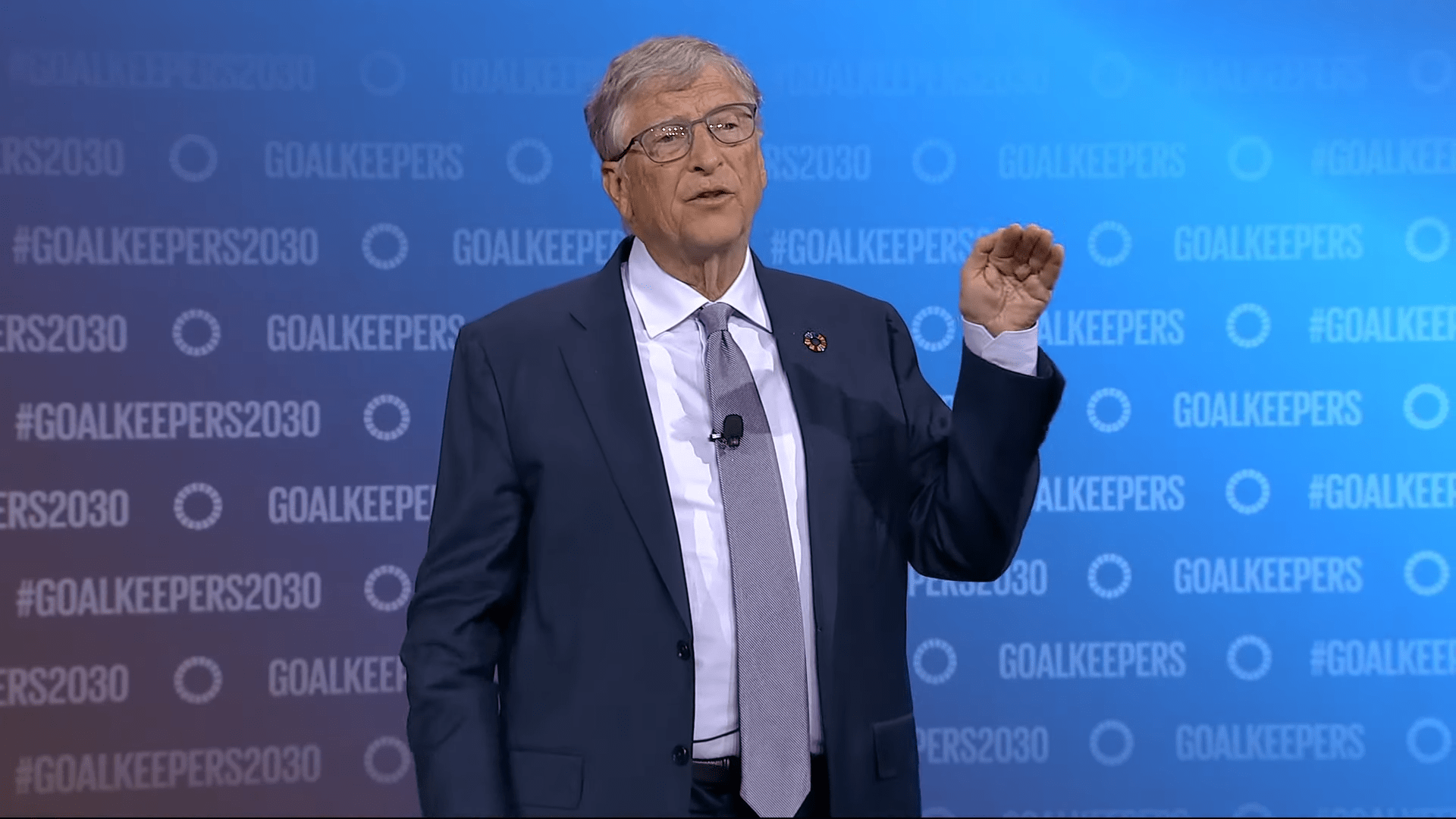
Bill Gates warns AI is more dangerous than the tech industry will admit
Bill Gates publicly warns that AI poses existential risks far greater than the tech industry admits, citing mass unemployment and AI-enabled bioterrorism as primary threats. He rejects self-regulation, accuses his own industry of deliberately suppressing risk disclosure to protect fundraising, and calls for mandatory government oversight of AI development and deployment.
Key Takeaways
- Key Highlight:Bill Gates publicly warns that AI poses existential risks far greater than the tech industry admits, citing mass unemployment and AI-enabled bioterrorism as primary threats. He rejects self-regulation, accuses his own industry of deliberately suppressing risk disclosure to protect fundraising, and calls for mandatory government oversight of AI development and deployment.
- Innovation & Tech:Highlights advancements in Bill, Gates, AI, demonstrating rapid progress in model capabilities.
- Industry Impact:Reported via The Decoder, offering actionable signals for developers and technology leaders.
【Executive Summary & Core Event】
Bill Gates, co-chair of the Bill & Melinda Gates Foundation and former Microsoft chairman, has issued what amounts to an unprecedented public rebuke of the artificial intelligence industry from within its own ranks. In a combination of a formal essay and a New York Times interview, Gates articulated a stark warning that AI systems present dangers significantly more severe than what leading technology companies and their executives are publicly acknowledging. His concerns center on two primary threat vectors: catastrophic labor market disruption through mass unemployment driven by AI automation, and the democratization of bioterrorism capabilities through AI-assisted biological weapon design. These are not abstract hypotheticals for Gates—they represent concrete, near-term risks that he believes the industry has a moral obligation to address transparently.
Gates made a particularly damning accusation against his own industry, stating that AI companies are deliberately hiding or minimizing risk assessments because disclosure would harm their financial interests. His quote—'It's bad for us, for the next trillion we're trying to raise'—reveals a candid acknowledgment that the trillion-dollar fundraising cycle currently underway in AI is directly incentivizing risk suppression. He explicitly rejected the prevailing industry consensus on self-regulation, arguing that voluntary safety commitments from companies with massive financial stakes in rapid AI deployment are structurally insufficient. Instead, Gates called for mandatory government oversight, regulatory frameworks with real enforcement power, and international coordination to manage the existential tail risks associated with advanced AI systems.
【Technical Architecture & Key Innovations】
The technical architecture concerns underlying Gates's warnings touch on several critical areas of modern AI systems. The mass unemployment threat stems from the rapid capability expansion of large language models and multimodal AI systems—particularly those with agentic capabilities that can plan, execute, and iterate on complex tasks autonomously. Models like GPT-4, Claude 3, and Gemini 1.5 demonstrate reasoning capabilities that increasingly overlap with cognitive labor previously exclusive to humans, including coding, legal analysis, medical diagnosis, and creative writing. The architectural trend toward tool-use, function calling, and multi-step agent architectures means AI systems are no longer confined to generating text but can interact with real-world systems, potentially displacing entire categories of knowledge work at an unprecedented pace.
On the bioterrorism front, the architectural concern relates to how large language models trained on vast scientific corpora—including virology, microbiology, and synthetic biology literature—can potentially generate actionable instructions for designing pathogens, optimizing viral vectors, or circumventing biosafety protocols. The same transformer architectures and attention mechanisms that enable GPT-4 to write code or answer medical questions also enable it to synthesize information from biological research papers into coherent, potentially dangerous protocols. The MoE (Mixture of Experts) architectures used by models like Mixtral and Gemini further complicate safety alignment, as the distributed nature of expertise across specialized sub-networks makes it harder to consistently filter harmful outputs across all possible query vectors. The latency and throughput improvements that make these models practical for real-world use also make them more accessible to malicious actors who previously lacked the computational or knowledge resources to pursue bioterrorism.
【Industry Context & Competitive Landscape】
Gates's public stance creates a fascinating tension within the AI industry's competitive landscape. While companies like OpenAI, Anthropic, and Google DeepMind have invested heavily in safety research and alignment work, Gates's comments suggest that even these safety-conscious organizations are underperforming relative to what the risks demand. OpenAI's pivot from nonprofit to capped-profit structure and its $66 billion valuation, Anthropic's rapid scaling despite alignment concerns, and Google's aggressive Gemini deployment all represent commercial pressures that Gates believes are overriding safety considerations. His comments implicitly challenge the narrative that leading AI labs are adequately managing risk through internal safety teams and voluntary commitments.
The competitive dynamics between US-based AI leaders and China's DeepSeek, Alibaba's Qwen, and other state-backed efforts add another layer of complexity to Gates's regulatory call. If the US imposes stringent AI regulations while China pursues less constrained development, the geopolitical implications could be severe. DeepSeek's recent releases of competitive models at a fraction of the cost of Western counterparts demonstrate that the AI arms race has multiple fronts. Gates's call for international coordination faces the same challenges that climate agreements and nuclear nonproliferation treaties have faced—sovereign nations with competing interests are reluctant to constrain their technological capabilities. His position also implicitly critiques Meta's fully open-source approach with Llama models, arguing that unrestricted access to powerful AI models may be inherently dangerous regardless of the intentions of the deploying organizations.
【Developer & Enterprise Implications】
For developers and enterprises, Gates's warnings carry significant implications for how AI systems should be integrated into production environments. The call for mandatory oversight suggests that regulatory frameworks will likely impose requirements around model documentation, risk assessment disclosures, red-teaming protocols, and deployment guardrails that go well beyond current voluntary standards. Enterprises building AI-powered applications should anticipate compliance costs, mandatory safety audits, and potential restrictions on deploying certain model capabilities in high-risk domains. The developer tooling ecosystem will need to evolve to support these requirements, with frameworks for automated safety testing, content filtering, and human-in-the-loop verification becoming standard components of AI deployment pipelines.
The hardware and deployment cost implications are also substantial. If regulatory frameworks require enhanced monitoring, logging, and safety infrastructure around AI deployments, the total cost of ownership for enterprise AI systems will increase. This could slow the pace of AI adoption in regulated industries like healthcare, finance, and government, where compliance requirements already create friction. However, it may also create opportunities for specialized safety tooling companies, AI governance platforms, and compliance-as-a-service offerings. The practical challenge for enterprises is balancing the competitive pressure to deploy AI capabilities rapidly against the growing regulatory and reputational risks of doing so without adequate safeguards—a tension that Gates's comments are likely to intensify as policymakers respond to his warnings.
【Key Takeaways & Strategic Outlook】
Gates's intervention represents a critical inflection point in the AI governance debate because it comes from a figure with unparalleled credibility within the technology industry. Unlike external critics, Gates has deep institutional knowledge of how AI companies operate, what safety investments are actually being made versus publicly claimed, and where the structural incentives for risk suppression lie. His willingness to publicly damage his industry's reputation for the sake of safety advocacy suggests he genuinely believes the risks are severe enough to warrant this political cost. This lends significant weight to his arguments and makes it harder for policymakers to dismiss AI risk concerns as alarmist or uninformed.
The strategic outlook points toward an inevitable tightening of AI regulation, particularly in the United States and European Union. Gates's explicit rejection of self-regulation and his call for government oversight align with growing bipartisan concern in Washington about AI risks. The next 12-24 months will likely see concrete legislative proposals, regulatory rulemakings, and international diplomatic efforts aimed at establishing binding AI governance frameworks. For AI companies, the era of minimal regulation and maximal speed may be ending. The strategic imperative shifts from pure capability scaling toward demonstrating safety, transparency, and societal benefit—capabilities that will become competitive differentiators as the regulatory environment matures and Gates's warnings are validated or refuted by unfolding events.
This page provides an editorial summary based on publicly available information. It is not a republished article. Use the source link below for the original report.
Industry Insights & Analysis
As artificial intelligence rapidly evolves, breakthroughs surrounding Bill, Gates, AI, AI-enabled are shifting toward scalable, robust real-world implementations.
Driven by both open-source ecosystems and proprietary model architectures, the integration between compute optimization, data engineering, and agentic workflows is accelerating. This development provides a strategic benchmark for upcoming AI tooling and developer workflows.