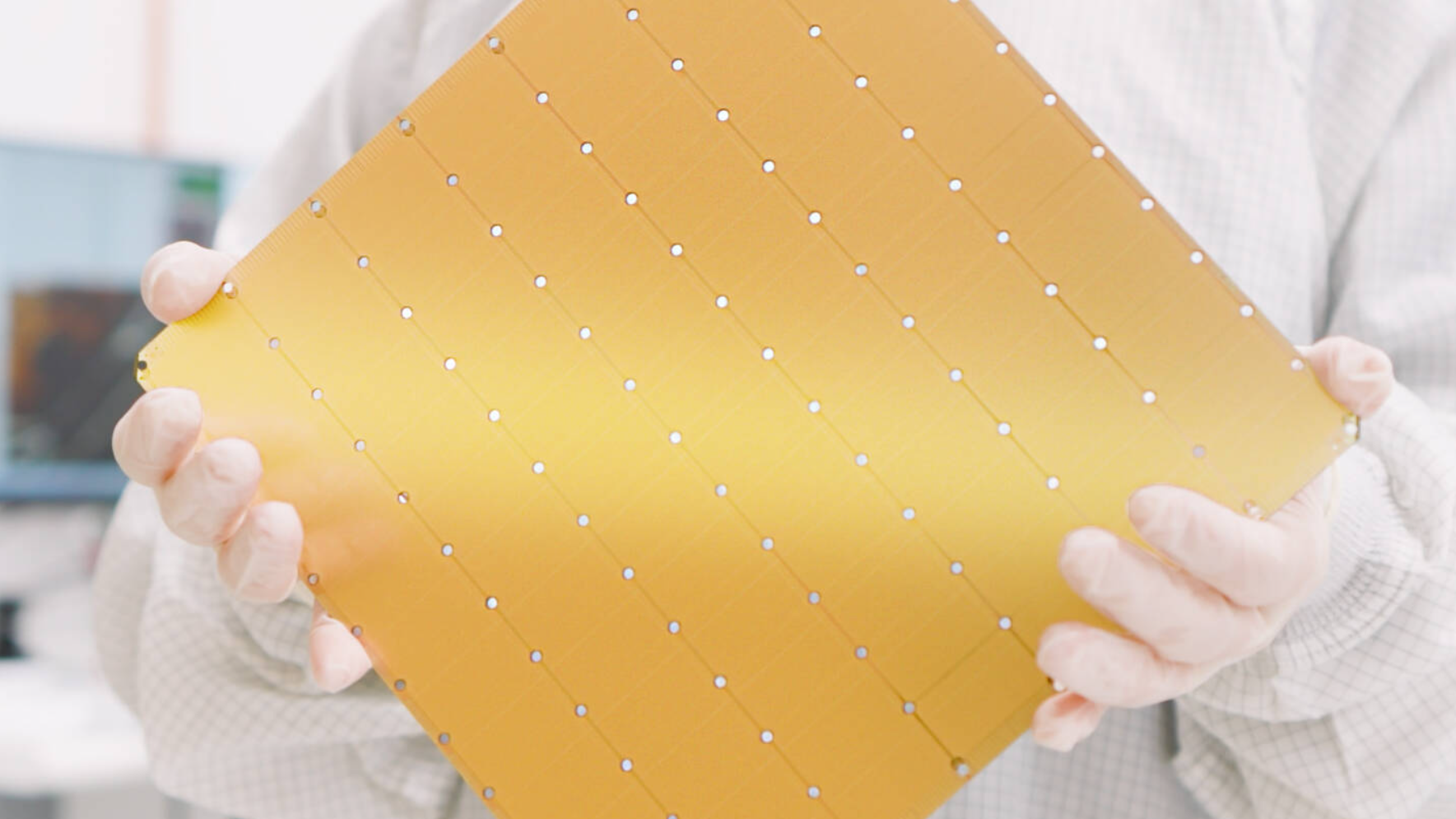
Cerebras unveils CS-4 with double the performance on the same chip
Cerebras has unveiled its CS-4 AI accelerator system, claiming double the performance of its predecessor CS-3 on the same wafer-scale chip. CEO Andrew Feldman positions it as the industry's fastest AI training system, reinforcing Cerebras' unique wafer-scale engineering strategy against NVIDIA, AMD, and custom silicon competitors in the large language model training race.
Key Takeaways
- Key Highlight:Cerebras has unveiled its CS-4 AI accelerator system, claiming double the performance of its predecessor CS-3 on the same wafer-scale chip. CEO Andrew Feldman positions it as the industry's fastest AI training system, reinforcing Cerebras' unique wafer-scale engineering strategy against NVIDIA, AMD, and custom silicon competitors in the large language model training race.
- Innovation & Tech:Highlights advancements in NVIDIA, Cerebras, CS-4, demonstrating rapid progress in model capabilities.
- Industry Impact:Reported via The Decoder, offering actionable signals for developers and technology leaders.
【Executive Summary & Core Event】
Cerebras Systems, the San Jose-based AI hardware company founded in 2016, has officially introduced the CS-4, its latest wafer-scale AI accelerator system. The announcement, made by CEO Andrew Feldman, claims the CS-4 delivers double the performance of its predecessor, the CS-3, while maintaining the same fundamental wafer-scale chip architecture. Feldman characterized the CS-4 as the industry's fastest AI training system, a bold assertion in a market increasingly dominated by NVIDIA's H100 and H200 GPUs and the emerging competition from AMD's MI300X and custom silicon from Google, Amazon, and Microsoft. The CS-4 represents Cerebras' third-generation wafer-scale engine (WSE-3 or WSE-4, depending on internal nomenclature), continuing the company's unconventional approach of using an entire 46cm x 46cm silicon wafer as a single monolithic processor rather than assembling multiple smaller chips.
The CS-4 system architecture retains Cerebras' signature wafer-scale engineering philosophy but incorporates significant improvements in memory bandwidth, interconnect topology, and compute density. The system reportedly features a massively parallel on-chip network that connects hundreds of thousands of cores, enabling the kind of fine-grained parallelism that is particularly well-suited to large language model training and inference workloads. The doubling of performance on the same chip form factor suggests substantial architectural refinements rather than simply scaling up transistor counts, which is notable given the inherent manufacturing challenges of wafer-scale fabrication. Cerebras has historically operated under the Apache 2.0 license for its software stack, the Cerebras Software Platform (CSP), which allows developers to port PyTorch and TensorFlow models with minimal code changes.
【Technical Architecture & Key Innovations】
The CS-4's technical architecture builds upon Cerebras' wafer-scale engine design, which treats an entire silicon wafer as a single processor die. This approach eliminates the inter-chip communication bottlenecks that plague multi-GPU systems, where data must traverse PCIe, NVLink, or InfiniBand fabrics between discrete accelerators. The CS-4 reportedly integrates over 900,000 cores on a single wafer, each capable of performing 8-bit and 16-bit floating-point operations at extremely high throughput. The on-chip memory architecture has been substantially expanded, with the CS-4 featuring a high-bandwidth memory system that provides each core with direct access to substantial local storage, reducing the need for data movement across the chip's interconnect fabric. This memory-centric design is particularly advantageous for transformer-based models, where attention operations require frequent access to large key-value caches and weight matrices.
The interconnect fabric within the CS-4 represents a critical architectural differentiator. Cerebras employs a custom 2D mesh network that connects all cores with uniform latency, enabling the kind of all-to-all communication patterns that are common in attention mechanisms and all-reduce operations during distributed training. The CS-4 reportedly improves upon this fabric with higher bandwidth links and more sophisticated routing algorithms, contributing to the claimed 2x performance improvement. Additionally, the system incorporates hardware-level support for mixed-precision training, allowing models to leverage FP8, FP16, and BF16 formats natively without software emulation overhead. The compiler stack, part of the Cerebras Software Platform, performs aggressive graph optimization and operator fusion, automatically partitioning model graphs across the wafer's cores to maximize utilization and minimize idle cycles. This compiler-driven approach means that developers can deploy models without manually tuning data parallelism or tensor parallelism strategies, a significant simplification compared to multi-GPU frameworks like DeepSpeed or Megatron-LM.
Performance characteristics of the CS-4 are particularly compelling for large-scale training workloads. While Cerebras has not published detailed benchmark numbers in the initial announcement, the company has historically demonstrated training throughput that exceeds multi-thousand GPU clusters for specific model sizes. The CS-4's architecture is especially well-suited to models in the 100 billion to 1 trillion parameter range, where the overhead of inter-GPU communication in conventional clusters becomes a significant bottleneck. For inference workloads, the unified memory architecture enables low-latency serving of large models without the need for model parallelism across multiple devices. The system also reportedly supports sparse attention patterns and MoE (Mixture of Experts) routing natively, making it competitive for the next generation of efficient large language models that are increasingly adopting sparse architectures to improve compute efficiency.
【Industry Context & Competitive Landscape】
Cerebras' CS-4 enters an increasingly crowded AI accelerator market dominated by NVIDIA, whose H100 and H200 GPUs remain the de facto standard for large-scale AI training. NVIDIA's advantage lies not just in raw hardware performance but in its CUDA software ecosystem, which has become the lingua franca of AI development. The CS-4's wafer-scale approach offers a fundamentally different value proposition: eliminating inter-chip communication overhead entirely by putting everything on one chip. This becomes increasingly relevant as models grow larger and the communication-to-compute ratio in multi-GPU systems degrades. Compared to NVIDIA's DGX SuperPOD clusters that interconnect thousands of GPUs via NVLink and InfiniBand, a single CS-4 wafer can potentially outperform a multi-rack GPU cluster for specific model sizes and training configurations, while consuming less power and occupying less physical space.
Against other competitors, Cerebras occupies a unique position. AMD's MI300X offers competitive memory capacity (192GB HBM3) and strong FP8 performance but still requires multi-chip interconnects for large-scale training. Google's TPU v5p and v5e chips, used internally for training Gemini models, employ a different wafer-scale-adjacent approach with ICI (Inter-Chip Interconnect) links, but remain proprietary to Google Cloud. DeepSeek's recent breakthroughs in training cost efficiency demonstrate that software optimization can dramatically reduce hardware requirements, but the company still relies on NVIDIA GPUs. Meta's Llama series and Qwen's models from Alibaba are trained on conventional GPU clusters. Cerebras' differentiation is that it offers a turnkey system where the hardware and software are co-designed, potentially reducing the engineering overhead that organizations face when building and maintaining large GPU clusters. The CS-4's claim of being the industry's fastest system is most credible for specific workloads where communication overhead dominates, particularly in the early stages of large model training where gradient synchronization across thousands of devices creates significant bottlenecks.
The competitive landscape also includes emerging players like Groq, which uses LPU (Language Processing Unit) architecture optimized for inference, and Tenstorrent, backed by Jim Keller, which pursues a different chiplet-based approach. Cerebras' wafer-scale strategy has always been considered high-risk due to yield challenges—any defect on a 46cm wafer can potentially render the entire chip unusable. However, the company's ability to ship production systems and now claim generational improvements suggests they have made significant progress in yield management and defect tolerance. The CS-4's arrival also comes at a time when hyperscalers are increasingly investing in custom silicon, potentially reducing the addressable market for third-party AI accelerators. Cerebras' strategy appears to be targeting enterprise and research institutions that need cutting-edge training performance but lack the resources to design and manufacture their own silicon.
【Developer & Enterprise Implications】
For developers and enterprises considering the CS-4, the integration experience differs substantially from conventional GPU-based workflows. The Cerebras Software Platform (CSP) supports model porting from PyTorch and TensorFlow with relatively minimal code changes, leveraging a compiler that automatically maps model operations onto the wafer-scale engine. This abstraction layer means that teams do not need to manually implement tensor parallelism, pipeline parallelism, or data parallelism strategies—the compiler handles these optimizations automatically. However, this convenience comes with a tradeoff: developers have less fine-grained control over how their models are partitioned and executed, which can be a concern for teams that have invested heavily in optimizing their training pipelines for specific GPU configurations. The CSP also provides tools for profiling, debugging, and monitoring model execution on the wafer-scale engine, though the ecosystem is considerably smaller than NVIDIA's CUDA toolkit.
Hardware requirements and deployment considerations for the CS-4 are unique. Unlike GPU clusters that can be incrementally scaled by adding individual accelerator cards or nodes, the CS-4 is a complete system that requires substantial infrastructure investment. Each CS-4 system reportedly requires significant power delivery (potentially 100kW+ per system) and cooling infrastructure, given the massive die area and power density of a wafer-scale chip. Data center facilities would need to be equipped with appropriate power distribution and liquid cooling systems. The system's physical footprint is also considerable, though potentially smaller than an equivalent-performance GPU cluster when accounting for networking infrastructure, power distribution units, and interconnect switches. For organizations that already operate large GPU clusters, the decision to adopt CS-4 would involve weighing the performance benefits against the operational complexity of introducing a fundamentally different hardware platform into their infrastructure.
Deployment costs and business impact vary significantly depending on the use case. For organizations training frontier-class models (100B+ parameters), the CS-4's ability to potentially match or exceed multi-thousand GPU clusters on a single system could represent substantial savings in capital expenditure, operational overhead, and training time. The reduced time-to-training completion has direct business implications for research organizations and AI labs that are racing to develop new models. However, for organizations with smaller models or inference-only workloads, the CS-4's premium positioning may not offer sufficient ROI compared to more affordable GPU alternatives. Cerebras has historically offered cloud access through its Cerebras Cloud platform, which lowers the barrier to entry for organizations that want to evaluate the technology without making a capital purchase. This cloud-based access model is likely to remain important for the CS-4, particularly as the company works to build its customer base and demonstrate the system's capabilities across a broader range of workloads and model architectures.
【Key Takeaways & Strategic Outlook】
The CS-4's claim of doubling performance on the same wafer-scale chip form factor represents a meaningful generational improvement that validates Cerebras' unconventional architectural bet. In an industry where performance gains typically come from adding more chips rather than improving per-chip efficiency, Cerebras' approach of squeezing more performance out of a single wafer-scale engine demonstrates the potential advantages of eliminating inter-chip communication bottlenecks entirely. This is particularly significant as the AI industry grapples with the scaling challenges of training increasingly large models, where communication overhead in multi-GPU systems is becoming a growing fraction of total training time. The CS-4 suggests that wafer-scale engineering can continue to deliver competitive performance improvements even as the technology matures.
Strategically, the CS-4 positions Cerebras as a credible alternative for organizations that prioritize raw training throughput and are willing to adopt a different hardware paradigm. However, the company faces significant challenges in ecosystem adoption, as the AI industry has deeply standardized around NVIDIA's CUDA stack and GPU-based workflows. The CS-4's success will depend not just on hardware performance but on Cerebras' ability to make the software transition as frictionless as possible and to build a compelling total-cost-of-ownership story for enterprise customers. The next generation of AI models, particularly those incorporating MoE architectures and sparse attention, may prove especially well-suited to Cerebras' architecture, potentially creating new use cases where the wafer-scale approach offers decisive advantages. As the industry moves toward trillion-parameter models and beyond, the question of whether single-chip wafer-scale systems or multi-chip GPU clusters will dominate large-scale training remains open—and the CS-4 is Cerebras' strongest argument yet for the former approach.
This page provides an editorial summary based on publicly available information. It is not a republished article. Use the source link below for the original report.
Industry Insights & Analysis
As artificial intelligence rapidly evolves, breakthroughs surrounding NVIDIA, Cerebras, CS-4, AI are shifting toward scalable, robust real-world implementations.
Driven by both open-source ecosystems and proprietary model architectures, the integration between compute optimization, data engineering, and agentic workflows is accelerating. This development provides a strategic benchmark for upcoming AI tooling and developer workflows.