Alibaba Qwen Launches New Generation Flagship Model Qwen3.7-Max
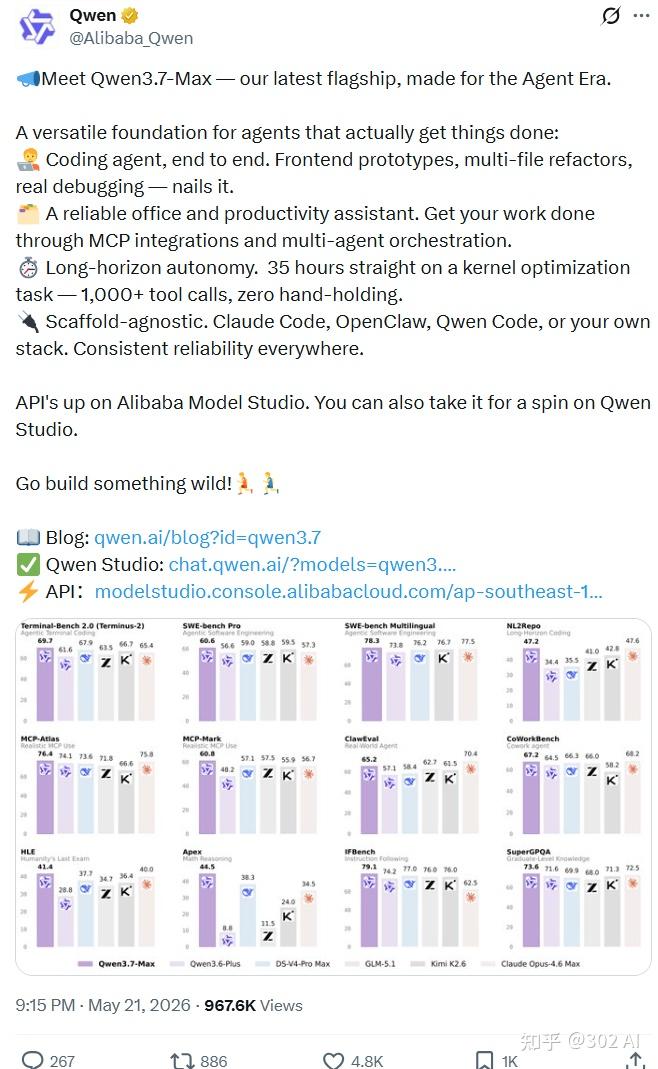
Alibaba Tongyi Qwen launches the flagship model Qwen3.7-Max, positioned as an all-around base for the agent era. The model excels in programming, office automation, and long-cycle autonomous execution. It achieved 10x acceleration in a kernel optimization task involving 35 hours and over 1,000 tool calls. Benchmark tests show the model leads peers in multiple agent evaluations such as SWE-Pro and MCP-Atlas.
302.AI Benchmark Lab | Qwen3.7-Max Evaluation: Improved Design Aesthetics, Stable Long-Range Tasks, Max-Level Digital Employee Arrives
Article Guide:
Just one month since the last release, Alibaba's new flagship model Qwen3.7-Max is officially online, aiming to be an all-around agent base. Evaluation finds that compared to Qwen3.6-Plus, the new version has more dynamic construction in logical reasoning, significantly evolved visual aesthetics and code interaction performance, and shows strong stability in long-cycle autonomous tasks. This article explores the true productivity of this "Max-level digital employee" through multi-dimensional practical cases.
Full text approx 4400 words
May 20th, just over 1 month since the last model release, Alibaba brings the new generation Qwen flagship model—Qwen3.7-Max, dedicated to becoming an all-around agent base.
As Alibaba's latest flagship in the agent era, Qwen3.7-Max aims to completely remove the "chat tool" label of traditional large models. It possesses extremely hardcore base strength, not only supporting million-level Token ultra-long context, but also achieving significant leaps in complex logical reasoning, math capabilities, and multilingual understanding including Chinese and English.
Based on official documentation, let's summarize its highlights:
1. True "Programming Agent", writing code without holding back
The previous Qwen3.6 programming model set records in the developer community for surging daily calls and frantically consuming Tokens. This time, Qwen3.7-Max continues to improve in code generation and debugging performance. It possesses the strength of a frontier programming agent, capable of understanding the entire project structure and directly helping you finish and debug the code.
2. Long-cycle autonomous execution, true office automation
This is the most exciting point for workers. Qwen3.7-Max has the capability for office production automation and long-cycle autonomous execution: in official tests, the model supports autonomous planning and operation for several hours, through thousands of tool calls and dozens of version iterations, continuously improving deliverable quality. This means you don't need to give it an instruction for every step; just throw the task goal at it, and it can break down steps itself, call tools itself, and quietly complete complex business loops.
3. Cross-framework generalization capability, true universal base
Whether you deploy the model on Claude Code, the popular AI assistant OpenClaw, or under toolchains like Qwen Code or Hermes Agent, Qwen3.7-Max can achieve seamless replacement and perfect compatibility. It does not require you to do any complex Prompt tuning for specific frameworks, truly achieving plug and play.
Currently on the Artificial Analysis list, Qwen3.7 Max ranks 6th.
Today's evaluation, 302.AI will test this new "Max-level digital employee" to see Qwen3.7 Max's true capabilities in different productivity scenarios.
I. Measured Model Basic Information
(1) Measured model price on 302.AI:
(2) Evaluation Purpose:
This evaluation focuses on testing the model on logic, math, programming, multimodal, and human intuition questions, not an authoritative test for professional frontier fields. It aims to observe and compare the model's evolution trends and provide selection reference.
(3) Evaluation Method:
This evaluation uses the question bank collected by 302.AI for independent testing. The model conducts case tests on logic and math (10 questions total), human intuition (7 questions total), and programming simulation (12 questions total), corresponding scoring rules take the final result, and representative cases are selected below for display.
Question bank address: https://docs.google.com/spreadsheets/d/1sBxs60yWsxc9I5Va8Rjc1_le1Omg2hOXbwqOzpImZio/edit?gid=0#gid=0
💡Scoring Rules:
Scored out of 10 points, set corresponding deduction standards, finally take the average score of each round.
(4) Evaluation Tools:
- All models are used within the 302.AI Studio client using the corresponding model, using unified prompts, taking the first generation result - Programming test uses the Vibe mode of the 302.AI Studio client: calls Claude Code sandbox
Programming Case Score Rating:
⭐⭐⭐⭐⭐ S Level (God-tier): Industry benchmark, redefining standards. ⭐⭐⭐⭐ A Level (Excellent): Productivity qualified, no obvious shortcomings. ⭐⭐⭐ B Level (Good): Performance is average, has shortcomings. ⭐⭐ and below C Level (Unqualified): Unusable, has obvious problems.
II. Test Results Overview
302.AI Model Evaluation Scoreboard:
III. Case Display
Case 1: Complex Logic Reasoning
Qwen3.7-Max differs from Qwen3.6-Plus in reasoning organization and output style.
When facing complex logic reasoning, Qwen3.7-Max leans towards constructive proof, focusing on the dynamic process of Reasoning, output content has a "popular science feel";
While Qwen3.6-Plus leans towards templated derivation, the first reaction is not to perform step-by-step reasoning of physical mechanisms, but to first identify classic question types (pattern match)
Prompt: One hundred fish swim in the stream at different speeds. If one fish catches up to another fish, it eats the latter and continues swimming. How many fish are expected to survive?
Qwen3.7-Max reasoning correct
Qwen3.6-Plus reasoning correct
Case 2: Programmatic SVG Graphic Generation
Prompt: Draw a dynamic SVG of a pelican riding a bicycle
Qwen3.7-Max's output is superior to Qwen3.6 in dynamic physics performance, slightly inferior in stylization, such as background richness.
Attached Qwen3.6-Plus output effect:
Prompt: Draw a dynamic SVG of a dolphin jumping on the sea surface
Qwen3.7-Max's output image fits the prompt requirements better, but the physics dynamics performance is not yet perfect, the splashing water performance is relatively stiff, and the dolphin jumping backwards does not fit reality.
Qwen3.6-Plus is too abstract, the biggest problem is depicting "dolphin jumping on the sea surface" as simple up and down jumping, not fitting reality.
Case 3: Three.js 3D Mini Game
Prompt:
Please develop a Three.js based 3D "Black Hole Swallows City" mini game using single file HTML + JavaScript.
Requirements:
1. **Visual Style**: Bright and relaxed cartoon low-poly style, blue sky and white clouds background, ground is procedurally generated city block grid (grass + road).
2. **Player Character**: Cartoon style black hole.
3. **Swallowing Objects**: Includes 9 types of city elements such as street lamps, cars, trees, bungalows, high-rises, landmarks, all spliced using basic geometric shapes.
4. **Generation and Growth**: All sized objects coexist at the start, no need to wait for upgrades; volume smoothly increases after swallowing, gradually unlocking larger targets.
5. **Physics Feedback**: Objects are attracted, rotated, and shaken in when approaching; if colliding with objects far exceeding its own volume, the black hole is bounced away.
6. **Camera and Interaction**: Mouse/touch controls movement, camera dynamically follows and height adapts to body size; slight camera shake triggered when colliding with large objects.
7. **System and Performance**: Includes scoring, growth progress bar, 90-second time limit and settlement interface; shared geometry and material optimize performance, code can run directly, no external resource dependencies.
Qwen3.7-Max output effect:
✅ Advantages:
- Visual style and graphic element depiction are more detailed, animation rhythm is strong
- Implemented black hole volume elasticity, and swallowing animation and score display effect feedback is better, attraction and bounce physics interaction is more delicate
❌ Defects:
- Set view following, but height adaptation intensity based on black hole body size is not strong enough, when the black hole occupies too large a proportion in the screen, the view did not pull back in time
Qwen3.6-Plus output effect:
Also implemented complete functions, just visually details and texture are slightly inferior to 3.7's effect, and black hole growth variable control is not reasonable enough, leading to too fast expansion, filling the screen.
Case 4: Brand Hero Page
Act as a world-class creative frontend developer and digital product designer.
Create a cinematic, highly immersive travel landing page in a SINGLE HTML file using Tailwind CSS via CDN and Vanilla JavaScript only.
The experience should feel like a modern premium product launch — emotionally engaging, visually atmospheric, and interaction-driven rather than template-like.
CORE GOAL:
Design a hero experience that feels alive, premium, and memorable. The page should immediately create a sense of exploration, movement, and anticipation.
TECH CONSTRAINTS:
- Single `index.html` only
- Tailwind CSS via CDN
- Vanilla JavaScript only
- Fully responsive
- Smooth performance on both desktop and mobile
BACKGROUND:
Use this exact background video:
https://cdn.sceneai.art/Hero%20Section%20Video/0519be39-d8d1-48a5-84ee-f8a1ec038cd6.mp4
The video should feel deeply integrated into the experience rather than simply placed behind content.
VISUAL DIRECTION:
- Cinematic and atmospheric
- Elegant typography
- Strong visual hierarchy
- Premium motion de.
This page provides an editorial summary based on publicly available information. It is not a republished article. Use the source link below for the original report.